


Table of Contents
Korea's character economy stretches far beyond BT21 and Kakao Friends. From a 2.1-meter-tall penguin who became a millennial icon to a global YouTube phenomenon spawned by a toddler-friendly song, Korean mascots have become an entire cultural industry of their own. They live on subway buses, department store walls, KCON stages, and corporate annual reports, blending Sanrio-inspired kawaii with distinctly Korean storytelling.
Here is your guide to the wider Korean mascot universe, the characters making millions in royalties, and the flagship stores where you can meet them.
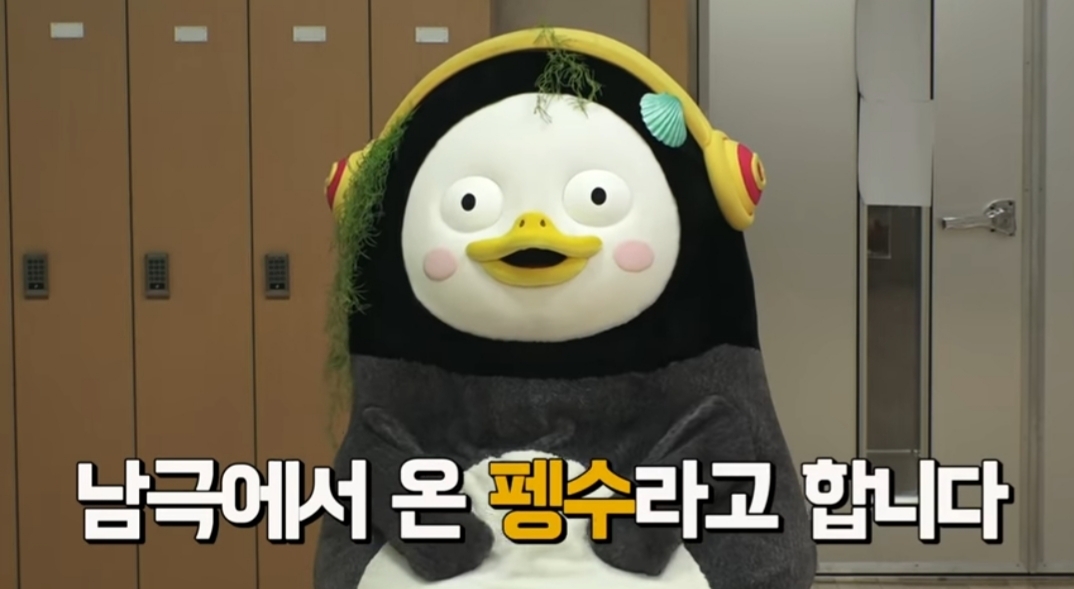
Pengsoo: The Giant Penguin Who Spoke for a Generation
Pengsoo debuted in 2019 on EBS, Korea's public educational broadcaster, as a 2.1-meter, ten-year-old Antarctic penguin who swam to Korea to become bigger than BTS. The character was originally aimed at teenagers, but its blunt, anti-hierarchy attitude turned it into an icon for burned-out millennial office workers. Pengsoo casually called the EBS CEO by his first name, refused to fake enthusiasm, and openly admitted it could not be good at everything.
Within a year, Pengsoo's Giant PengTV YouTube channel passed three million subscribers, its emoji became the bestseller on KakaoTalk, and Pengsoo topped Korea's 2019 Person of the Year polls ahead of BTS. The penguin is still the textbook case of how a Korean mascot can outgrow its kids' programming origins.
Pinkfong and Baby Shark: Korea's Billion-View IP Machine
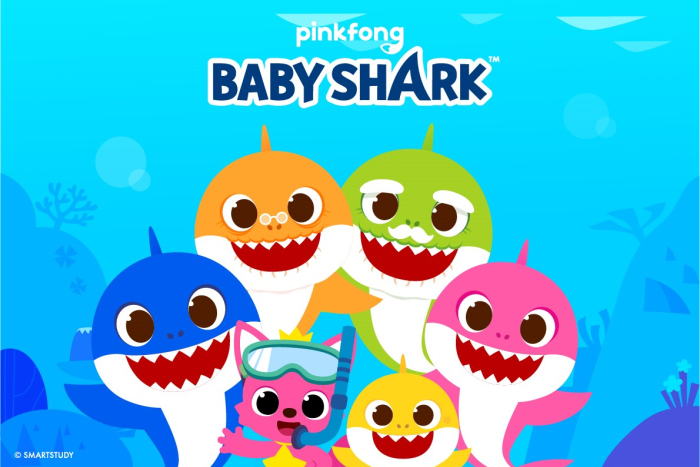
If Pengsoo speaks to adults, Pinkfong owns the under-five demographic worldwide. Created by Seoul-based edtech firm The Pinkfong Company (formerly SmartStudy), the cheerful pink fox character launched in 2010 and then unleashed Baby Shark in 2015. The Baby Shark Dance video became the most-watched YouTube video in history, now sitting at well over 15 billion views, and turned Pinkfong into Korea's 13th unicorn startup with more than 2,000 licensing agreements covering everything from Crocs to Crayola.
Pororo, Mubicha and the EBS Penguin Dynasty
Long before Pengsoo, there was Pororo the Little Penguin. Launched in 2003 by Iconix Entertainment and Ocon Studios, the goggle-wearing blue penguin earned the nickname "Children's President" and has been sold to more than 140 countries. Pororo built the template that later EBS penguin characters, including Pengsoo, would expand upon, generating royalties from over 1,500 merchandise items from chopsticks to bankbooks.
The wider Pororo universe also includes Petty, the female penguin sometimes nicknamed Mubicha in Korean fan circles, alongside Poby the polar bear, Crong the green dinosaur, and Eddy the fox. Together they make up one of the most valuable IP catalogs in Korean animation, with brand value estimated at over 380 billion won.
Seoul's Haechi and the Rise of City Mascots
Korea's mascot mania is not just a private-sector story. Local governments treat mascots as serious civic branding. Seoul's official mascot Haechi, based on the mythical haetae creature that has guarded the city for six centuries, was first launched in 2009. In February 2024, the Seoul Metropolitan Government unveiled a full Haechi makeover with a bright pink body and blue-green stripes inspired by dancheong, Korea's traditional architectural color palette, alongside four new Soul Friends based on the Four Guardian Deities: Blue Dragon, Red Bird, White Tiger, and Black Tortoise.

You can spot Haechi on bright pink Seoul buses, at Dongdaemun Design Plaza, along Cheonggyecheon Stream, and at the Seoul Tourism Plaza gift shop. Busan has its seagull Boogi, Daegu its otter Dodalssu, and Yongin its dragon Joa Yong. Cities, provinces, and even the Korea Intellectual Property Office (with mascots Miri and IPI) treat character design as essential civic infrastructure.
Corporate Mascots: Tubo, Pinky, Bokjia and the B2B Cute Wave
Korean conglomerates have leaned hard into character marketing. LG Group is associated with Tubo and a wider character family used across stationery, events, and internal culture campaigns. Korea Hydro and Nuclear Power introduced Pinky as a friendly face for the energy sector. Public broadcaster KBS has Bokjia among its lineup of channel mascots, and even heavy industries are joining in. POSCO triggered a B2B mascot boom in 2021 with Poseokho the bear, followed by LS Electric's Bolt, Echo and Hero, LX International's chameleon LEX, HD Hyundai's superhero Hi-RO, and Hyundai Steel's molten-iron character. Woori Financial Group went the furthest, building WiBee Friends into a full "idol group" of banking mascots.
The Mascot Economy: Why Korean Retail Loves Characters
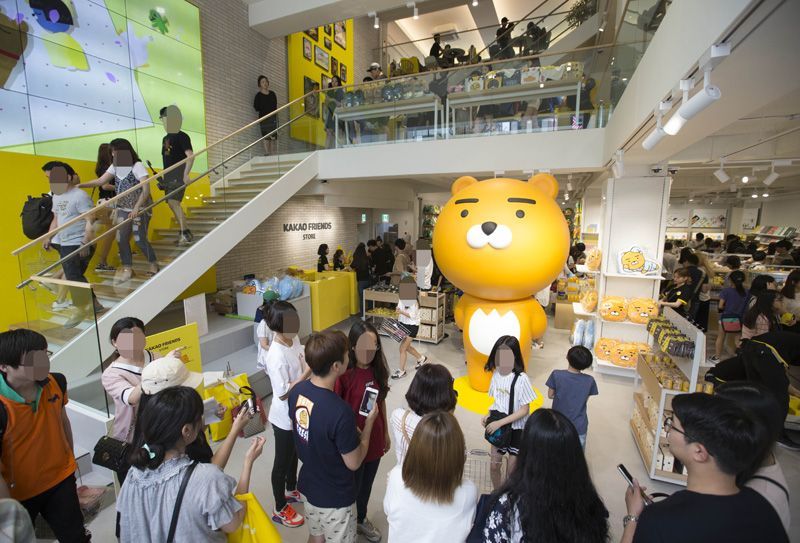
The reason every Korean company seems to have a mascot is simple: characters move product. Korean department stores, university campuses, K-pop groups, and even financial firms use mascots as low-risk, high-engagement marketing assets. Kakao embedded Ryan, Apeach, and the Kakao Friends crew into flagship physical retail spaces. LINE Friends turned Brown, Cony, and the BT21 lineup into a global tourism draw. Pinkfong opened pop-up stores at Hyundai Department Store Pangyo and a flagship Baby Shark store in Hong Kong's Times Square.
This is the Sanrio template reinterpreted through Korean cultural codes. Kawaii aesthetics are present, but the storytelling is local: hierarchy-breaking attitude (Pengsoo), Korean folklore creatures (Haechi), dancheong color palettes, and tie-ins with K-pop fan economies (BT21, NewJeans's bunini, aespa's nævis).
Korea Mascot World, KCON, and Where Mascots Meet Fans
Korea has a dedicated character industry calendar. The annual Character Licensing Fair in Seoul gathers hundreds of IP holders, while regional festivals such as the Goyang International Flower Festival and the Korea Mascot World style events showcase city and corporate mascots in parade format. KCON, the global K-pop convention, regularly hosts brand booths where LINE Friends, Kakao Friends, and Pinkfong meet international fans alongside K-pop merch.
Where to Shop Korean Mascots in Seoul
To meet these characters in person, plan a Seoul shopping route. The LINE Friends Hongdae Flagship Store, now part of K-Pop Square, spans three floors of LINE Friends and BT21 merchandise with a giant Brown statue at the entrance and a BRAUND cafe in the basement. A short walk away, the Kakao Friends Hongdae Flagship welcomes you with a Ryan statue and three floors of Apeach, Muzi, Frodo, Neo and Jay-G goods. For the biggest Kakao branch, head south to the Gangnam flagship near Gangnam Station Exit 10, with its 100-seat Ryan Cafe.
For Pinkfong and Baby Shark fans, Seoul rotates pop-up stores at Hyundai Department Store branches and at major toy retailers in Dongdaemun. Seoul Tourism Plaza, Dongdaemun Design Plaza's Design Store, and HBAF stores in Myeongdong all stock Haechi merchandise, from blind boxes to plushies and chicken-flavored almonds. Toys R Us branches at Seoul Station and Jamsil carry curated Hechi displays too.
The Bigger Picture: Korean Mascots as Soft Power
Korean mascots now sit alongside K-pop, K-drama, and K-beauty as a recognizable export of the Hallyu Wave. They show up in animated form on Webtoon platforms, as light stick figures at K-pop concerts, on Olive Young limited-edition packaging, and on Hyundai Department Store gift cards. They are also a window into how Korean companies talk to customers: emotionally, playfully, and through a character first rather than a product spec sheet. Once you start spotting them, you will see Korea's mascot economy everywhere.
Explore More of Korea with Daebak
Want to bring a little piece of Korea into your life? The Daebak Box is packed with the best Korean snacks, ramen, and cultural goodies delivered monthly to your door.


