


Table of Contents
Here is the honest read from someone who has spent over a decade watching what Koreans actually reach for when the beer arrives: dried squid (오징어) is not a novelty snack for foreigners. It is the single most durable 안주 (anju, drinking snack) in the country, and it has held that position through five decades of shifting fandoms, three collapses in domestic squid catch, and the full arrival of Costco Korea. Alongside 쥐포 (jyupo, filefish jerky) and 노가리 (nogari, dried baby pollack), it forms what most Korean 편의점 (convenience stores) and hof pubs treat as the sea-jerky trinity. The appeal is not that the snack is exotic. The appeal is that these three snacks quietly outperformed every trend, from the craft beer wave of the 2010s to the current 소맥 (soju-plus-beer) refinement, because they solve a specific texture and salt-umami problem that potato chips and nuts do not.
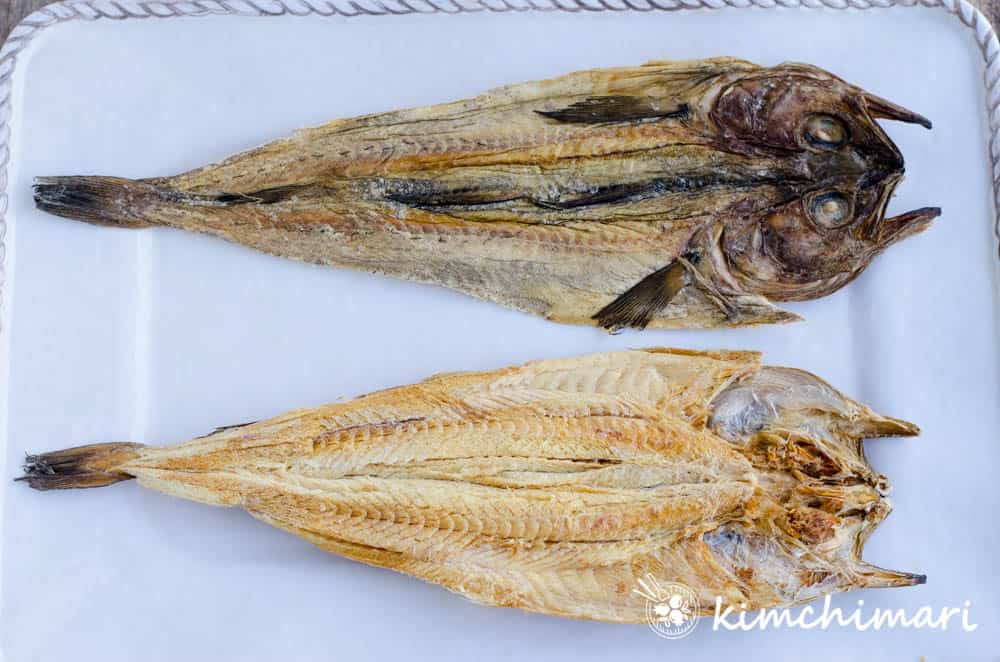
오징어 (Ojingeo): The 술안주 that never went out of style
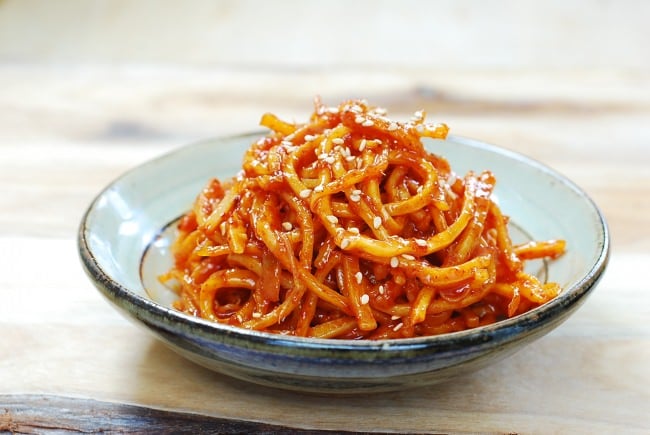
Dried squid in Korea splits into two camps. There is the whole flame-grilled 마른 오징어 that the 편의점 clerk warms on a small counter-top press and hands you in a paper bag with a squeeze of mayonnaise and gochujang on the side. Then there is 오징어채 (ojingeochae, or 진미채 jinmichae), the shredded, slightly sweetened, salt-processed squid that comes in resealable bags and turns into a proper side dish once you toss it with a gochujang-corn-syrup sauce. Both descend from the same drying tradition that Korean coastal towns like Ulleungdo built their local economies on. What most Western explainers miss is that these are not interchangeable. The whole grilled squid is a communal chew for beer nights (the flame gives it a smoky top note that no pack of chips can approximate), while the shredded 진미채 is a rice-friendly 반찬 (banchan) that also happens to work as anju. Koreans intuitively separate the two occasions. Serving flame-grilled squid at a home dinner reads as odd. Serving 진미채 at a hof bar reads as amateur.

쥐포 (Jyupo) and the quiet Vietnam pipeline nobody talks about
Jyupo is the sweeter, kid-friendly gateway. If you grew up in Korea in the 1990s, this is the snack you got at 초등학교 spring picnics: a flat, pressed sheet of filefish (쥐치) that arrives amber, slightly translucent, with a sugar-soy-glaze finish that sits somewhere between fruit leather and jerky. Here is the appeal read: 쥐포 is the only anju in the sea-jerky category that toddlers and grandmothers eat with equal enthusiasm, which is why it never lost 편의점 shelf space even as trendier snacks came and went. The industry side of this is less romantic. Korea's own filefish stocks were essentially fished out by the late 1990s, and the domestic 쥐포 industry now sources most of its raw material from Vietnam, where the fish is caught, pressed, and often partially seasoned before being finished in Korea. This is a genuinely open secret in Korean food business, but the packaging still leads with rural Korean coastal imagery. What holds 쥐포's popularity together is not sourcing purity. It is the specific mouth-feel of that thin pressed sheet, which Vietnamese-caught fish delivers as reliably as domestic caught fish did in the 1980s.
노가리 alley: How dried baby pollack built Seoul's most famous drinking street
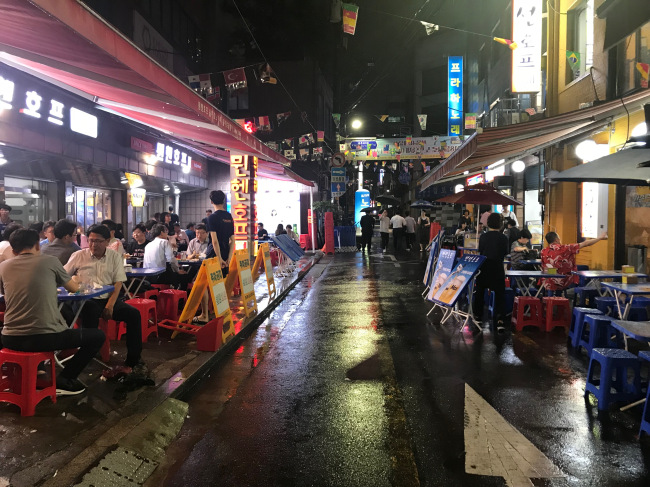
The single most Korean thing about dried seafood snacks is that one man's 1981 workaround built an entire beer-culture heritage district. Kang Hyo-keun, who opened Eulji OB Bear in Euljiro in 1980, invented the modern 노가리 anju convention almost by accident. Korea's Fair Trade Commission had just banned beverage suppliers from providing free snacks to bars, so Kang needed a cheap in-house alternative to the peanuts pubs used to hand out. He built a peppery mayo-gochujang dipping sauce, paired it with grilled dried baby pollack (노가리 is technically 명태 pollack caught young), and priced the whole plate at 1,000 won. Neighboring pubs copied him. By the mid-1980s, that alley behind Euljiro 3-ga Station had a name: 노가리 골목. Seoul Metropolitan Government designated it a Future Heritage site in 2015. The 노가리 beer festival launched in 2013 and now draws foreign tourists specifically for the outdoor red-chair drinking experience. This is what most K-content coverage misses about Korean drinking culture: it is not that Koreans drink more than anyone else. It is that a single anju convention held together for four decades and turned a working-class alley into a designated cultural heritage zone. The snack was the culture.

The trade dynamics: Why 노가리 got 40 percent more expensive after 2019
Here is the industry mechanic that Korean food coverage rarely translates into English. In 2019 Japan tightened its pollack (명태) quota in the North Pacific waters where Korean 노가리 traders had been sourcing since the 1990s, and the wholesale price of dried baby pollack in Seoul climbed roughly 40 percent over the following 18 months. Nogari Alley pubs held their 1,000-won retail line as long as they could (that price was a matter of pride, not economics), but by 2022 the average grilled 노가리 fillet in Euljiro had crept up to 1,500 won. Whole grilled 오징어 has faced a similar squeeze because Korea's own East Sea squid catch has been in decline for a decade, driven by warming currents pushing squid migration north into Russian and North Korean waters. What this means practically: the dried squid you buy at a Korean 편의점 in 2026 is very likely Chinese-caught and Korean-processed, and the 노가리 on your Euljiro plate is Russian-caught. Koreans by and large accept this because the seasoning and the ritual are what they are paying for, not the geographic origin of the fish. The appeal is the anju experience, not the terroir.
What actually makes these snacks appealing: texture and salt-fat-umami
The reason dried squid, 쥐포, and 노가리 outlasted every trendy Korean snack of the last decade comes down to a specific texture-and-flavor problem that no other snack category solves as cleanly. Beer wants a chewy, salty, high-umami counterpart that slows down consumption. Nuts get boring fast. Chips go stale in a shared bowl. Fresh 안주 like 골뱅이무침 (spicy sea snails) or 파전 (green onion pancake) require an actual kitchen. Dried seafood sits in the sweet spot: shelf-stable, requires minimal preparation (a quick pass over a warming plate is enough), and delivers the kind of chew that pairs with a slow beer session. My honest take from years of watching Korean food-and-beverage industry moves is that this is the only anju category where the ritual actually matters more than the product. Tearing a strip of grilled 오징어 with your hands, dipping it in mayo-gochujang, and passing the plate to the next person is a communal choreography that turns a snack into a shared object. Chips do not have that. Neither do the wave of "premium" Korean anju products that keep trying to displace this trinity.
마른 오징어 채: The gochujang-mayo pairing that owns 편의점 shelves
The dipping sauce is not incidental. If you walk into any GS25 or CU convenience store in Seoul and pick up a bag of shredded dried squid, there is a very high chance you will grab a small tube of mayo-gochujang from the counter to go with it. That specific combination (Korean mayo, which is slightly sweeter and less tangy than American, plus gochujang, which delivers heat with a fermented depth) is what most Korean drinking guides call the default anju sauce. It emerged in the late 1980s in pub culture (again, Euljiro credit) and migrated into home use through the 1990s. The reason it works is chemical rather than cultural: the fat in the mayo cushions the salt intensity of the dried squid, the gochujang delivers heat that clears the palate for the next sip of cold beer, and the sweetness in Korean mayo balances the umami depth of the squid. This is the kind of pairing that gets engineered by home cooks over decades, not by product-development teams. It is also the specific combination that most globally exported Korean dried squid packaging still cannot replicate: the mayo has to be Korean, the gochujang has to be a decent brand (Sunchang or Chung Jung One work), and the ratio matters.
How dried squid became a global Korean export
Post-2010, dried squid and 쥐포 quietly rode the same K-food wave that put 김치 in Costco and 삼양 불닭볶음면 on TikTok, just with less English-language coverage. Costco Korea has stocked large-format dried squid packs since roughly 2015, and both Amazon and specialty snack subscription boxes like Bokksu started listing Korean dried squid varieties as bestsellers around 2019. The appeal for the global market is a little counterintuitive. Non-Korean buyers are not typically buying it for the beer-pairing ritual (though beer subscribers who happen to also buy Korean snack boxes end up there naturally). They are buying it as a high-protein savory snack for keto-adjacent eating, which fits the nutritional profile: 오징어채 runs around 60 to 65 percent protein by dry weight with very little fat. That reframing (Korean drinking snack becoming Western high-protein snack) is one of the quieter K-food export success stories of the last five years, and it is running mostly under the K-food PR radar because the product does not photograph as well as tteokbokki or bibimbap on Instagram.
치맥 vs 소맥: Dried squid works with both, which is the actual point
Korean drinking pairings tend to get flattened in Western coverage into two categories: 치맥 (chimaek, chicken plus beer) and 소맥 (somaek, soju plus beer mixed). What gets missed is that dried squid is the one anju that works with both without any adjustment. Fried chicken pairs with beer through salt-and-fat coverage, so you would not usually stack another salty snack on top. Yet 노가리 and grilled 오징어 still show up on chimaek tables because the chew rhythm slows down consumption between chicken pieces. Somaek is a different mechanic: the mixed drink is stronger, gets consumed faster, and needs an anju that can absorb some of the alcohol impact. Dried squid delivers on that too because the salt content genuinely does help pace the drink. This is why you will see a shredded 진미채 plate on virtually every 포장마차 (pojangmacha, street tent bar) menu regardless of what people are ordering. It is not the marquee item. It is the constant.
A note on sodium: what Korean nutritionists actually say
The one caveat worth naming honestly. Dried seafood snacks are high in sodium (a 100-gram serving of 오징어채 can hit 1,500 to 2,000 mg, which is close to the recommended full daily intake), and Korean public health messaging has been quietly pushing awareness of this for years. Korean 편의점 packaging updated in 2021 and 2022 to include clearer sodium warnings after a Ministry of Food and Drug Safety push. This does not mean stop eating them. It does mean that the traditional pattern (dried squid plus salty pub food plus salty stew plus more dried squid over the course of a five-hour drinking session) is exactly the pattern Korean cardiologists point to when they discuss the country's stroke rates. The Korean Bapsang and Maangchi versions of home-made 오징어채 muchim, which use rice syrup and a moderate salt hand, are meaningfully lower in sodium than the shrink-wrapped pub-grade versions. If you are cooking these at home, that matters.
The Daebak read: why dried squid still belongs on your next anju board
For anyone tracking Korean food culture through the lens of what actually sticks, the sea-jerky trinity of 오징어, 쥐포, and 노가리 is the file to keep open. These are not novelty imports. They are the foundation layer of Korean drinking culture, the reason a single Euljiro alley became a heritage site, and the specific reason Costco Korea moves the volume of dried squid it moves. If you have not tried the flame-grilled whole squid with mayo-gochujang yet, that is the entry point. If you already have and want to go deeper, get the shredded 진미채 and try either the Maangchi or Korean Bapsang home-made muchim recipe. It will change how you think about what "Korean snack" means.
Bring Korea's Anju Board Home with SnackFever
If dried squid, 쥐포, and 노가리 pulled you into Korea's actual drinking-snack canon, the SnackFever Box is your monthly ticket to more of it: curated Korean snacks, including seasonal 편의점 exclusives and pub-style anju, delivered straight to your door. Subscribe, and let each month land like a fresh plate at Nogari Alley.


