


Table of Contents
Jeju Island (제주도) sits about an hour by air off Korea's southern coast, and after ten years working around Korean tourism and content marketing I still tell first-time visitors the same thing: forget the Hawaii comparison. Jeju is a volcanic island with a matriarchal fishing culture, a UNESCO World Natural Heritage designation the Korea Tourism Organization has anchored its international pitch around since 2007, and a food-and-lodging economy that pivoted hard after Chinese group tourism collapsed in the late 2010s. It is also, thanks to being one endpoint of the Seoul (Gimpo) to Jeju air corridor, connected to the busiest single city-pair flight route on the planet. The International Air Transport Association put that route at 13.2 million passengers in 2024, ahead of Sapporo-Tokyo and Fukuoka-Tokyo. Get on that plane and here is what I would actually plan.
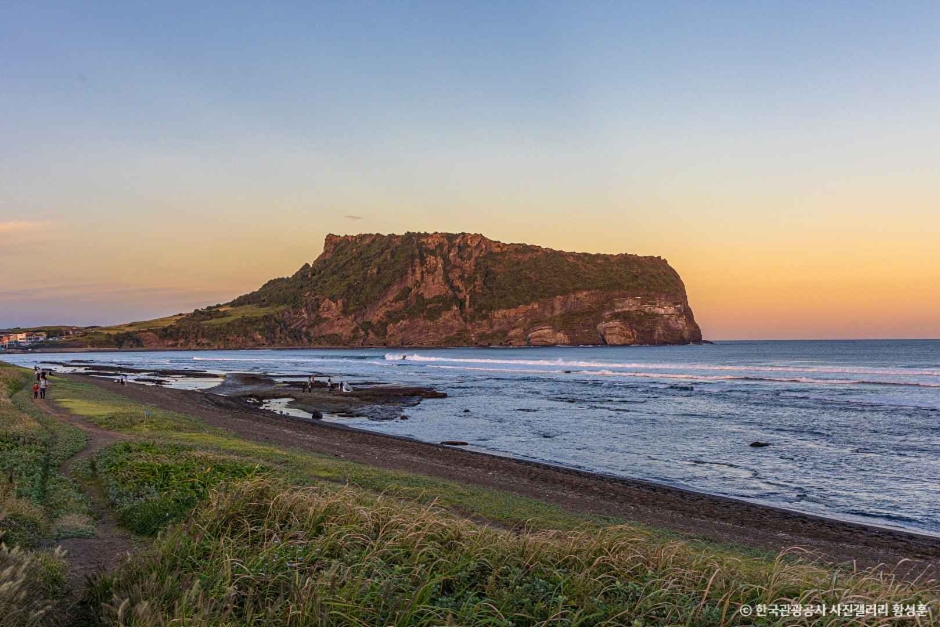
1. Seongsan Ilchulbong (성산일출봉): the sunrise peak that made Jeju famous
If you are picking one image for KTO's Jeju pitch deck, this is it. Seongsan Ilchulbong is a tuff cone that shot up about 5,000 years ago when magma met cold seawater, forming a sticky ash that piled into a 180-meter crater ring on Jeju's east coast. UNESCO added it to the World Natural Heritage list on July 2, 2007, and to the Global Geopark network in 2010. What you are actually paying 5,000 won for at the ticket gate is a 30 to 40 minute climb up wooden steps to a viewing platform where the crater opens below you and Udo island floats to the north. Locals will tell you the sunrise version is the point, but the honest tourism-industry read is that most foreign visitors go at 9 or 10am and still walk away impressed. Do the paid summit trail, not just the free coastal loop, if you have the knees for it.
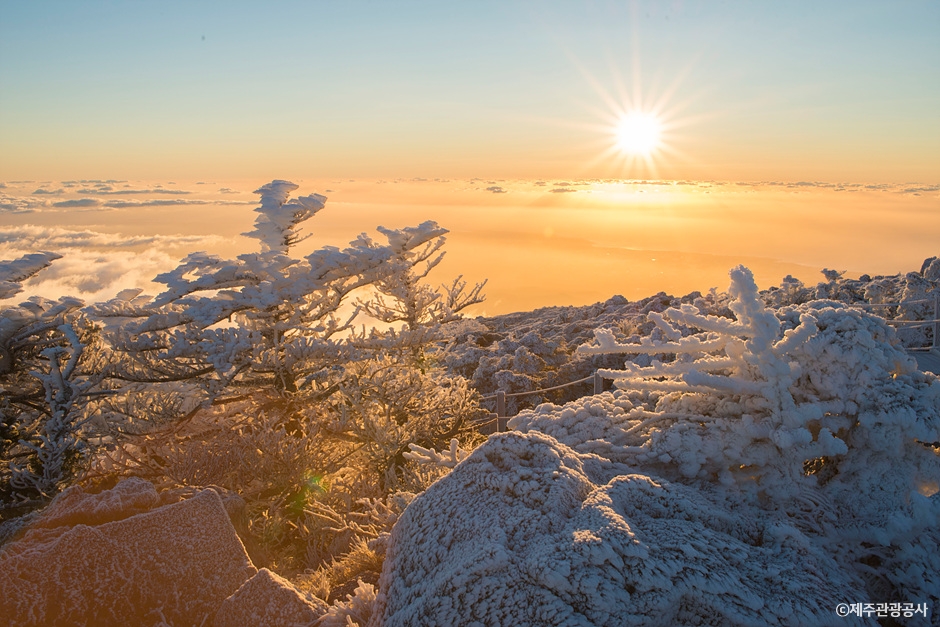
2. Hallasan Mountain (한라산): South Korea's highest peak
Hallasan sits at 1,950 meters at the center of Jeju and is technically the tallest peak on the entire Korean Peninsula (yes, taller than anything in the DMZ area). It was designated a national park in 1970 and functions as an ecological library: 1,800 plant species and 4,000 animal species stacked in vertical layers by altitude. Only two of the five trails, Seongpanak and Gwaneumsa, reach the summit crater lake Baengnokdam, and reservations are now required through the official portal. Seongpanak is the easier one at 9.6 km each way, about 4.5 hours up, and yes, you eat a hot cup of ramyeon at Witse Oreum before the final push. That ramyeon-at-altitude moment is not marketing schmaltz. It is genuinely one of the small rituals Korean hikers organize whole trips around, and it is why every convenience store at the trailhead sells the exact same three cups.
3. Manjanggul Lava Tube (만장굴): a UNESCO cave you can walk through
Manjanggul is part of the Geomunoreum Lava Tube System, the underground half of the 2007 UNESCO listing. Total length is roughly 7.4 km, with a main tunnel that runs 18 m wide and up to 23 m tall, which makes it one of the largest in the world. Tourists get 1 km of that. The payoff at the end is a 7.6-meter lava column, the tallest known, sitting at the turn-around point like a natural obelisk. Wear a jacket in summer. The cave stays around 11 to 18 degrees Celsius year-round, and after 20 minutes underground you feel it. From a KTO branding angle, this is the site that lets Jeju claim serious geological science (versus the Hawaii-comparison beach-and-palm-tree pitch) and it is the reason many international geology tours route through Jeju in the first place.
4. Haenyeo (해녀): the sea women who are UNESCO Intangible Heritage
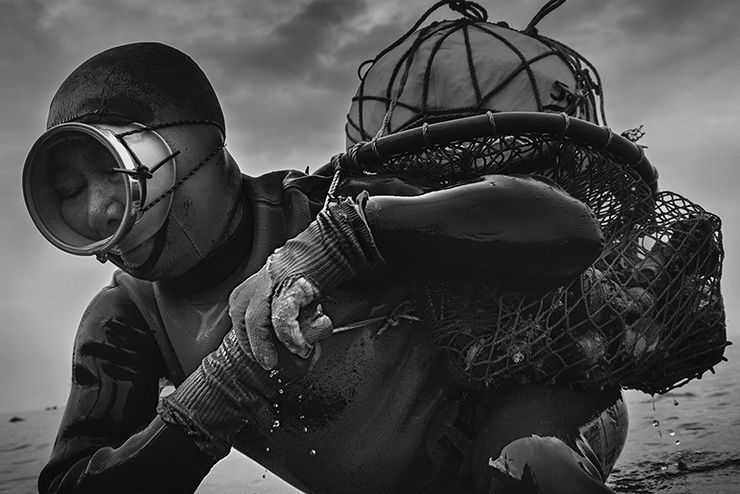
The haenyeo are the single most authentic thing on Jeju, and they are also the fastest disappearing. These are the free-diving 어머니 (mothers) who, wearing only neoprene wetsuits and holding a net bag and a small scoop, hold their breath for two to three minutes at a time to harvest abalone, sea urchin, and turban conch off the seabed. UNESCO added their culture to the Intangible Cultural Heritage list in 2016 for exactly the reasons that make them worth planning a trip around: matriarchal breadwinner structure (rare anywhere in East Asia), sustainable pre-industrial harvesting, and a communal apprenticeship system that has run continuously since at least the fifth century. The uncomfortable part of the appeal-point is that most active haenyeo today are in their 60s to 80s. Photographer Peter Ash Lee's book The Last Mermaid centers on Ko Ryou-jin, one of the youngest divers, who told him bluntly "I am the last mermaid." You can watch a haenyeo demonstration at the Seongsan performance area or the Haenyeo Museum in Hado-ri, but the honest advice is to also buy their fresh catch at the small stalls they run themselves. That direct exchange is what keeps the practice alive at the household level.
5. Jeju Black Pork BBQ (흑돼지): the wagyu of Korean pork
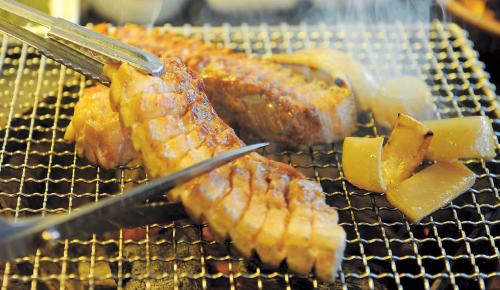
Jeju's native black pig, 흑돼지 (heukdwaeji), is not just a novelty menu item at 서귀포 (Seogwipo) BBQ restaurants. It is a genuinely different animal from mainland pork. The breed has a higher proportion of red muscle fibers, so the meat reads slightly redder and eats closer to steak, with what Korean chefs describe as elasticity or 쫄깃 chew when it is properly aged. Industry estimates put the black pig ratio at about one for every six average pigs going through Jeju slaughterhouses annually, which is why the tag hits roughly 20 percent above regular pork. Order the 오겹살 (five-layer belly) at a hardwood-charcoal spot, not gas, and dip the crisp slices in the anchovy sauce (멜젓) the server puts on the grill edge. That anchovy dip is Jeju-specific and does not really exist on the mainland. If you take one culinary insight home from the island, it should be this: 흑돼지 done properly is the case that makes non-pork-eaters reconsider pork.
6. Jusangjeolli Cliff (주상절리대): hexagonal basalt columns at Jungmun
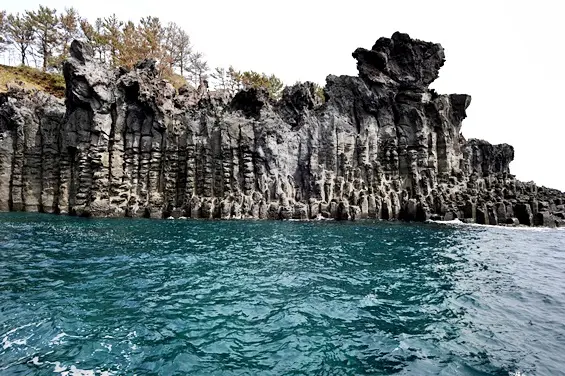
On the south coast at Jungmun Tourist Complex, Jusangjeolli is Korea's most photographed columnar-joint formation. The dark red hexagonal basalt columns formed when lava hit seawater and cooled at right-angle geometry, so precisely they look carved. Natural Monument No. 443 since 2004. The visual payoff is watching a 20-meter wave crash into these columns and explode into white foam. Free viewpoint, minor entrance fee to the cliff-edge walk. If you skip Seongsan Ilchulbong for some reason, this is your consolation UNESCO-adjacent stop, and it pairs geographically with Cheonjeyeon Waterfalls below for a half-day Jungmun loop.
7. Cheonjeyeon Waterfalls: three tiers of forest and freshwater
Cheonjeyeon is a three-tiered waterfall in Jungmun Resort area, tucked into a subtropical forest that quietly houses 447 species of plants. Only the first tier flows year-round; the second and third depend on rainfall. The name means "pond of the emperor of heaven" (천제연), which tracks with the way the water pools and drops through cliff-sides overgrown with Korean feather-leaf ferns. There is a fine hike-loop with the Seonimgyo Bridge (선임교), the arched bridge over the ravine decorated with the seven-nymph reliefs. Most Chinese group tour buses skip this. Independent travelers should not. It is the calm, slow-paced counterweight to Jusangjeolli's crowds five minutes away.
8. Osulloc Green Tea Fields: Amorepacific's tea empire
Osulloc (오설록) is where Amorepacific, Korea's number-one cosmetics conglomerate and the parent of Innisfree, Laneige, Sulwhasoo, and Etude, has been running its Seogwang tea plantations since 1979. The museum next to the fields attracts about a million visitors a year, and the green tea ice cream at the cafe is the actual reason most Korean 20-somethings visit. Jeju's volcanic soil, 16 degrees Celsius average temperature, and 1,880 mm annual rainfall are what let Amorepacific corner the domestic green tea supply for beverage and skincare lines simultaneously. From a K-beauty industry standpoint, walking these fields is walking the raw material pipeline for Innisfree's green tea seed serum, which is the single product that made Innisfree a global brand.
9. Jeju Dongmun Market (동문시장): tangerines, hallabong, and grilled seafood
Dongmun Market in Jeju City is the traditional 재래시장 (jae-rae sijang) that ate the tourism playbook well. During the day it is a working market for local aunties buying seafood and produce. From late afternoon it turns into an evening food-hall night market where the black-pork skewers, hallabong tangerines, boiled peanut stalls, and grilled abalone all line up under strings of lights. The single item to try is 감귤 or 한라봉 (hallabong), the bumpy citrus that only really grows properly in Jeju's climate. Ship a box home via 택배 if you can. It is 3 to 4 times better than what makes it to mainland Seoul supermarkets.
10. Jeju Folk Village (제주민속촌): the K-drama location you have already seen
제주민속촌 in Seongeup is a preserved 19th-century Jeju village with 100 or so thatched-roof houses moved and rebuilt in one place. It is also the most-filmed K-drama shooting location on Jeju, which is why every serious hallyu fan visiting the island has a personal reason to be there. The KBS Dae Jang Geum (Jewel in the Palace) scenes were shot here in 2003 and are still walked-through daily by Chinese and Southeast Asian visitors specifically hunting for those spots. What makes this site work versus other folk villages on the mainland (Yongin, Andong) is that Jeju's houses use black basalt stone walls and thatched-grass roofs weighted down with volcanic rope, which is architecturally unique. You are not looking at a generic Korean village. You are looking at Jeju's specific answer to typhoon weather.
11. Aqua Planet Jeju: the Hanwha aquarium next to Seopjikoji
Aqua Planet Jeju is Hanwha Group's marquee aquarium, opened in 2012, and it happens to sit next to Seopjikoji (섭지코지) on the east coast, which means you can combine it with a coastal walk and Seongsan Ilchulbong for a full east-Jeju day. Around 500 species and 48,000 marine animals. The programming pull is the daily haenyeo tank performance where actual retired divers demonstrate free-diving inside the main tank. That is a rare tourism content angle: the aquarium industry keeping haenyeo relevant by paying them to demonstrate what they used to do commercially. Whether you like it or not, that is exactly the kind of tourism-meets-heritage transaction the Jeju government has been trying to design.
12. Udo Island (우도): 15 minutes by ferry, half a day to explore
Udo is a small volcanic island east of Jeju, ferry ride from Seongsan port, about 15 minutes each way. The whole island is 6 km around and locals shape it like a lying-down cow, which is what 우도 (cow island) literally means. Rent an electric bike or three-wheeled scooter at the ferry terminal, do the coastal loop, stop at Seobinbaeksa (서빈백사, the white coral-sand beach), and pick up a Udo peanut ice cream cone at any of the stalls. Peanuts are the island's other agricultural product besides seafood, and the peanut soft-serve is genuinely Jeju-specific. The most recent development is Hundertwasser Park, opened around 2022, an art park licensed from the Austrian Hundertwasser Foundation, which is one of only two permanent Hundertwasser exhibitions in the world (the other is in Vienna). It converted Udo from a two-hour drop-by into a full destination day.
13. Hamdeok Beach (함덕 서우봉해변): white sand and turquoise water on the north coast
Hamdeok Seoubong Beach on Jeju's north coast is the postcard swimming beach: white sand, that shallow gradient that stays turquoise for 100 meters out, and the black basalt outcrops framing each end. It sits about 25 minutes from Jeju International Airport, which is why it is the beach every domestic traveler stops at on the way to their pension. Between June and August it does get crowded. Off-season (April, May, October) the beach is empty and the seafood shacks that back onto it are still open. Order the raw octopus (산낙지) and the grilled hairtail (갈치구이) at the same table. That combo, plus a cold Jeju local beer, is a real appeal point for foreign visitors who want to eat the way people from 제주도 actually eat, not the tourist-menu version.
14. Innisfree Jeju House: K-beauty's origin story in situ
Innisfree Jeju House sits inside the Osulloc tea field complex in Seogwang. For K-beauty fans this is the mothership. Innisfree is Amorepacific's mid-tier brand built entirely around the Jeju natural-ingredients story (green tea seed, volcanic clay, tangerine peel, 오름 herbs), and this location is where the brand made the story physical. Beyond the shop, there is a cafe using Osulloc tea and Jeju citrus and a small workshop where you can build a hand cream from Jeju ingredients. The appeal point Innisfree cracked in the mid-2010s was that Western K-beauty consumers wanted a farm-to-face brand story, and no other Korean beauty company had actual farmland to back that up. That is why Innisfree scaled globally while other Amorepacific brands (Laneige, Sulwhasoo) had to lean on hero SKUs alone.
15. Jeju Horseback Riding on 오름 hills: the Mongol legacy nobody mentions
Horseback riding across Jeju's parasitic volcanic cones (오름, oreum) sounds like a generic tourism activity until you know the history. Jeju was where the Mongol Yuan dynasty ran their horse-breeding operation during the 13th and 14th centuries when Korea was under Mongol influence, and the Jeju horse (제주마) is the direct descendant breed. That is why the island still runs professional stables where you can canter through 초원 (grasslands) with volcanic cones on the horizon. Look for stables near Saebyeol Oreum (새별오름) in Aewol. Rates run 30,000 to 60,000 won for a 30 to 60 minute guided ride. The insight for photographers: mid-afternoon light against the 오름 silhouettes is what Korean travel photographers actually build their portfolios around. It is not a random horseback ride. It is the specific shot that has been selling Jeju to Korean domestic tourists for a decade.
Bonus: Cafe Gongbech, the BTS Suga adjacent stop
ARMYs, you know why you are here. Cafe Gongbech (공백) on Jeju's northeast coast was originally opened in 2019 by Min Geumjae, older brother of BTS's SUGA (Min Yoongi). The name 공백 means "blank space" or "empty space," the exhibition-space concept was intentional, and the opening drew Dynamic Duo and Heize as performers. Ownership has since changed, but the cafe is still operating and still on every fan itinerary. Even non-BTS visitors go for the architecture and the ocean-view coffee. If you go, treat it as an extra stop on the northeast-coast loop with Manjanggul and Hamdeok, not as a standalone destination.
What to actually plan for a Jeju trip
Three tourism-industry realities that shape a good Jeju itinerary. First, the Seoul-Jeju flight corridor at 13.2 million passengers a year means seats are cheap but weather-cancellation risk is real, especially in winter monsoon season. Second, most domestic travelers rent a car at the airport (small SUVs are 60,000 to 100,000 won a day), because Jeju's public bus system is workable but slow and rideshare is nonexistent. Third, the island splits geographically into east (Seongsan, Udo, Manjanggul, Hamdeok), south (Seogwipo, Jungmun, Jusangjeolli, Cheonjeyeon), west (Osulloc, Innisfree, Hyeopjae Beach), and central (Hallasan, folk village). Do not try to hit all four quadrants in two days. Two nights per quadrant is the honest minimum if you want to actually see anything and not just drive.
The Jeju that stays with you
The reason Jeju keeps drawing repeat visitors from Seoul, Busan, and increasingly Japan is not the sunrise photos, though those are real. It is that the island still has genuinely irreplaceable things going on: the haenyeo culture, the 흑돼지 charcoal grill economy, the Hallasan-and-oreum landscape that formed 5,000 years ago and looks it. Post-COVID the property market corrected sharply (Jeju real estate dropped 30 percent-plus from peak) and the pivot has been from Chinese group tourism toward domestic Korean and Japanese independent travelers. That means the honest advice for a foreign visitor in 2026 is that this is the best moment in a decade to visit Jeju without fighting bus queues. Book the flight through Jeju Air, T'way, or Air Busan, land at 제주국제공항 (Jeju International), rent the car, and go.
Bring the Rest of Korea Home with Daebak
Loved Jeju and want more of the Korea you cannot pack into a suitcase? Grab the Daebak Box and get a monthly curation of Korean snacks, drinks, K-beauty samples, and cultural picks delivered straight from Seoul to your door.


