Hyunwoo Cho

Hyunwoo Cho

With over 10 years of experience in the Hallyu industry, Hyunwoo has dedicated his career to connecting Korean culture with the world. As the founder of Daebak, he works closely with Korean brands and stays ahead of the latest trends to deliver an authentic taste of Korea to fans globally.

Haeinsa Temple in Gyeongsangnam-do home of the Tripitaka Koreana a popular Korean Buddhist temple stay destination

Korean Temple Stay Guide: Inside Korea's Buddhist Monastery Experience

Hyunwoo Cho

Table of Contents

If your idea of a Korea trip stops at street food, palaces, and K-pop, the Korean Temple Stay (템플스테이) program quietly offers something completely different: a night or two inside a working Buddhist monastery, tucked into a misty mountain valley, where the day starts with a 4 a.m. bell and ends in candlelit silence. It is one of the most popular cultural experiences in Korea for foreign visitors, and the program is run across more than 130 temples nationwide.

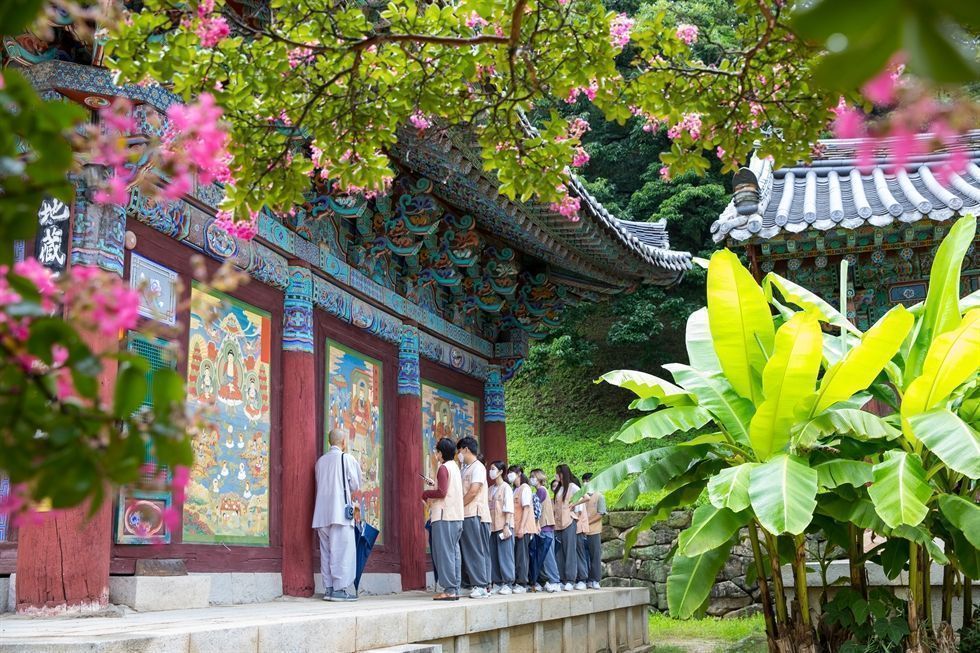
University students follow a Korean Buddhist monk on a guided temple stay tour at Jikji Temple in North Gyeongsang Province during a templestay program
Templestay participants follow a Korean Buddhist monk on a guided tour of Jikji Temple, the very first temple to host the iconic Templestay program in 2002. | Source: The Korea Times

What Is a Korean Temple Stay?

A Templestay is an experiential cultural program run by the Jogye Order of Korean Buddhism that invites both locals and foreigners to live alongside monks for a short stay, usually one or two nights. Guests sleep in temple quarters, wear loose grey or brown training robes (provided on arrival), eat vegetarian temple food, and follow a simplified version of the monastic daily schedule. The point is not to convert anyone to Buddhism. It is to step out of city noise, smartphones, and deadlines, and to spend time with what Korean monks call your true self.

Programs range from highly structured experiential stays with set activities to relaxed rest-focused stays where you can simply walk the mountain paths, read, and sleep. As of recent years, the cumulative number of templestay participants has exceeded 6 million, including hundreds of thousands of visitors from more than 200 countries.

A Short History: Born From the 2002 World Cup

The modern Templestay program is younger than many people assume. It was launched in May 2002, just weeks before the 2002 FIFA World Cup co-hosted by Korea and Japan. The Jogye Order opened 33 temples to provide extra accommodation for the flood of foreign visitors and to share traditional Korean Buddhist culture with the world. Jikji Temple in Gimcheon hosted the very first official Templestay session for 50 members of the diplomatic corps on May 11, 2002.

The experiment was meant to be a one-off, but it was so popular that the program was made permanent that same year. In 2004 the Jogye Order set up the Cultural Corps of Korean Buddhism to operate it full time. In 2009 the OECD selected Templestay as one of the world's five most successful examples of combining culture and tourism. Today around 150 temples participate, and roughly 25 of them have English-speaking coordinators on staff.

Korean temple stay participants bowing before the Buddha in the Daeungjeon main hall during the 108 prostrations ceremony
Templestay participants bow before the Buddha statues in Daeungjeon at Jikji Temple, where the program was first launched in 2002. | Source: The Korea Times

A Typical Temple Stay Schedule

Every temple sets its own timetable, but a standard Templestay day looks roughly like this:

  • Afternoon, Day 1: Check-in, change into temple clothes, orientation, etiquette briefing, and a temple tour.
  • Late afternoon: Yebul, the evening Buddhist ceremonial service, with chanting in the main hall as monks strike the four percussion instruments (bell, dharma drum, wooden fish, and cloud gong).
  • Evening: Baru gongyang, the formal monastic meal, eaten in silence from a four-bowl set. You take only what you can finish, and you clean every bowl with water and a piece of yellow radish before drinking it.
  • Night: Tea ceremony or chadam, a quiet teatime conversation with a monk where guests can ask anything.
  • 4 a.m., Day 2: The dawn temple bell, dawn chanting, and the famous 108 prostrations, said to release the 108 forms of human anguish from past, present, and future.
  • Morning: Seon (Zen) meditation and a forest walking meditation along the temple's mountain trails.
  • Mid-morning: Communal work (cleaning, gardening), lotus lantern craft, breakfast, and check-out.

Recommended Temples for First-Time Visitors

Korea has dozens of temples open to international guests. These six are the most accessible and culturally rich starting points.

  • Haeinsa (해인사), Gyeongsangnam-do: One of the Three Jewel Temples and the home of the Tripitaka Koreana, the 81,258 hand-carved woodblocks of the Buddhist canon stored in a UNESCO-listed wooden archive. Strict, atmospheric, deep in Gaya Mountain National Park.
  • Bulguksa (불국사), Gyeongju: A UNESCO World Heritage Site and the architectural masterpiece of Silla-era Buddhism, rebuilt over the original 8th-century foundations. Great for travelers combining the temple stay with a Gyeongju history trip.
  • Magoksa (마곡사), Chungcheongnam-do: One of Korea's seven UNESCO-inscribed Sansa mountain monasteries, set along a meandering stream surrounded by old pine forests. Famous for its peaceful spring scenery.
  • Beomeosa (범어사), Busan: The major mountain temple of southeastern Korea, founded in 678, just a subway ride from downtown Busan. A convenient pick if you are flying in or out of Gimhae.
  • Songgwangsa (송광사), Jeollanam-do: The Sangha Jewel temple, known for producing 16 national preceptors and for its long-standing Seon (Zen) meditation tradition.
  • Jogyesa (조계사), central Seoul: The head temple of the Jogye Order, right in downtown Jongno. Ideal if you cannot leave the city; it offers shorter half-day programs and lights up beautifully during the Lotus Lantern Festival.
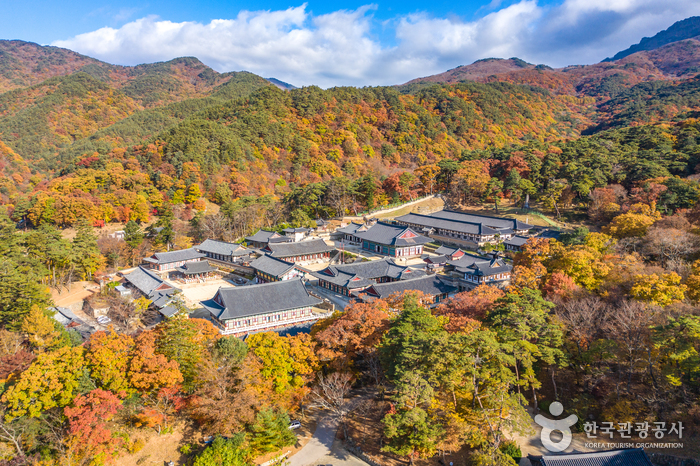
Haeinsa Temple in Gyeongsangnam-do, home of the Tripitaka Koreana woodblocks, one of Korea's most famous temple stay destinations
Haeinsa Temple, the Dharma Jewel of Korean Buddhism and home to the UNESCO-listed Tripitaka Koreana. | Source: Korea Tourism Organization (VisitKorea)

How to Book Through Templestay.com

The official booking portal is eng.templestay.com, operated by the Cultural Corps of Korean Buddhism. The English site lets you filter by region, program type (experiential vs. rest), date, language support, and number of nights. A typical one-night program costs around 50,000 to 90,000 KRW per person depending on the temple, and includes accommodation, all meals, and program activities.

Reservations usually open one to two months ahead and weekend slots at famous temples (Haeinsa, Bulguksa, Magoksa) can fill up quickly. If you prefer in-person help, the Templestay Information Center sits directly across from Jogyesa Temple in Seoul's Jongno district, a five-minute walk from Anguk Station Exit 6 or Jonggak Station Exit 3-1. Staff there can recommend temples in English and help you book on the spot.

Jogyesa Temple in central Seoul, home of the Jogye Order and a popular Korean temple stay location for international visitors
Jogyesa Temple in central Seoul, the head temple of the Jogye Order and the location of the Templestay Information Center. | Source: Visit Seoul

What to Bring (and What to Leave Behind)

Most temples lend you a set of training clothes, bedding, towels, and toiletries, so you can pack very light. A simple list:

  • Comfortable socks (you will be barefoot indoors and want warm feet on wooden floors).
  • Slip-on walking shoes for the mountain paths.
  • A warm layer even in summer; mountain temples get cold at 4 a.m.
  • A small notebook (smartphones are discouraged during programs).
  • Any prescription medication and your own contact lens solution.

Leave behind: alcohol, meat, scented perfume, valuables, loud clothing, and a packed schedule. Drinking, eating meat, and smoking are not allowed on temple grounds.

Temple Etiquette for Foreign Visitors

Korean temples are sacred working spaces, not museums, so a few quiet rules matter more than they would at a tourist site.

  • Always enter the main hall through the side doors, never the center door, which is reserved for monks.
  • Place your shoes neatly facing outward when you step inside.
  • Move quietly. Even your heels on a wooden floor are noticeable in early-morning stillness.
  • If others are praying, meditating, or chanting, walk behind them rather than across.
  • Photography is fine in the courtyards but check before shooting inside halls, and never photograph monks without asking.
  • Bowing is a Buddhist gesture, but it is not religious worship in the Western sense. Monks usually explain it as bowing to the Buddha nature inside you. If you are uncomfortable, you can simply observe.
Bulguksa Temple in Gyeongju, a UNESCO World Heritage Site and one of Korea's most famous temple stay destinations
Bulguksa Temple in Gyeongju, a UNESCO World Heritage Site built during the Silla kingdom and a popular templestay destination. | Source: Korea Tourism Organization (VisitKorea)

Why It Stays With You

People come to a Korean Temple Stay expecting a cultural activity and leave talking about something else: the sound of the dawn bell rolling down a mountain, the silence of eating from a four-bowl set, the simple realization that you can survive 36 hours without your phone. In a 2023 satisfaction survey by Gallup Korea, 71.4 percent of foreign templestay participants said the program reduced their anxiety, and 74.2 percent said it reduced their stress. That is not a coincidence. The temples have been refining this rhythm for 1,700 years; the program just opens the gate for one night so you can step inside.

Explore More of Korea with Daebak

Want to bring a little piece of Korea into your life? The Daebak Box is packed with the best Korean snacks, ramen, and cultural goodies delivered monthly to your door.

ブログに戻る