


Table of Contents
Hi Daebak-Fam. Let's talk about honey. Specifically, 꿀 (kkul). Because in Korean, honey is not just a sweetener you drizzle onto toast. It is a word people call each other (허니, honey), a thousand-year-old medicinal ingredient that shows up in royal-court desserts, a national snack craze from 2014 that briefly turned a potato chip into a black-market commodity, and the reason a K-beauty term like 꿀피부 (honey skin) became the whole aspirational ideal for two generations of Korean women. I have been covering the Korean food and lifestyle space for more than a decade, and honey is one of those threads that runs through everything. This is a proper walk through what Korean cuisine and Korean culture actually do with honey, and why the 2014 Honey Butter Chip explosion is not the fluke it looks like from the outside.
허니 vs 자기야 vs 여보: How Koreans Actually Call Each Other Sweet
Before we get to the food, the word. 허니 (heoni) is the Konglish-adopted honey, and it does get used in casual Korean relationships, mostly among younger millennial and Gen Z couples who grew up on American sitcoms and K-drama romantic comedies. It sits alongside 자기 (jagi) and 자기야 (jagiya), which is the softer, everyday endearment for a partner (a rough English cousin of babe or darling). Then there is 여보 (yeobo), which is the older, married-couple version (closer to dear or honey used by an actual spouse). And 오빠 (oppa), which technically means older brother but in a dating context is the affectionate term a woman uses for her boyfriend when he is older by a year or two.
What is interesting about 허니 as a modern import is how it hierarchies against those older terms. Nobody's grandmother is calling her husband 허니. She is calling him 여보. But post-2010, K-drama scripts started dropping 허니 into scenes with couples who were meant to read as globalized, cosmopolitan, or a little bit performative. If a chaebol heir on screen calls his girlfriend 허니 rather than 자기야, you can read that as a character signal: this is a person who spent time abroad, or wants to be seen as international. The word choice does work in the story. That is the thing to understand about Korean endearments. They are never neutral. They tell you generation, class, and how a couple wants to present.
Yakgwa (약과): Why Korean Honey Cookies Are Called Medicine Food
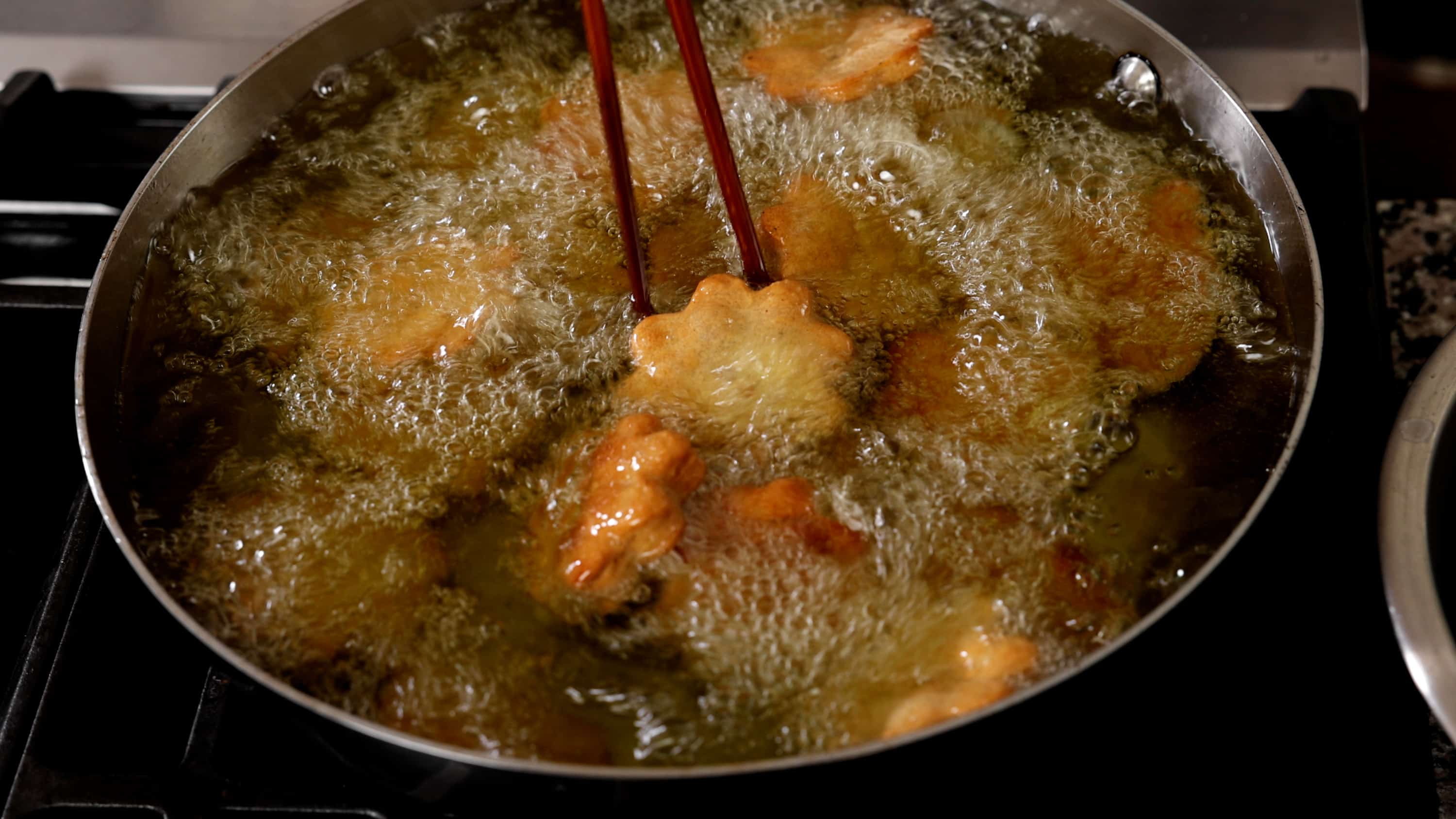
Yakgwa is where the honey-as-medicine idea gets literal. The word breaks down into 약 (yak, medicine) plus 과 (gwa, confection), because Joseon-era Koreans treated honey as a healing ingredient rather than just a sweetener. Yakgwa is a deep-fried wheat-flour cookie made with honey, sesame oil, ginger juice, and soju, then soaked in a cinnamon-ginger honey-and-rice-syrup bath for hours until the syrup fully saturates the cookie. When you bite into a properly made one, the syrup bursts out. It is not subtle. It is a full sensory event.
What most modern write-ups miss is the class layer. In pre-modern Korea, honey was scarce and expensive. Beekeeping was labor-intensive, imports were limited, and the volume you needed to make a proper batch of yakgwa was serious. That meant yakgwa was upper-class food. It appeared at royal-court banquets, at 제사 (jesa, ancestral rites), at weddings, and at 잔치 (janchi, feast) tables where a family was trying to signal status. Commoners might see yakgwa once a year on Chuseok if they were lucky. This is why the recent Gen Z resurgence of yakgwa (which the Korean press called the 약과 열풍, the yakgwa fever, around 2022 to 2023) hit so hard. Young Koreans were rediscovering it through K-drama food scenes and Instagram bakeries, and there was this delicious inversion: the food of the yangban aristocrats had become a hipster cafe order.
Chapssal Yakgwa: The Sweet Rice Variant That Went Viral
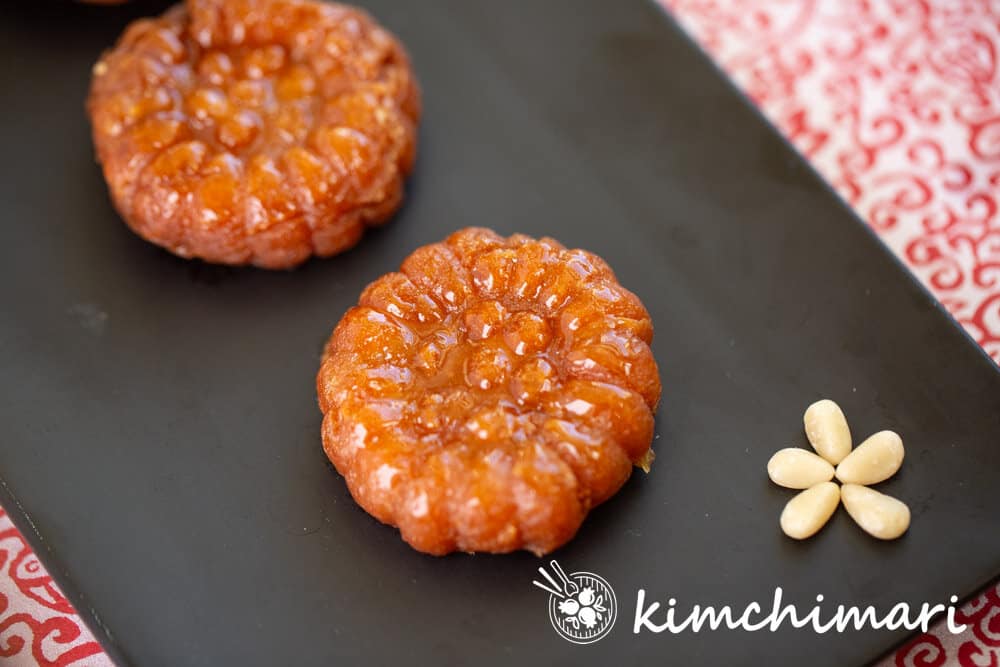
Chapssal yakgwa (찹쌀약과) is the sweet-rice-flour cousin of regular yakgwa, and it is the version that basically owned Korean cafe menus from 2022 onward. Where standard yakgwa uses wheat flour, chapssal uses 찹쌀가루, which delivers a softer, more mochi-like chew after the honey bath soaks in. The Gen Z K-food space latched onto it because it photographs like a proper dessert (compact, flower-shaped, glossy from the syrup) and because pairing it with 아메리카노 became the Instagram move. Cafes in Seongsu-dong and Yeonnam-dong started selling single chapssal yakgwa pieces for 3,500 won each, and lines formed. This is the industry mechanic worth flagging: when a traditional Korean dessert gets rebranded through cafe culture, price per piece can move 5x versus what your grandmother would have paid at a traditional market. The premium is the presentation, the coffee pairing, and the sense that you are eating a piece of court history.
Yaksik (약식): The Sweet Rice Cake Where Honey Does the Heavy Lifting
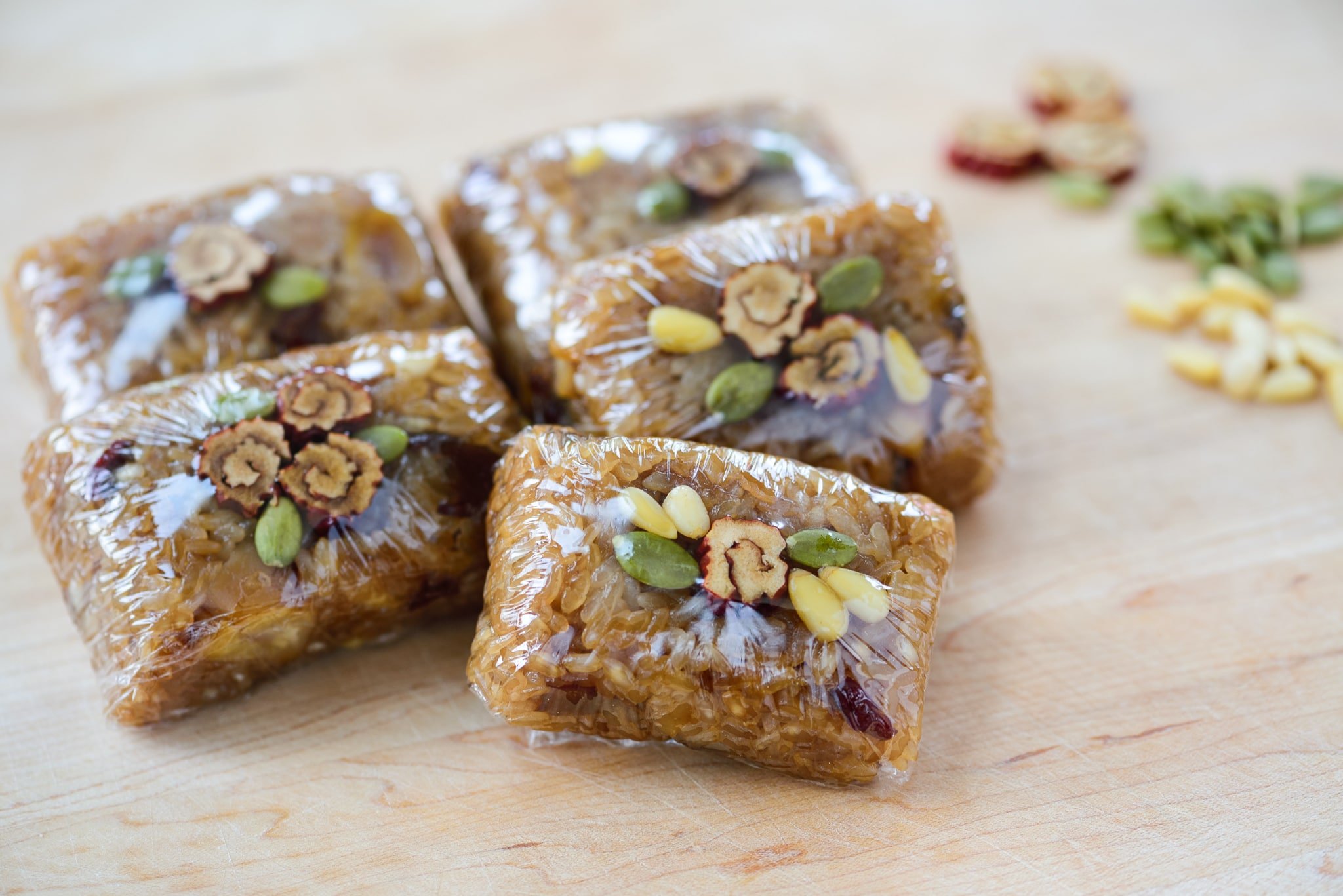
Yaksik (also called yakbap, 약밥) is the honey-glazed sweet rice cake studded with chestnuts, jujubes, and pine nuts. Same 약 (medicine) prefix as yakgwa, same reason: the honey is treated as the healing agent. Legend traces yaksik back 1500 years to a Silla king named Soji, who was saved from an assassination plot by a crow. He set the first full moon of the Lunar New Year (정월대보름, Jeongwol Daeboreum) as a day to make chalbap (glutinous sweet rice) in thanks. Over the centuries, that ritual rice evolved into yaksik with honey, brown sugar, soy sauce, and sesame oil driving the flavor.
The reason yaksik matters as a modern Korean food is texture. Each grain of the 찹쌀 (chapssal, glutinous rice) stays intact but chewy. The honey and brown sugar caramelize into the rice without turning it wet. The chestnuts and jujubes give bite. If you get yaksik done well, it is a candy-adjacent dessert that also functions as a proper breakfast or afternoon snack (Koreans genuinely eat it with coffee). It travels well, freezes well, and it is one of those foods where the traditional method (long steaming, hand-mixing) got completely replaced in a decade by the Instant Pot rice-cooker approach. If your Korean aunt has an electric pressure rice cooker, she is almost certainly making yaksik in it now.
Kkae Gangjeong and the Whole Gangjeong Family (강정)
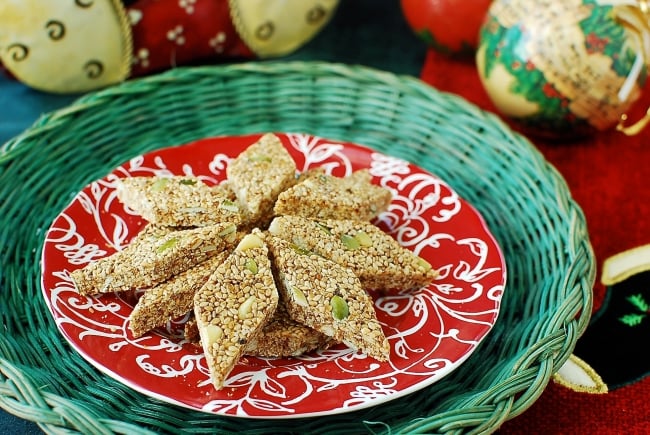
Gangjeong (강정) is a whole family of traditional Korean sweets, and honey is the glue that holds them together. Literally. The base technique is: boil honey and sugar with a little water and salt until it caramelizes to a golden syrup, then stir in whatever you want (sesame seeds, puffed rice, peanuts, dried fruit, chocolate later on) and press flat. When it cools, the honey syrup hardens into a candy that binds everything into a bar. Kkae gangjeong (깨강정) is the sesame version and probably the most photogenic, with its glossy dark surface and neat rectangular cuts.
The appeal point of gangjeong for global audiences is the same thing that makes it a good gift in Korea: it looks like a health snack (seeds, whole grains, no artificial anything) but eats like candy. The honey does two jobs at once: sweetener and preservative. That is why gangjeong keeps for weeks at room temperature and why it has been a holiday-gift-box staple for centuries. Modern Korean brands like 담터 and 신세계 sell premium acacia-honey gangjeong sets during Chuseok that run 40,000 to 60,000 won a box. That price point tells you something. Honey-based traditional confection has kept its premium status even as sugar and corn syrup got cheap.
Kkul-Tarae (꿀타래): The 16,384-Thread Dragon Beard Candy
Kkul-tarae is the honey candy that Seoul street vendors turn into a performance. The base is a dense honey-and-maltose block that gets stretched and folded 15 times, doubling each time (2, 4, 8, 16, 32, 64, 128, 256, 512, 1024, 2048, 4096, 8192, 16384). Yes, 16,384 hair-thin honey threads. The vendors do this out in the open at Insadong and Namdaemun with cornstarch on their hands, calling out the count as they fold, wrapping the threads around a crushed-nut-and-chocolate filling, and handing over a little box of five or six pieces. It is theater as much as food.
What makes kkul-tarae specifically Korean rather than a generic dragon-beard-candy variant is the honey base. Chinese dragon beard candy typically uses maltose. Korean kkul-tarae leans into honey for its flavor signature, which gives a floral undertone the maltose-only versions lack. And the vendor patter (the counting, the sales pitch, the tourist-friendly English commentary) is a live-performance layer that has kept kkul-tarae as one of the top-photographed Seoul street-food experiences. If you have watched a Korean-street-food YouTube video in the last decade, you have seen kkul-tarae stretched at least once.
2014: Honey Butter Chip and the Craze That Broke the Supply Chain
Now the big one. On August 4, 2014, Haitai-Calbee (a joint venture between Korean confectionery giant Haitai and Japanese snack company Calbee) launched Honey Butter Chip (허니버터칩). Thin, wavy potato chip. Acacia honey powder. Real butter. Slightly sweet, mostly salty, extremely photographable pale-yellow color. It looked innocuous. It went nuclear.
Within three months, Korean convenience stores were rationing bags. Within six months, single 60g bags were reselling on Naver marketplaces for 5,000 to 10,000 won (up from a retail price of 1,500). Photos of empty CU and GS25 chip shelves with a hand-lettered sign reading 허니버터칩 품절 (Honey Butter Chip sold out) were their own meme. Girls' Generation's Sooyoung, Super Junior's Siwon, and actress So Yoo-jin all posted about it. Which fed the loop harder. Korean media coined the term 허니버터 열풍 (Honey Butter craze) and by early 2015 the craze had jumped categories. Every K-snack company launched a honey butter version of something.
The industry mechanic behind why Honey Butter Chip worked, versus the many failed snack launches Haitai had before and after, is a combination of three things. First, the honey-butter flavor profile hit a sweet spot Koreans had not seen at scale: a salty snack that reads as sweet without being a dessert. Second, Haitai deliberately kept supply constrained in the first six months (either as a distribution decision or because they genuinely could not scale acacia honey supply that fast, and both interpretations circulated). Constrained supply plus celebrity endorsement plus social-photo shareability is the classic scarcity-marketing recipe. Third, the pale-yellow color photographed like a soft filter on Instagram in 2014. That was the pre-TikTok era when Instagram aesthetic drove snack sales in Korea, and Honey Butter Chip's yellow bag against dark cafe tables was a visual meme.
The Honey Butter Extended Universe: Squid Jerky, Almonds, Twists
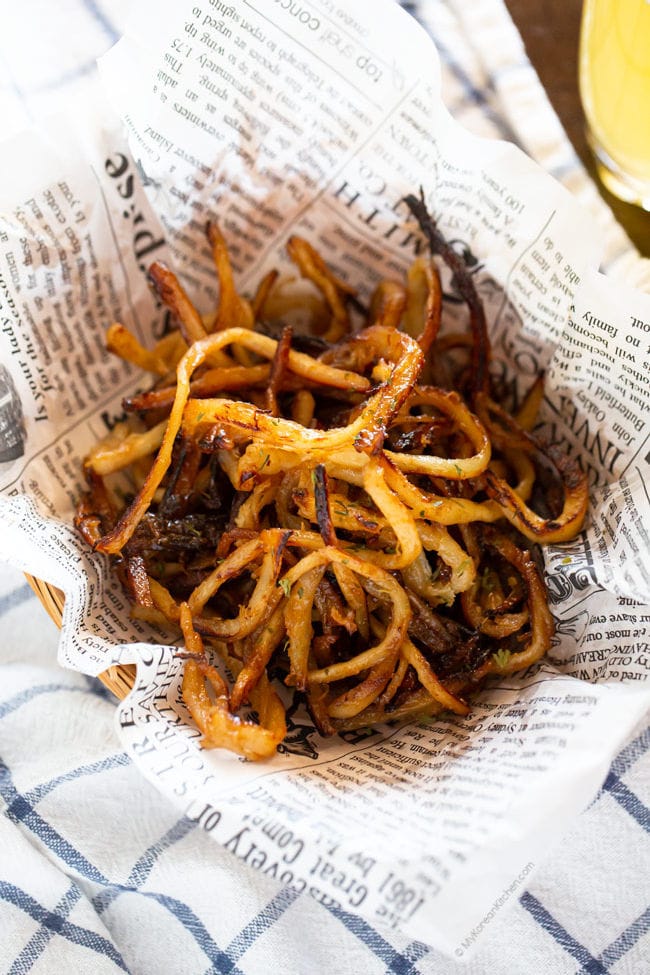
After Honey Butter Chip proved the flavor could sell, every Korean confectionery brand scrambled to attach honey butter to whatever they already made. Haitai released Honey Butter Tangerine Chips using Jeju-grown dried tangerines. Nongshim launched Honey Twists (꿀꽈배기) with Korean acacia honey glaze. Orion added a honey butter Turtle Chip. HBAF released honey butter almonds (which then blew up abroad, especially in duty-free Incheon Airport channels, and became the Korean-airport-souvenir default). Even squid jerky, historically the classic beer 안주 (anju, drinking snack), got honey-buttered.
The lasting business lesson from the honey butter era was that Korean snack innovation could travel globally at speed if the format was portable and the flavor was Instagram-friendly. HBAF's honey butter almonds are now sold in 30-plus countries. Honey butter has effectively become a permanent flavor category in K-snacks the way barbecue is in American snacks. It never went away. It just stopped being new.
Honey Wings, 허니 치킨, and the Korean Fried Chicken Sweet-Salty Move
Parallel to the snack side, honey worked its way into Korean fried chicken. 후라이드 치킨 (huraideu chikin, plain fried chicken) has been the KFC-inspired baseline in Korea since the 1980s, but the flavor variants really took off in the 2010s. Kyochon's Honey Series (Honey Original, Honey Combo), BBQ Olive Chicken's honey glaze, BHC's various honey-mustard offerings. The 허니 치킨 (honey chicken) category became a permanent menu section at every major Korean fried-chicken chain.
What Korean fried-chicken chefs figured out is that acacia honey and gochujang play surprisingly well together. The floral sweetness rounds off the chili-paste heat, and the honey's low melting point means it glazes the crust rather than pooling in the plate. That is why 양념 치킨 (yangnyeom chicken, the sweet-spicy sauced version) uses honey rather than sugar in most premium chain recipes. If you have ordered Korean fried chicken outside Korea and wondered why the sauce hits differently than American BBQ or Thai sweet-chili, honey (specifically Korean acacia honey) is a lot of the answer.
Korean Honey Categories: 아카시아, 밤꿀, 잡화꿀, and Why Jeju Matters
The Korean honey market itself is worth a paragraph, because most global readers only know Manuka. Korean beekeeping produces four main categories. 아카시아 꿀 (acacia honey) is the light, floral, clear-yellow honey most commonly used in K-cuisine, because it does not overpower whatever you are cooking. It is also the honey specifically named on the Honey Butter Chip packaging. 밤꿀 (chestnut honey) is the dark, bitter, mineral-heavy honey from Korean chestnut trees, prized for medicinal use and traditional 한약 herbal remedies. 잡화꿀 (wildflower honey) is the mixed-source honey from bees that forage across multiple plant types. 벌꿀 (bee honey) is the general umbrella term.
Jeju Island is the premium honey origin. Halla-based acacia honey from Jeju runs 50,000 to 80,000 won per kilogram at Korean gift-market retail (roughly 2 to 3 times mainland acacia). The premium is real: Jeju's isolated ecosystem means the bees forage over cleaner air and unique flora, and the honey is often marketed as a high-end Chuseok or Seollal gift. The Korean honey industry as a whole runs around 300 billion won annually in domestic sales, plus a growing export market to China, Southeast Asia, and, increasingly, the US via Korean-American grocery channels.
꿀피부 (Honey Skin): The K-Beauty Term That Became Universal
Outside food, honey shows up as the entire aesthetic ideal for Korean skin. 꿀피부 (kkul-pibu, honey skin) is the K-beauty term for skin that has the exact glow, translucency, and moisture of honey. It is not just dewy. Dewy is 촉촉 (chokchok, moist). Honey skin is 꿀피부, which layers on the glow (honey's inner luminance), the smoothness (honey's viscosity), and the youthful bounce (honey's density). K-beauty brands built entire skincare lines around delivering honey skin as an outcome. Innisfree, Etude House, Skinfood, and Papa Recipe all have honey-based product ranges (real acacia honey, propolis, royal jelly). The K-beauty industry effectively productized a Korean food-cultural term into a global export.
Honey in K-Drama and K-Pop: The Coffee Prince and Reply 1997 Scenes
K-drama has used honey as a metaphor and a plot device longer than most global viewers realize. Coffee Prince (2007) had multiple scenes where the leads shared honey-drizzled desserts as a soft romantic beat. Reply 1997 (2012) used honey-butter bread and honey-dipped snacks as nostalgic markers for the late-1990s teenage era. In K-pop, the honey imagery pops in comeback aesthetics whenever a group wants to signal warmth, sweetness, or first-love innocence. Look at any TWICE, IVE, or LE SSERAFIM concept photo from the last five years that leans golden-hued, and you will see the honey visual language: amber tones, dripping textures, soft focus, honeycomb patterns.
This is not accidental. Korean art directors know that 꿀 (honey) carries a specific emotional weight: nostalgia, comfort, first love, mother's kitchen. It is the K-culture equivalent of what apple pie carries in American ads. When a K-pop group wants to feel domestic and tender rather than edgy, honey visuals are one of the go-to language choices.
Where the Korean Honey Category Sits in 2026
As of 2026, Korean honey category is doing well. The premium Jeju-honey gift market is growing steadily. Honey butter has settled in as a permanent K-snack flavor pillar alongside cheddar, kimchi, and hot spicy. Yakgwa has gone through its Gen Z revival and is now a stable cafe-menu item rather than a novelty. K-beauty honey-skincare lines are still one of the top three category leaders in Korean beauty exports. And the 허니 endearment shows up in about 30 percent of contemporary K-drama romantic-comedy scripts, per the loose count I keep in my head from watching too many. Honey is not going anywhere in Korean culture. If anything, it has cemented as one of the ingredients most identified with the aspirational, healthy, premium version of what Korean food and Korean lifestyle can be.
If you take one thing from this piece, take this: honey in Korea is not just sweetness. It is a status ingredient (yakgwa royal-court legacy), a health signal (medicinal 약 prefix), an aesthetic ideal (꿀피부 skin), a marketing accelerant (2014 Haitai-Calbee), a term of affection (허니), and a category the Korean confectionery industry treats with real strategic weight. Every time you see a 꿀 label on something Korean, that is a lot of history in one small syllable.
Explore Korean Snacks with Daebak
Love Korean food? Get authentic Korean snacks and ramen delivered straight to your door with the SnackFever Box by Daebak.


