


Table of Contents
I have spent over a decade watching Korean pop culture and retail bend around one deceptively small thing: the Instagram feed. When Korean cities started building Christmas markets in the mid 2010s, the industry logic was not about German tradition or European nostalgia. It was about the MZ세대 (Gen Z and younger millennials) needing a new 인생샷 (best-photo-of-my-life) location every winter, and the K-drama holiday date scene giving that photo a story arc. 크리스마스 마켓 (Christmas market) is a fully imported concept in Korea, there is no historical Advent tradition to draw from, and yet three markets in Seoul have quietly built a real foot-traffic economy: the Seoul Christmas Fair at Gwanghwamun Square, the Common Ground container market in 건대 (Konkuk University area), and the German-style Herrenberg food row that anchors Gwanghwamun. What follows is how each of those actually works, and why they keep pulling crowds every December even though Korea itself does not close for Christmas the way the West does.
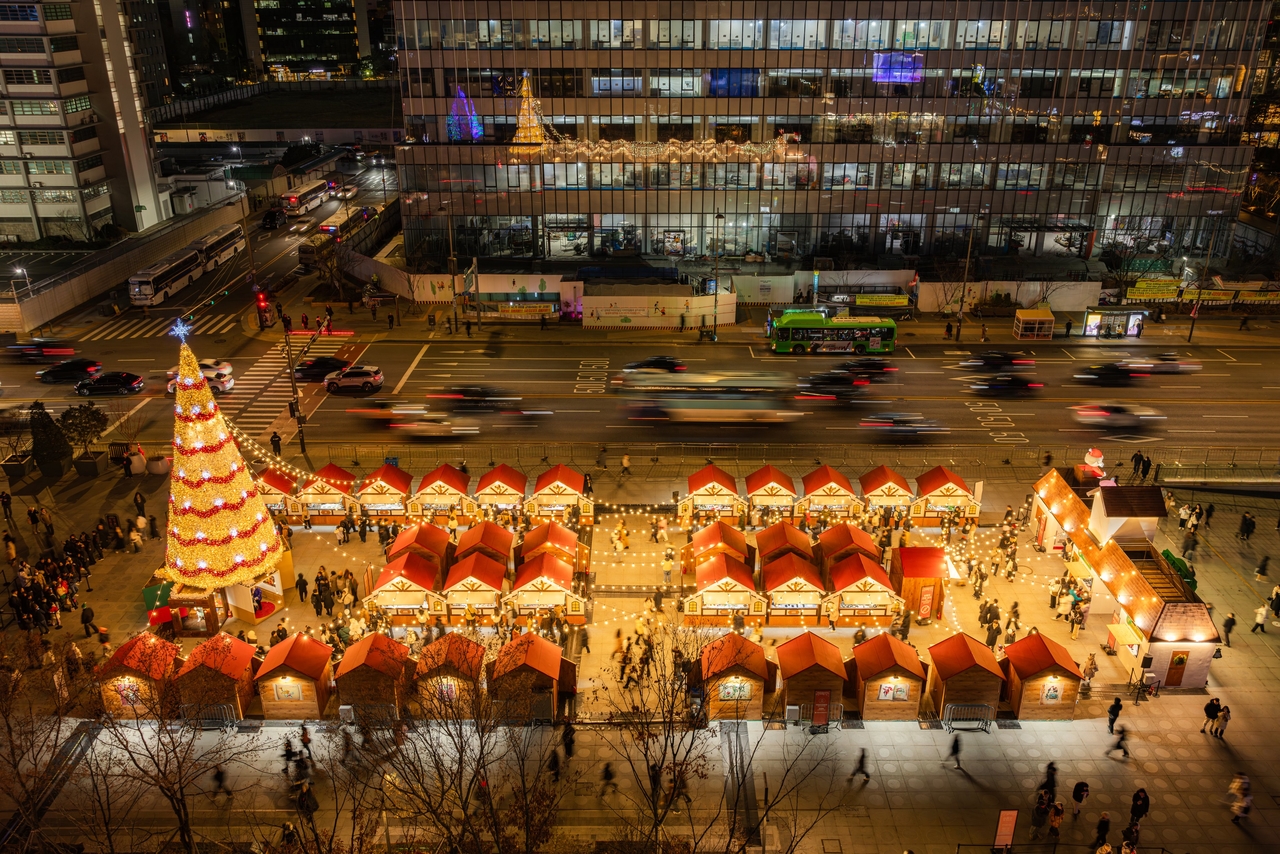
How Korean Christmas Markets Became MZ-Generation 인생샷 Territory
Here is the honest business framing. Christmas Day (December 25) is a public holiday in Korea, but the cultural weight sits with couples going on a 데이트 (date), not with families gathered around a hearth. That difference is load-bearing. When Seoul Metropolitan Government and district offices started programming winter events in the 2010s, they were not competing with Christmas Eve dinner at home, they were competing with cafe hopping in Ikseon-dong and skiing in Pyeongchang. The winning format turned out to be an outdoor market with tall trees, warm lighting, and enough photo backdrops per square meter that a couple could clear ten Instagram Stories in under thirty minutes. Seoul Winter Festa, the umbrella program that runs from Gwanghwamun to Cheonggyecheon to Seoul Plaza, drew over five million visitors in 2024 alone according to city government figures. That number is what makes the whole 크리스마스 마켓 build-out sustainable. This is not tradition, it is calibrated MZ engagement.
The Seoul Christmas Fair at Gwanghwamun Square: Government-Engineered Winter Photo Zone
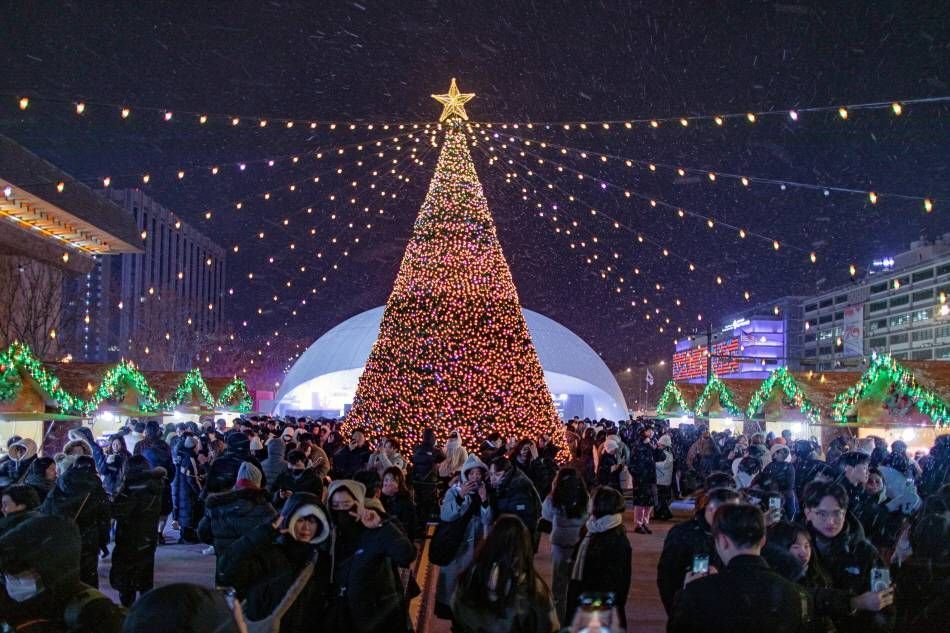
The Gwanghwamun Market (광화문 마켓) is the flagship. It has been running since 2022 under Seoul Metropolitan Government and Seoul Tourism Organization sponsorship, and by its third edition in 2024 it was drawing more than a hundred small business vendors selling handmade goods, seasonal items, and food. The centerpiece is a fifteen-meter Christmas tree. Around it, Seoul Tourism Organization built out three zones: Zone 1 is Santa Village (the tree), Zone 2 is the Santa Village Food Street (mulled wine, gingerbread, German sausages), and Zone 3 is the Santa Village Play Plaza with Rudolph's sleigh photo op. The zoning matters. It maps directly to Instagram carousel logic: wide-shot of the tree, close-up of the food, character selfie, done. Foreign visitors know this square from K-dramas already. Gwanghwamun is where Kim Shin (Gong Yoo) walked through his mystical door in Guardian: The Lonely and Great God (도깨비), and where Jin-woo (Hyun Bin) fought an assassin in Memories of the Alhambra. The city government is quite consciously leveraging that pre-loaded emotional recognition when it builds the winter market on the same tiles.
Common Ground in 건대: The Container Market That Rewired Korean Outdoor Shopping in 2015
Common Ground (커먼그라운드) is a different beast. Opened in April 2015 near Konkuk University Station (건대입구역), it was Korea's first cultural retail space built entirely from stacked shipping containers, 200 blue containers arranged around a central courtyard, roughly 5,300 square meters in total. That structural choice was a deliberate copy of London's Boxpark and Amsterdam's outdoor pop-up culture, but Korean developer Kolon Industries adapted it for Korean retail rhythm: rotating tenants, on-site food trucks, weekend markets in the courtyard, rooftop dining, and a design language calibrated for Instagram before Instagram had reached full saturation in Korea. Common Ground was the market that proved to the Korean retail industry that outdoor container shopping could work in a country with brutal humid summers and sharp winters. By 2016, Seongsu-dong, Yeonnam-dong, and Hongdae all had container-adjacent pop-ups following the template. During November and December, Common Ground rolls out Christmas lights, a courtyard tree, and holiday pop-ups tied to whatever brand tenant currently rents the space. It is not a traditional Christmas market. It is a photogenic Korean adaptation of the format, and that is precisely why the Konkuk area 데이트 crowd keeps returning.

Herrenberg-Style German Christmas Food and the Korean-EU Soft-Power Handshake
The German-style food row at Gwanghwamun is the quiet diplomacy story most travel guides skip. The German-food theming (goulash, bratwurst, glühwein, gingerbread) at the Santa Village Food Street connects to a broader Korea-EU soft-power exchange that the Seoul Metropolitan Government and the German Embassy in Seoul have been building since the early 2010s. Korea does not have a real Advent food tradition, so importing the aesthetic of Herrenberg, Nuremberg, or Stuttgart Christmas markets was a low-friction way to signal European cosmopolitanism to Korean consumers who read holiday markets as inherently European. On the other side, the annual European Christmas Market in Seongbuk-gu, hosted in the neighborhood where more than thirty foreign embassies cluster, has run since 2013 with embassy participation from Spain, Finland, Lithuania, Germany, and other rotating countries each year. This is not organic folk culture, it is coordinated cultural diplomacy that plays because Korean consumers actively want it. The appeal here is not authenticity, it is the aspirational cosmopolitan signal that European Christmas markets carry for Korean MZ diners.
Why K-Drama Holiday Scenes Drive Foot Traffic (Love Actually, About Time, Christmas in August)
If you want to understand why Korean Christmas markets outperform their thin cultural roots, watch the Christmas Eve scenes in K-dramas from the past ten years. The romantic winter date is one of the most reliably deployed emotional beats in Korean television. Record of Youth (청춘기록) put Hye-joon (Park Bo-gum) and Jeong-ha (Park So-dam) under the Starfield Library Christmas tree at COEX. Guardian: The Lonely and Great God (도깨비) shot key emotional turns around a snowy Gwanghwamun. Christmas in August (8월의 크리스마스, 1998), the Han Suk-kyu film that reset how Korean cinema handled bittersweet romance, made the season a code for tender melancholy in a way still cited by Korean drama writers. Add in the perennial year-end broadcasts of Love Actually on Korean cable and the About Time time-travel Christmas Eve scene circulating on Korean movie Twitter every December, and you get an audience that arrives at a market pre-primed for the story arc: cold hands, warm drinks, walking under lights with someone who might or might not become a partner. Korean marketers know this, and they design the market layout so that every fifteen meters there is a set piece that mirrors a K-drama camera angle. Foot traffic is essentially audience conversion.
The Instagram Economy Behind Every Korean Christmas Market Booth
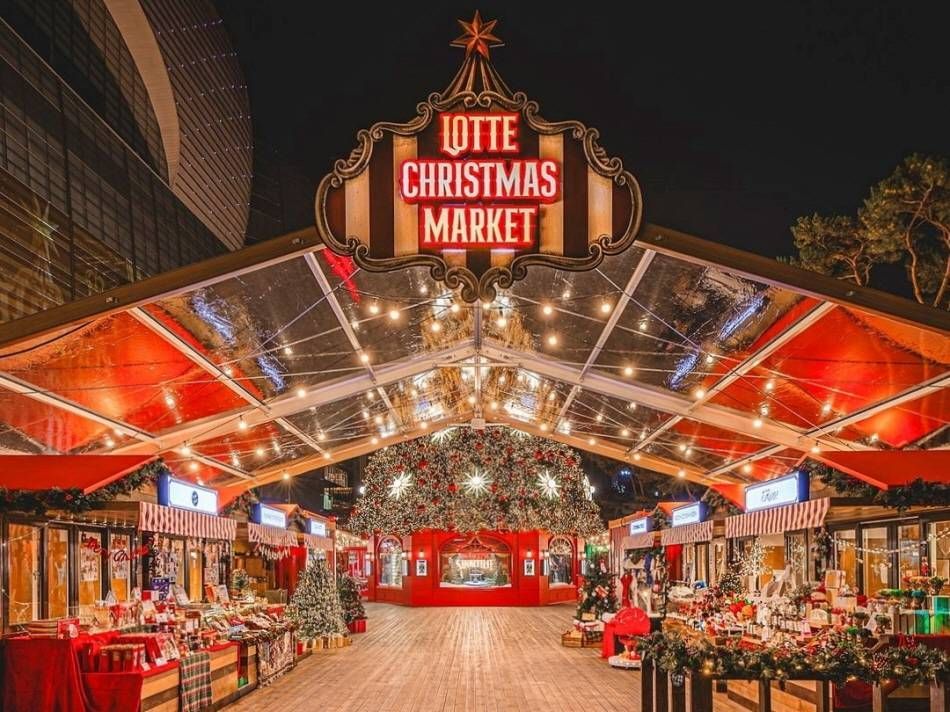
Talk to any Korean retail marketer who has worked a holiday pop-up, and they will say the same thing. The metric that matters is 인증샷 (verified photo). Not sales per booth, though sales matter. Not repeat visitors. The photo taken and posted to Instagram or Threads or Naver Blog with the market's location tag. That is the compounding acquisition mechanic. Each posted photo becomes a discovery surface for the next weekend's visitors, which is why market operators like Seoul Tourism Organization and Kolon prioritize very specific things: uniform warm-toned lighting (2700K to 3000K, never harsh white), tree placement calibrated for 9:16 phone-camera framing, food that photographs well including 크리스마스 콘 (cone-shaped ice cream), and enough negative space around the tree that a couple can pose without ten strangers in frame. The 22-meter Lotte Christmas Market tree at Jamsil World Mall Square drew 240,000 visitors in 2023 largely because NCT's Taeyong posted a selfie in front of it. That single idol photo did more for the market's opening weekend traffic than a paid ad campaign at the same budget could have delivered. This is the actual economic model behind every Korean Christmas market. Instagram is the market, the physical stalls are the studio set, and MZ couples are the productive labor generating the acquisition content the operators need for the next year.
Explore More of Korea with Daebak
Want to bring a little piece of Korean culture into your December? The Daebak Box ships the best Korean snacks, K-drama merch, and seasonal K-culture goodies straight to your door every month.


