


Table of Contents
Hi Daebak-Fam. Let's talk about the Korean travel snack, properly. Not the "here are cute Korean snacks" TikTok list. The actual working knowledge of what gets tossed into a bag before a Seoul-to-Busan drive, why 새우깡 (Saeukkang) is currently outselling every other snack in the country as of late 2025, why 소떡소떡 (sotteok sotteok, the rice-cake-plus-sausage skewer) is what you eat at the 휴게소 (rest stop) but never in the car, and how the post-2020 캠핑카 boom rewired the whole snack-industry SKU strategy. I have been covering K-food and K-lifestyle for over a decade, and travel snacks are a genuinely underrated window into how Koreans think about long trips.
휴게소 Culture: Why Koreans Snack Twice on a Road Trip
Before the picks, one bit of context most non-Korean write-ups get wrong. In Korea, a road trip is not one continuous drive. It is two eating events with a car ride connecting them. There is the 휴게소 stop (highway rest area) where you eat hot food, and there is the actual in-car snacking with dry snacks from the 편의점 (convenience store) or 대형마트 (hypermart). Those are separate meals with separate rules, and the packaged-snack industry lives and dies on the second one.
The 휴게소 side is famous for stuff like 소떡소떡 (grilled rice-cake-and-Vienna-sausage skewer glazed with gochujang-and-mustard sauce), 감자 (whole steamed potatoes with butter), 우동 (a big steaming bowl of udon), 호두과자 (walnut pastries), and grilled squid. Anseong 휴게소 is where 소떡소떡 got popularized around 2018 after comedian Lee Young-ja plugged it on TV. Those are sit-down or standing-eat foods. You do not put a hot gochujang skewer into a Kia Carnival with kids. That is the rule.
The car-snack rules follow from that. Whatever you eat while driving has to survive four conditions. First, sturdy packaging that reseals or crumples closed with one hand. Second, low crumb (no shatter chips that end up in the floor mat). Third, no melt (chocolate as a rear-window souvenir is a tragedy). Fourth, one-hand eating (the driver needs the other hand on the wheel). Every snack below passes those four tests. That is why they got picked, not because they are trendy on Instagram.
1. 꼬깔콘 (Kkokkalcorn): The Cone That Slides Onto Your Finger
Kkokkalcorn is the cone-shaped corn puff from Lotte Wellfood, and it is genuinely one of the smartest travel-snack designs Korea ever put out. Launched in 1983, it is a hollow corn-flour cone about the size of a thimble that you slide onto your fingertip and eat off. Kids in Korea have been doing the ten-finger Kkokkalcorn stack for decades. That interaction is the point. It is a snack that keeps a bored kid in the backseat busy for the length of a Kkokkalcorn bag, which is roughly one hour of highway between Seoul and Cheongju.
What makes it a proper travel pick is the corn structure. Because it is fried corn puff, not potato chip, it does not shatter under bag pressure. You can jam a Kkokkalcorn bag into a backpack side pocket and pull it out three hours later with the cones intact. The flavors matter too. The Onion Butter and Kkokkalcorn Corn Soup versions are the road-trip defaults because they are savory and not too sticky. Kkokkalcorn was the 6th best-selling snack in Korea for the first half of 2025 at 41.2 billion won in retail sales, and travel-bag positioning is a real slice of that number.
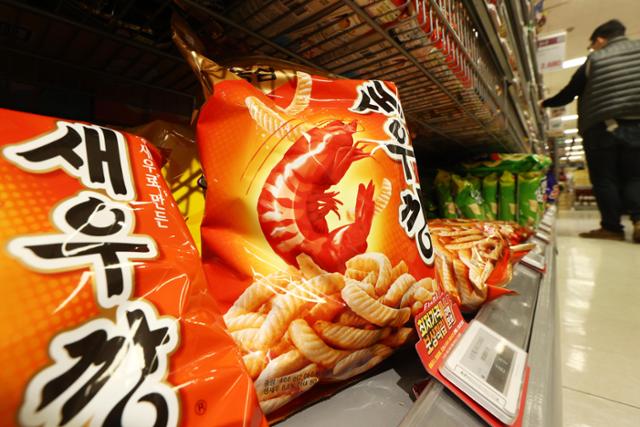
2. 새우깡 (Saeukkang): The 1971 Shrimp Cracker That Just Won the Snack Race
Saeukkang is Nongshim's shrimp-flavored cracker, launched in 1971, and if you are looking at Korea's snack market right now, this is the current champion. In the first half of 2025 Saeukkang did 57.8 billion won in retail sales, the No. 1 spot across all snack categories, second year running. That is not nostalgia buying. That is Nongshim actually pulling off a Gen Z reactivation with the KPop Demon Hunters limited-edition packaging collaboration (the Netflix animated film with the Huntrix girl group visual), which pushed Saeukkang bags into K-drama social feeds and back onto convenience-store must-buy lists.
For road-trip purposes: 90g bag, parchment-paper style outer wrapper that folds closed, low crumb (the shrimp crackers are dense, not thin chip), no melt. The taste profile is what I would call "savory umami with a light shrimp aroma," which pairs well with hours of highway monotony because it is not aggressive. You will not get palate fatigue at kilometer 200. This is the reason 새우깡 has stayed in the top 5 for decades. It works.
3. 오징어 땅콩 (Ojingeo Ttangkong): The Squid-and-Peanut That Broke Format Rules
Ojingeo Ttangkong (literally squid-and-peanut) is Orion's 1976 classic that took the airline-nut format and put a shrimp-and-squid-flavored fried batter shell around a whole peanut. Every piece is a small crunchy ball with a peanut center. The visual is the appeal: it looks nothing like a normal Korean snack. It reads more like a Japanese kakinotane or an American beer-nut than a K-snack.
The road-trip logic is peanut-forward. Peanuts do not stain fingers, do not crumble catastrophically, and travel through temperature swings without going stale. And Orion sells 오징어 땅콩 in a resealable stand pouch these days, which is the small format upgrade that matters. The old original was a rigid box, which is fine for the beer-with-friends 안주 use case but not great for a car. The pouch version fits into a door cupholder. That is a real travel-friendly redesign.
4. 초코송이 (Chocosong-i): The Mushroom-Shaped Chocolate Biscuit
Chocosong-i (초코송이) is Orion's mushroom-shaped chocolate biscuit, launched 1984, and it is the snack Korean parents actually buy for road trips with kids under 10. The design is the pitch: a little biscuit stem topped with a milk-chocolate cap, so the child bites the chocolate off first then eats the biscuit. It is a two-stage snack disguised as one piece, which stretches the eating time (important when you are trying to occupy a backseat kid). The individual mushrooms are about 2cm tall and come in a rigid tray inside a colorful box.
The travel-snack caveat is the melt risk. Chocosong-i's chocolate cap will get soft in a hot car in July. The workaround Koreans use is buying the winter-run 초코송이 Cookies&Cream version (which uses a firmer white-and-brown chocolate) or keeping the box in a cooler until you actually crack it. As of 2025 the mini variant (in a smaller pouch designed for lunchboxes and travel bags) is the way to go. Costco Korea sells them in bulk 12-pack cases specifically for road-trip families.
5. 자일리톨 껌 (Xylitol Gum): The Post-Meal Reset That Fights Drowsiness
This is the pick most road-trip lists miss. 자일리톨 껌 is Lotte's Xylitol chewing gum, launched in Korea in 2000, and it is the snack Koreans actually reach for at hour three of a drive. The chewing keeps the driver's jaw active, which is a real anti-drowsiness tool. The xylitol (from Finnish birch sugar originally) gives a cool sweetness without the sugar spike. And the Fresh Mint and Fresh Blueberry flavors do double duty as breath fresheners after your 휴게소 udon stop.
The industry side is worth flagging. Lotte's Xylitol gum was one of Lotte Wellfood's biggest export wins. It became the No. 1 Korean food-industry export by category outside of ramyeon, dominant in China and Japan (Lotte held 50-plus percent chewing-gum market share in both countries at peak). The 100-piece Xylitol bottle is a Korean travel-bag staple you will see in every long-distance driver's cupholder in Korea. If you have driven with a Korean uncle on a family trip, you have been offered Xylitol at least three times.
6. 홈런볼 (Homerun Ball): The Only Biscuit in the Top 10
Homerun Ball (홈런볼) is Haitai's hollow bite-sized biscuit filled with chocolate, custard, or strawberry cream. Launched in 1981, it is the one biscuit product currently in Korea's top 10 best-selling snacks (39.6 billion won in retail sales, first half of 2025). Every ball is roughly grape-sized, rigid, and non-crumbly. The Chocolate Homerun Ball is the road-trip pick because the chocolate is filled inside the biscuit shell, which means the biscuit takes the heat before the chocolate melts. That is a small engineering point that matters at 32 degrees Celsius outside the window.
The name is the reason it sticks in Korean cultural memory. Haitai launched Homerun Ball at the peak of KBO (Korean baseball) fandom in the early 80s, and the ball-shape-plus-baseball-branding tied it to family-outing culture. If you took your kids to a Lotte Giants game in 1985, you almost certainly bought a Homerun Ball on the way. That association got baked in. Homerun Ball still shows up in K-drama scenes where a character wants to signal childhood nostalgia, and it is still a top seller because the format (hollow filled biscuit) genuinely travels well in a bag.
7. 에이스 (ACE): The Salted Cracker That Anchors the Trip
ACE (에이스) is Haitai's plain salted cracker, launched 1974. This is not the most exciting snack on any list, and that is the point. Every Korean travel bag needs a neutral, salty, sturdy cracker as a palate cleanser between the sweeter, saltier chip categories. ACE is that cracker. Dry, mild, faintly buttery, individually sleeved in 6-cracker packs inside the outer box. You can pull a sleeve out, tear the top, eat three crackers, and stash the rest in a jacket pocket without losing crumbs.
The appeal point for a road trip is what ACE does to the palate reset. After 새우깡 (salty shrimp) and Choco Pie (sweet chocolate marshmallow), your mouth needs the mild cracker to recalibrate. Korean travel families instinctively know this. Watch a 대전 휴게소 shopping session at a hypermart and you will see ACE going into the cart alongside the flavor-heavy picks, every time. It is the shock absorber of the snack lineup.
8. 초코파이 mini (Choco Pie mini): The 50-Year-Old Global Classic in Travel Size
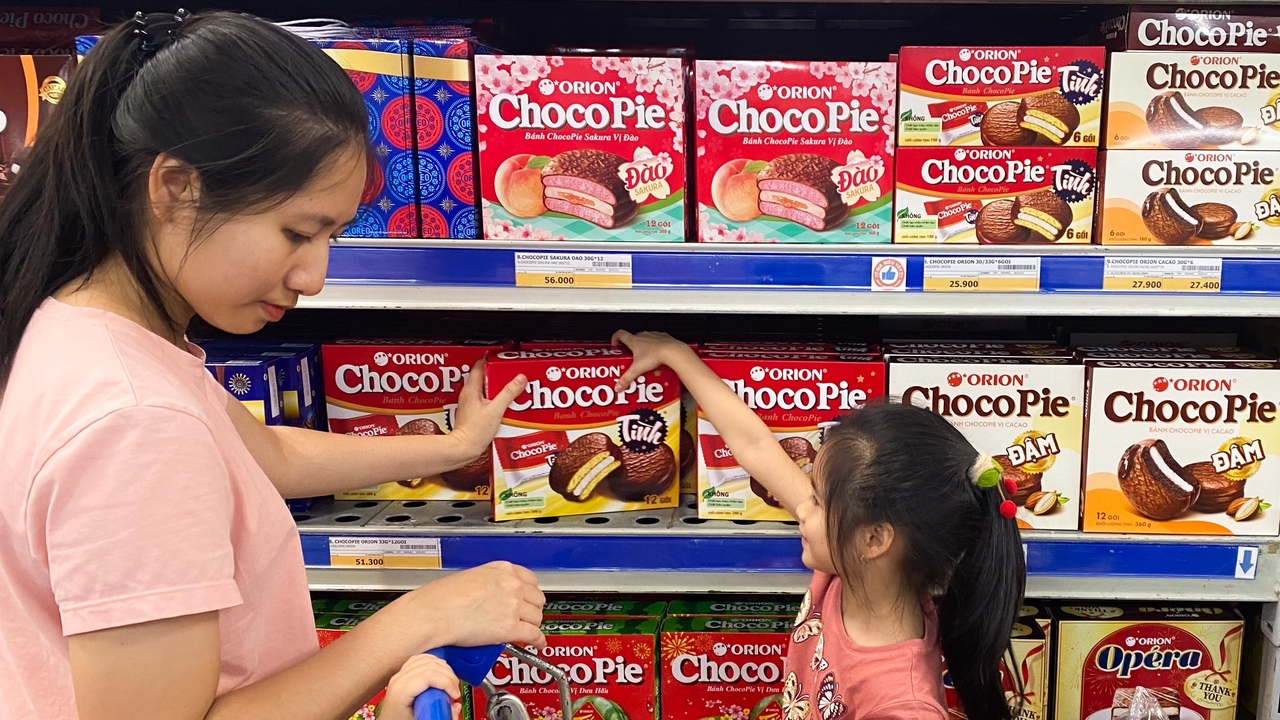
Choco Pie is the Korean snack story on a global scale. Orion launched it in 1974 as a marshmallow-filled chocolate-coated round biscuit, and in 2024 it crossed 4 billion units sold in a single year (the highest annual figure since launch), with cumulative lifetime sales past 50 billion units and 8 trillion won in revenue. 67 percent of that comes from outside Korea. Choco Pie is now sold in 60-plus countries with 24 regional flavor variants, matcha-and-red-bean in China, coconut in Vietnam, berry jam in Russia.
For a road trip, you want the mini format. The standard Choco Pie is a fine snack but too big for a car (you take three bites and you are covered in chocolate). Choco Pie mini is the same product engineered down to bite-size, one piece per individual wrapper, packed 12 to a bag. That is a snack you can eat one-handed while driving, and it will not stain your steering wheel. The Orion strategy behind mini is exactly this use case: Korean domestic travel bag, kid lunchbox, office desk drawer. It is the classic K-snack scaled to the moment.
The 500 Billion Won Travel-Snack Industry
The Korean travel-snack industry (which the trade press calls 여행 간식, travel snacks) is roughly a 500 billion won annual category and grew notably after 2020 when the pandemic drove Koreans toward domestic road trips, 캠핑카 (camping cars), and free-travel over group tours. The SKU explosion since then has been real. Every major Korean confectionery player, Nongshim, Orion, Lotte Wellfood, Haitai, Crown, launched travel-specific formats. Pouches replaced boxes. Mini versions replaced full-size. Limited-edition packaging with K-drama, K-pop, or K-content tie-ins (like the Saeukkang x KPop Demon Hunters run) became routine.
The channel side matters too. Domestic Korean snack sales split roughly between 편의점 (convenience stores like GS25, CU, 7-Eleven) and 대형마트 (hypermarts like Emart, Lotte Mart, Homeplus). The convenience-store channel is where you buy snacks in the moment (you are already on the road, you stop for gas, you grab a bag). The hypermart channel is where you stock up before the trip (multi-pack, family size). Every snack in this list dominates both channels. If it does not, it does not survive.
What Actually Goes in a Korean Road-Trip Snack Bag
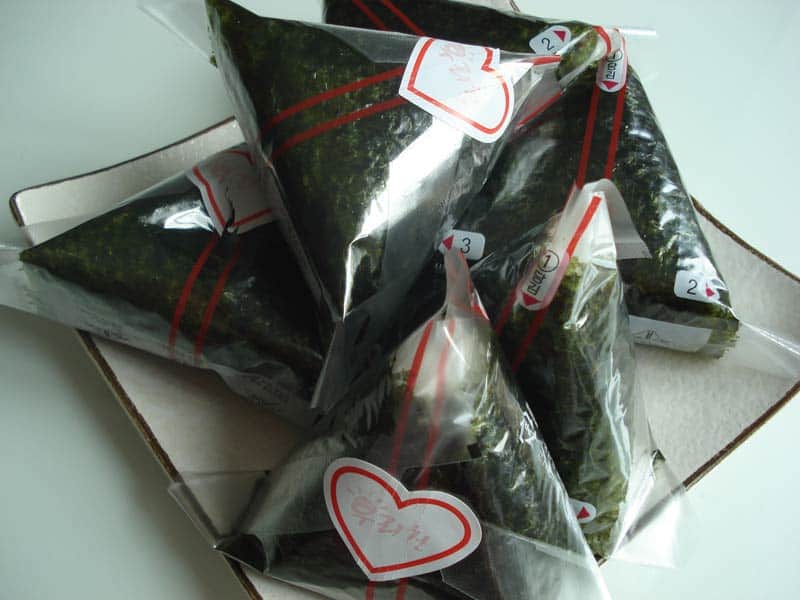
Putting it all together, the classic Korean road-trip snack bag for a family of four heading Seoul-to-Busan looks like this. One bag of 새우깡 (the anchor). One bag of 꼬깔콘 (kids). One pouch of 오징어 땅콩 (adults). One box of 초코송이 mini (a treat). One 100-piece Xylitol bottle in the driver door. One box of 홈런볼 (backup sweet). One box of ACE (palate reset). One bag of 초코파이 mini (the reserve). Plus 삼각김밥 (triangle gimbap) and 바나나우유 (banana milk) picked up at the last GS25 before you hit the highway.
That is not an arbitrary list. That is the shape of the Korean 편의점 travel-snack aisle from left to right. Every Korean parent who has done that drive more than three times has that lineup memorized. The industry knows this. That is why the Nongshim, Orion, Lotte Wellfood, Haitai top four control the road-trip market and why the SKUs stay stable across decades. A snack has to earn its slot, and once it earns it, it is very hard to displace.
Explore Korean Snacks with Daebak
Love Korean food? Get authentic Korean snacks and ramen delivered straight to your door with the SnackFever Box by Daebak.


