

Table of Contents
Spring in Korea is festival season, and not in the casual sense. From late March through May, the country runs roughly 70 official spring festivals, most of them backed at some level by the Korea Tourism Organization (KTO) or local government tourism budgets. The reason is not just civic cheer. Korean municipalities compete for a tight pool of inbound tourists, and a successful festival can lift a small county's annual visitor count by 10x in a single weekend. I have worked alongside Korean tourism marketing teams for over a decade, and the math has only gotten sharper since K-content turned Korea into a destination brand.
Three festivals carry most of the international load because they each solve a different marketing problem. Yeon Deung Hoe (연등회), the Lotus Lantern Festival, gives Korea a UNESCO-listed cultural showcase right in central Seoul. Hampyeong Butterfly Festival (함평나비대축제) gives a rural southern county a reason to exist on the tourist map. And Jinhae Gunhangje (진해 군항제) is the biggest cherry blossom event in the country, period. Here is what makes each one tick.
Yeon Deung Hoe (Lotus Lantern Festival): The UNESCO Centerpiece
If KTO had to nominate a single spring festival to represent Korean traditional culture abroad, it would be Yeon Deung Hoe, and they basically already did. The festival was inscribed on UNESCO's Representative List of the Intangible Cultural Heritage of Humanity in December 2020, which is the cultural diplomacy equivalent of winning an Oscar. The inscription was the payoff after years of lobbying through the Cultural Heritage Administration, and it gave Korea something Japan's Hanami season does not have: a globally certified cultural badge attached to a single, photographable event in the capital.
The festival traces back more than 1,200 years to the Silla period, which is the kind of provenance Western tourism boards cannot manufacture. Held on the weekend before Buddha's Birthday (the eighth day of the fourth lunar month, usually falling in April or May), it centers on a 3-kilometer lantern parade that starts at Heunginjimun Gate (the eastern gate of old Seoul), winds through Jongno, and ends at Jogye Temple, headquarters of the Jogye Order of Korean Buddhism. About 50,000 participants march carrying roughly 100,000 handheld lanterns, and around 300,000 spectators line the route. Seoul tourism numbers it as the city's single largest cultural festival by attendance.
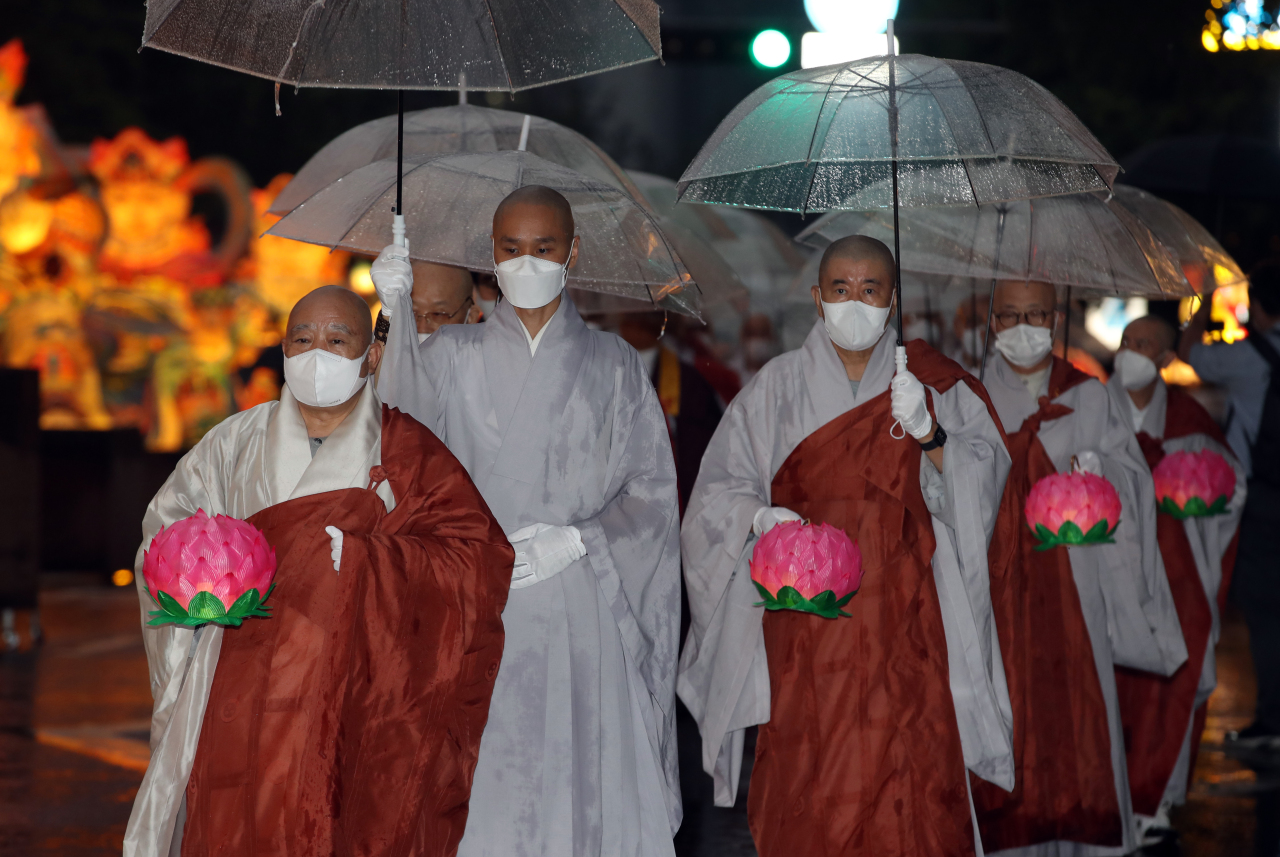
What people get wrong about Yeon Deung Hoe is treating it as purely a religious event. It is religious in origin, sure, but the modern execution is heavily produced and consciously inclusive. The Jogye Order runs lantern-making workshops where anyone can show up, learn to fold mulberry hanji paper around a bamboo frame, and carry their own lantern in the parade. Foreign tourists are not just welcome, they are openly encouraged, with English-language guides and reserved viewing zones near Jonggak Intersection. The reason is strategic. Yeondeunghoe is one of the few traditional Korean events that translates instantly on Instagram and Reels, because the visual payoff (thousands of glowing lanterns at night against Joseon-era gates) does not need a caption to land.
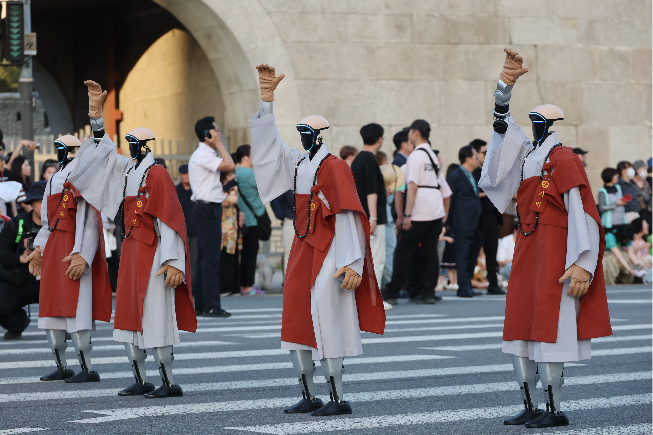
The 2026 edition added something I did not see coming. Four robot monks named Seokja, Mohui, Gabi and Nisa joined the parade alongside human monks, wearing traditional Buddhist robes with blue lights glowing on their faces. Dongguk University's AI robot monk Hyean also marched. It looked like a stunt, and partially it was, but it is also the exact kind of tradition-meets-tech framing that gets Korean cultural events into Western news cycles. CNN, AP, and Reuters all picked up the robot monk story within 48 hours, which is more international press than the festival typically pulls in a year.
Why fans love it: Yeondeunghoe is the rare Korean cultural event you can experience without speaking Korean or knowing Buddhist liturgy. You stand on Jongno at dusk, the lanterns start moving toward you, and the spectacle does the work. The appeal point is not the religious ceremony but the sensory density, candlelight on hanji paper plus the smell of incense plus the slow march of hanbok plus the muffled drum lines. It is one of the few "tradition" events in Asia that has not been over-restored into theme-park sterility, which is the part Korean culture nerds quietly appreciate.
Hampyeong Butterfly Festival: The Eco-Tourism Underdog
Hampyeong is a small county in South Jeolla Province (전라남도) with a population of around 30,000. Without the butterfly festival, it would not exist on the foreign tourism map at all. With it, Hampyeong-gun pulls in roughly 300,000 to 400,000 visitors over an 11-day spring window, which is more than 10x its resident population. This is the model rural Korean counties have been trying to replicate for two decades, and Hampyeong cracked it first.
The festival opens at Hampyeong Expo Park, a purpose-built eco-attraction with butterfly gardens, insect habitats, and flower fields. The 2026 edition opened in late April and ran for 11 days, with admission at 7,000 won for adults, 5,000 won for teenagers, and 3,000 won for children. The pricing matters because it is calibrated to be cheap enough for family day trips from Gwangju (the nearest big city, about an hour away) while still funding the next year's flower budget. Korean local festivals live and die on this calculation.
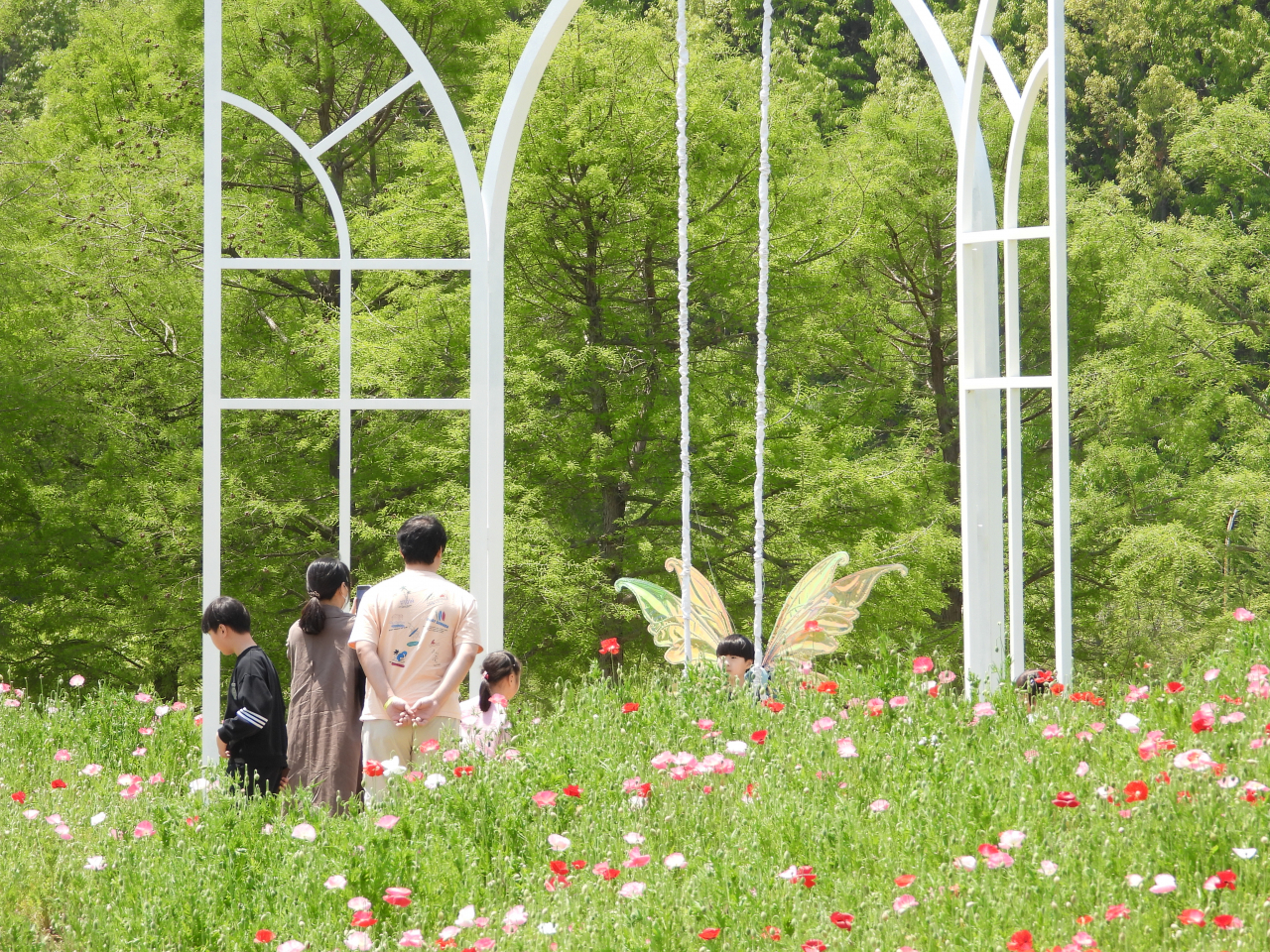
Inside the festival grounds, the showstoppers are not just the butterflies. The Butterfly Ecology Center holds specimens from around the world, the flower fields run wildflower exhibitions, and there are hands-on activities I rarely see at Western festivals: livestock feeding, milking cows, parrot feeding, banana harvesting (yes, banana, grown in greenhouses), and even pizza-making workshops. The most popular family activity is trapping butterflies in small bottles and then releasing them in the flower garden, a small ritual that doubles as the perfect 30-second Reel.
What makes Hampyeong work as a Hallyu tourism vector is that it is unapologetically a regional festival, not a Seoul export. Korean drama scouts and travel show producers (think KBS, MBC, JTBC variety shows) film at Hampyeong every spring because the visual contrast (city idol guests stepping into a field of butterflies and wildflowers) is built-in B-roll gold. That feeds back into KTO's foreign-language tourism materials. The KTO English site has highlighted Hampyeong for years specifically because it gives a credible "eco-Korea" angle to balance the K-pop and shopping content that dominates inbound marketing.
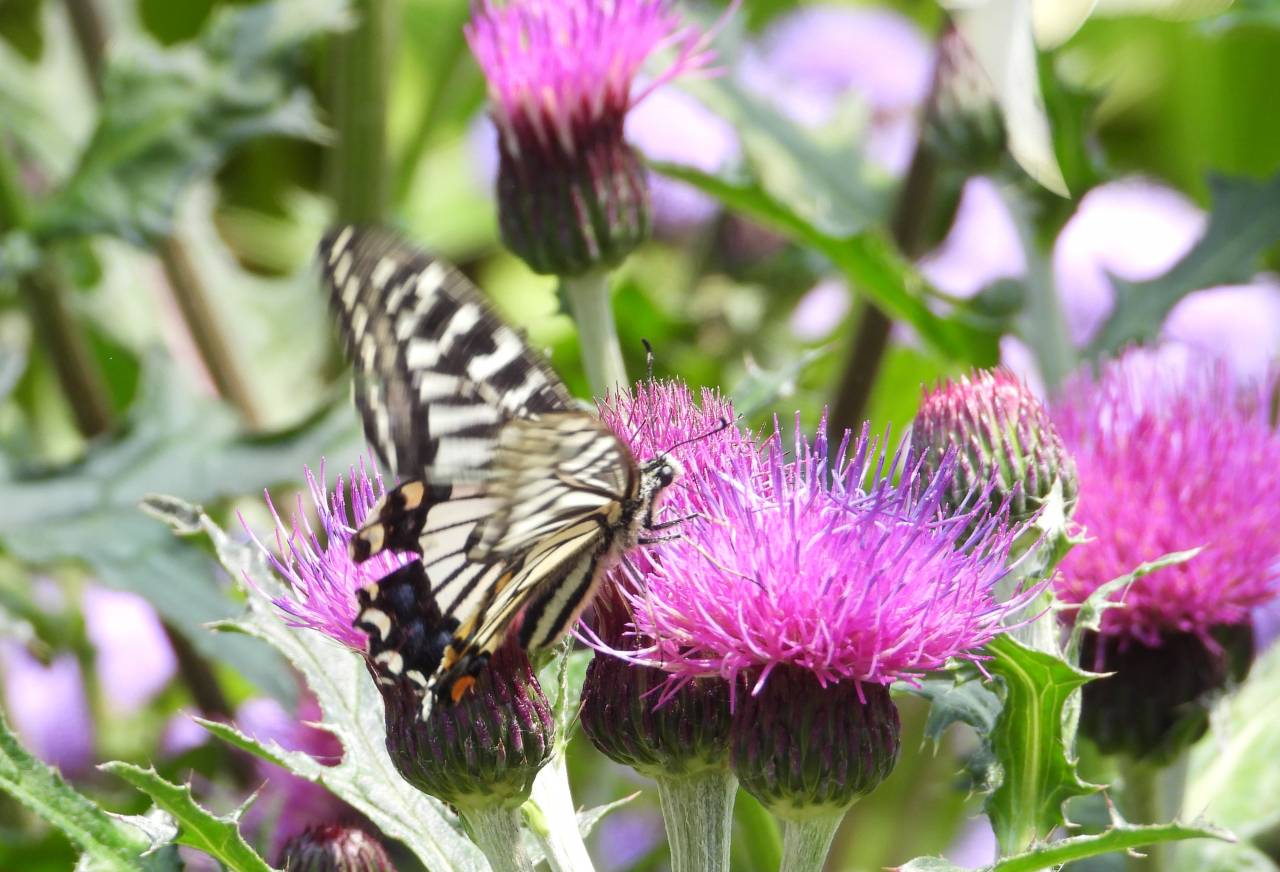
Why fans love it: Hampyeong gives international visitors something most Seoul-only itineraries miss, the texture of small-town Korea. You ride a bus through 전라도 countryside, eat 함평 한우 (Hampyeong Korean beef, a small but real regional specialty), and watch your kid run through a butterfly tent in a place that is not optimized for tourists the way Myeongdong is. It is unpolished in the best sense. That authenticity, perversely, is exactly what KTO is now selling.
Jinhae Gunhangje: Korea's Biggest Cherry Blossom Stage
Jinhae Gunhangje is the headliner. It is the country's largest cherry blossom festival, drawing more than 2 million visitors annually, and the only Korean festival routinely ranked alongside Tokyo and Kyoto for hanami-style cherry blossom tourism in regional Asia travel guides. Held in Jinhae-gu, a district of Changwon in South Gyeongsang Province (경상남도), the festival runs for about ten days from late March into early April depending on the bloom timing.
The festival's origin is the part that confuses foreign visitors. Gunhangje (군항제) literally means "Naval Port Festival," and it started in 1952 as a memorial for Admiral Yi Sun-sin (이순신), the Joseon-era naval commander who broke the Japanese navy at the Battle of Hansando in 1592. The cherry blossom angle came later, after the Republic of Korea Naval Academy in Jinhae planted roughly 360,000 cherry trees across the district as ornamental landscaping. Today the trees are why everyone shows up, and Yi Sun-sin gets the memorial wreath on day one.
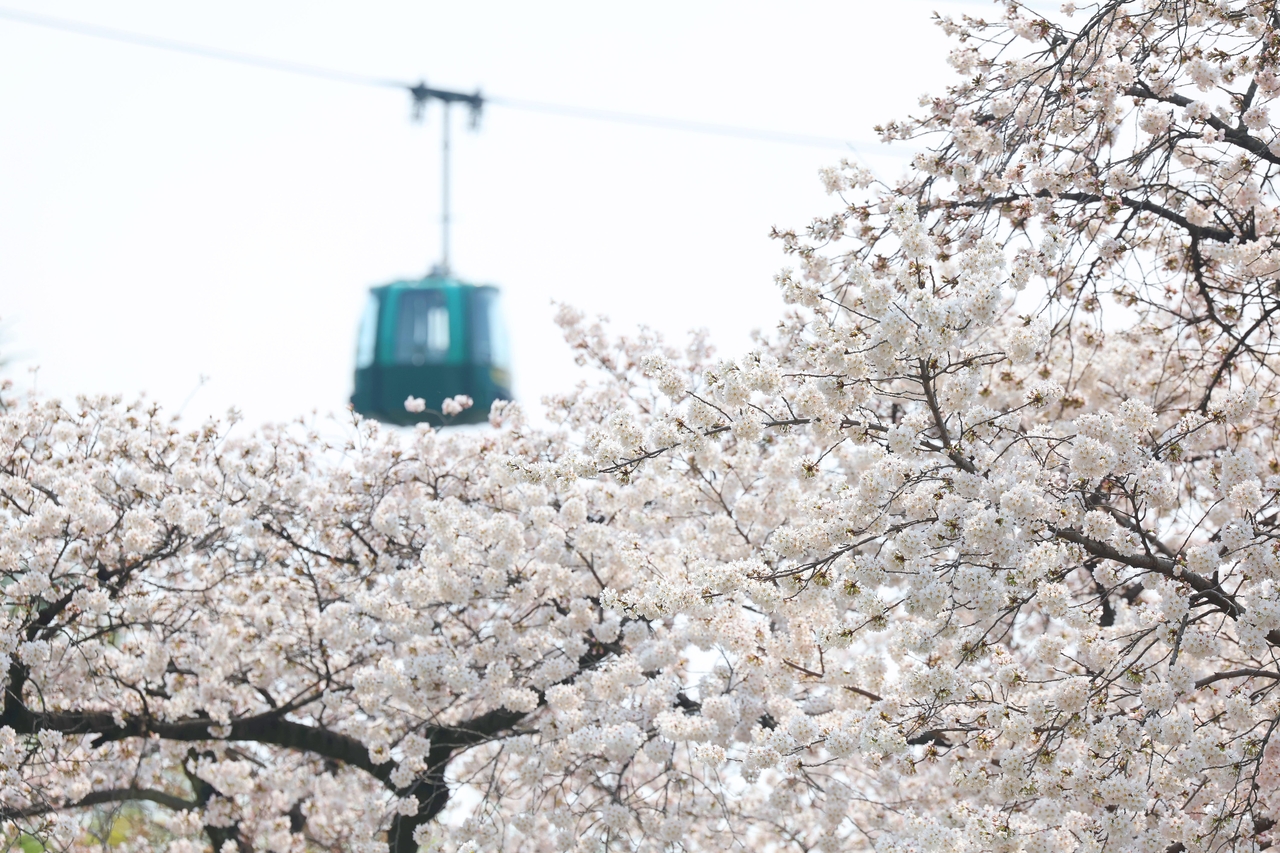
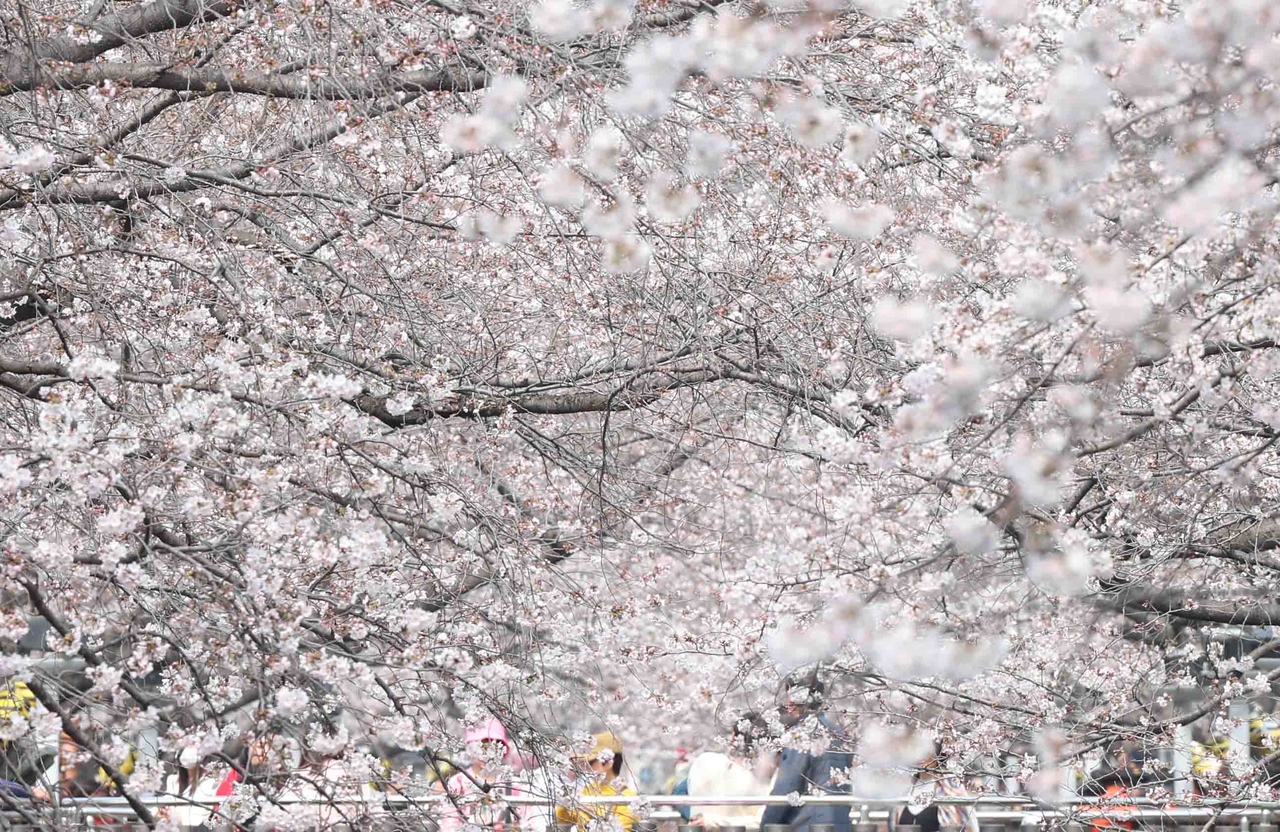
The strategic reason Jinhae became the cherry blossom destination, not Yeongdeungpo in Seoul or any number of other Korean spots with cherry trees, comes down to two specific assets. First, Yeojwacheon Stream, a narrow waterway with cherry trees planted on both banks at angles that arch across and meet overhead, creating a tunnel effect that photographs better than any other cherry blossom site in Korea. Second, Gyeonghwa Station, a defunct railway platform where cherry trees grow directly between the rails, allowing photos with a vintage Korean train against pale pink blossoms. Both spots are roughly 800 meters long, which is just enough to absorb the crowd without feeling like a single Instagram backdrop. Jinhae cracked the Instagram math before Instagram existed.
The other thing Jinhae has that nowhere else does is the special opening of the Republic of Korea Naval Academy and Jinhae Naval Base Command. Both are normally restricted military areas, but during the festival they open to the public, with cherry blossom-lined parade grounds, navy band performances, military demonstrations, and uniformed honor guard appearances. That mix (cherry blossoms plus active naval base plus historic admiral memorial) is a uniquely Korean cultural assembly that does not exist in Japan or anywhere else in cherry blossom Asia. KTO leans on this hard in foreign marketing because it cleanly differentiates the Jinhae experience from generic hanami tourism.
The 2026 festival ran from late March through early April and saw exceptionally good bloom conditions, with daytime highs hovering around 22 degrees Celsius on opening day. That weather window matters more than people realize. A cold snap in late March 2024 left Jinhae's blossom buds closed during the official festival dates, and visitor numbers crashed by an estimated 40 percent. Korean cherry blossom tourism runs on a 7 to 10 day window per location, and a single bad year of timing forces the festival economics back to square one. That is why every Korean newsroom tracks 벚꽃 개화 (cherry blossom blooming) timing the way Wall Street tracks earnings releases.
Why fans love it: Jinhae is not just about the blooms. It is about the density of the canopy at Yeojwacheon, the slight melancholic note of taking a photo on the rails at Gyeonghwa Station (the station has been defunct since 2006, and the cherry trees grew up around the abandoned platform), and the absurd-but-charming juxtaposition of a Korean naval cadet posing for couples photos under cherry blossoms. The appeal point is contrast, military discipline meets ornamental softness, that you genuinely will not see at any other cherry blossom festival in Asia.
The Bigger Picture: Why KTO Bets Big on These Three
If you map the three festivals against KTO's marketing playbook, the logic snaps into focus. Yeon Deung Hoe is the urban-cultural-heritage anchor in Seoul, sized for short-stay international visitors who want a UNESCO checkbox. Hampyeong is the regional-eco hook that gives KTO an answer to the "but where else in Korea besides Seoul" question that every long-haul tourism office hears. Jinhae is the marquee photogenic event that drives Instagram and TikTok organic reach, which is now worth more in spring acquisition than any paid display campaign.
The K-drama tourism flywheel feeds all three. KBS' Reply 1988 used Hampyeong-style rural Korea as emotional shorthand. The 2026 hit drama Doctor Slump used Jongno-area cherry blossoms in promo content that nudged Yeondeunghoe weekend bookings. And every spring at least one drama or variety show shoots a Jinhae sequence, because the visual sells itself. The pipeline runs: K-content visual hook, foreign viewer Googles location, KTO landing page captures intent, tour operator (Trazy, Klook, KKday) closes the booking. Each leg of that pipeline is intentional, and the three spring festivals are the visual hooks at the top.
If you are planning a Korea trip and you want to hit one, your decision tree is simple. Late March to early April: Jinhae, period. The blooms are time-locked and the festival is the country's biggest. Late April to early May: Hampyeong if you want eco-rural texture, or wait one more week and catch Yeon Deung Hoe if you want urban cultural spectacle. If you can do two: Jinhae on the front end of your trip, then a Seoul base for Yeon Deung Hoe two weeks later, with Hampyeong as a possible day-out by KTX-and-bus from Gwangju in between. That is the itinerary KTO would build for you if you let them.
Spring festival season in Korea is one of those things that earns the hype because the country has been refining the formula for decades and has the budget and cultural assets to keep raising the bar. Show up, take the photo, eat the festival 호떡 (hotteok) or 닭강정 (sweet-spicy fried chicken bites) from the street stalls, and notice how every detail is engineered to make you want to come back next year. That is not an accident. That is policy.


