


Table of Contents
Here is the industry read almost no international K-pop retrospective bothers with. Boyfriend, the six-member Starship Entertainment group that debuted in May 2011 and disbanded quietly in May 2019, is remembered by most Western fans as "the group with the twin members" (Youngmin and Kwangmin) and not much else. That framing misses what actually made them significant. Between June 2014 and March 2015, Boyfriend executed one of the most conceptually tight cinematic trilogies of the entire second generation: three consecutive comebacks (Obsession, Witch, Bounce) built on a single connecting spine, three Western fairy tales twisted into dark psychological horror. It was a mid-tier group under an ambitious label attempting cinematic-scale storytelling on a mid-tier budget, and the choices they made on that trilogy are the blueprint Starship later used on their flagship group, Monsta X.

The group Starship actually built, and why Boyfriend never cracked the top tier
Boyfriend debuted May 26, 2011 on Mnet's M!Countdown with their self-titled single "Boyfriend," pitched as Starship Entertainment's original "boyfriend-dol" (보이프렌드돌, the boyfriend idol) concept: relatable, romance-forward, unthreatening pretty boys engineered for the 2011 female K-pop consumer who was still processing SS501 and early SHINee-era teen romance. The six-member lineup, Donghyun (leader), Hyunseong, Jeongmin, twins Youngmin and Kwangmin, and Minwoo, was itself an industry first. Boyfriend was the first K-pop group ever to debut with twin members, and Starship pushed the "pure boy next door" (콘셉트, konsept, concept) hard in year one.
The problem is that positioning was already outdated by 2012. INFINITE was locking down synchronized dance mania, EXO was about to explode with a two city SM ecosystem launch, and BTS was two years from redefining what a small label could pull off. Boyfriend's early singles ("Boyfriend," "Don't Touch My Girl," "I'll Be There") charted respectably (Gaon top 10 for the peak track) but never converted into the kind of album sales that let a group headline domes at home. By 2013 they were pivoting hard to Japan (their J-pop debut hit Oricon top 5), which in K-pop industry code is the "Plan B" every second-gen group of their size ends up running. That decision is important context for the fairy-tale trilogy, because it explains why Starship greenlit an unusually ambitious visual concept on a mid-budget group: Boyfriend needed a domestic reset, and cheap-to-produce cutesy pop was not going to deliver it.
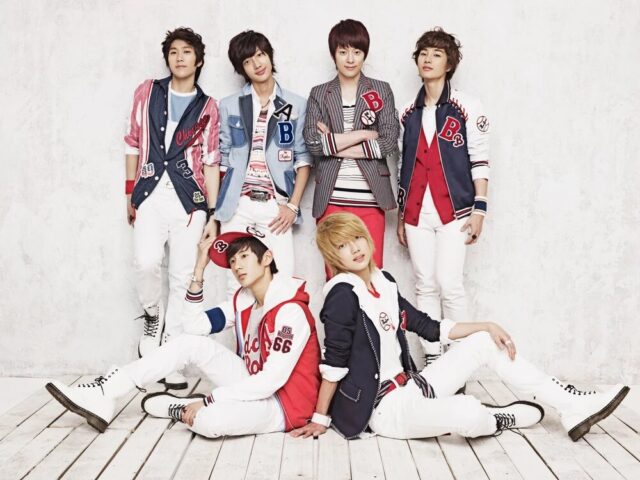
Obsession (June 2014): the Peter Pan retelling that pivoted the entire brand
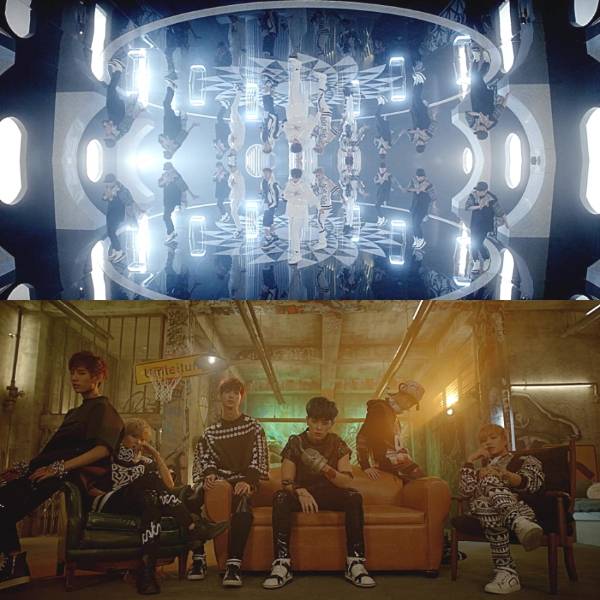
Obsession dropped June 4, 2014 as Boyfriend's second Korean EP, and it is where the fairy-tale trilogy actually starts. The music video repositions J.M. Barrie's Peter and Wendy (1911, the original novel, not the 1953 Disney softening) into a psychological thriller. Wendy is reading the actual book on screen in the opening frame. The Lost Boys are Boyfriend. Leader Donghyun plays a Lost Boy who falls for Wendy while realizing that Peter Pan (the mysterious green cloaked figure in the shadows) is not the whimsical protagonist the audience remembers. In the source novel, Peter kills Lost Boys who grow too old. The MV commits to that darkness. The Lost Boys build a bomb to take Peter out, the plan fails, and the final frame is Donghyun donning a pirate's hook, a direct visual promise that the surviving Lost Boys will become Captain Hook and return for revenge.
What makes this a genuinely sharp creative bet, not just a generic "dark concept comeback," is the fidelity to the source. The MV director trusted the audience to know the difference between Disney Peter Pan and Barrie Peter Pan, and staged the reveal (Peter Pan as antagonist) as if that gap were the actual twist. For an international K-pop fanbase raised on Disney, that gap is where the "wait, this is not the story I thought" reaction lives. That reaction is the entire hook, and it is the reason Boyfriend's global forum activity spiked visibly after Obsession compared to their earlier releases.
Witch (October 2014): Red Riding Hood as werewolf noir
Four months later, "Witch" (the third mini album's title track, released October 13, 2014) doubled down on the darker aesthetic. This time the fairy tale is Red Riding Hood, but rewritten as urban werewolf noir. Donghyun opens the MV investigating a crime scene marked "BF" (an on the nose fan wink that also functions as the group's ongoing brand mark), and a newspaper prop tells us bodies keep turning up alongside a girl in a red hood. When one of the members is ambushed by Red Riding Hood herself, the group's transformation sequence lands: canines, discolored eyes, part wolf silhouettes. The audience is expected to root for Boyfriend and hate the hunter, until a second reading of the MV suggests Boyfriend might in fact be the "witch" the lyrics warn against, and Red Riding Hood is the monster hunter keeping the city safe.
That deliberate ambiguity, where a re-watch changes the moral read, is what turns a music video into a rewatch object. It is the same "twin timeline" logic that BTS's Wings-era MVs would formalize two years later, and the same trick VIXX built their entire concept-idol identity on. Boyfriend was working in that mode a full generation earlier, and doing it on a Starship mid-tier budget rather than a big-three label's cinematic slush fund. That is the technical achievement that gets lost when second-generation Boyfriend gets flattened into "the twin boys' group" in casual K-pop history.
Bounce (March 2015): Alice in Wonderland and the trilogy's aesthetic payoff
"Bounce" closed the trilogy on March 9, 2015, as the title track of the fourth mini album "Boyfriend in Wonderland." Each member takes on an Alice character: Donghyun as the White Rabbit, Minwoo as the Mad Hatter, Hyunseong as the Cheshire Cat, twins Youngmin and Kwangmin as Tweedledum and Tweedledee, and Jeongmin as a card knight (a slightly ambiguous read, since he holds a black Nutcracker figure rather than the classic red Queen of Hearts palette). The MV opens on a girl in a red cloak (the direct callback to "Witch" is intentional and vital) entering Wonderland through a door and stealing the White Rabbit's pocket watch. Boyfriend chase her down a hole. The plot resolves less than Obsession or Witch and leans instead on aesthetics: pastel and blue Wonderland set design, a mad tea party staging, the members styled as ambiguous non human creatures.
The industry point is that Bounce is when Starship stopped trying to sell the group as "boyfriend-dol" and committed to letting Boyfriend be something stranger. That is a difficult marketing pivot for any label, and the fact that it happened on a fourth mini album (rather than a full album relaunch) is the specific budget signal. Starship wanted the visual upgrade without the album-cycle cost of a proper reintroduction. It worked at the concept level. The MV still gets pulled into Alice-in-Wonderland K-pop retrospectives on Koreaboo and Soompi a decade later, even though it did not deliver a chart-scale hit.
Why fairy-tale concepts became a K-pop mid-tier survival tactic
Zoom out from Boyfriend for a second. The fairy-tale concept trilogy is a specifically Korean industry playbook, and understanding it explains why groups like Boyfriend, later Oh My Girl ("Closer"), and eventually SEVENTEEN and TXT keep returning to it. The industry logic is cost per emotion. A dance-heavy performance MV (see: BLACKPINK's "How You Like That," EXO's "Growl") needs a top tier choreographer, a dedicated set build, and 4 to 6 shoot days minimum. Cinematic fairy tale concepts (Bounce, Witch, IU's "Twenty-Three," Oh My Girl's "Closer") can be shot in 2 to 3 days on smaller sets because the emotional load is carried by costume, color grade, and story cues the audience already knows. Ballpark, a fairy-tale concept MV in the 2014 to 2016 window ran roughly 60 to 70 percent of what a peak-tier dance MV cost, and the visual richness in the frame reads as high-budget to viewers who cannot see the compressed shoot schedule.
There is a second reason this format punches above its weight: it clears the language barrier. Boyfriend's Korean-language lyrics did not need to translate for the "wait, that is Peter Pan / Alice / Little Red Riding Hood" recognition to land internationally. This is the same principle that made Squid Game's visual language (the giant creepy doll, the red and green light game) go global before any subtitle was needed. Fairy tale K-pop concepts operate on that same universal visual shorthand principle, which is exactly why Starship kept pushing the format even when the group's chart position stayed mid tier.
The Boyfriend-to-Monsta X pipeline nobody talks about
Here is the industry insight that reframes what Boyfriend actually was for Starship (스타쉽, Starship). Boyfriend never became a top-tier commercial success, but the label's investment in them was not a loss. Starship used the Boyfriend fairy-tale trilogy to train their in-house creative team on mid-budget cinematic 컴백 (kombaek, comeback) execution, and that muscle memory got redeployed on Monsta X, who debuted May 2015, exactly two months after Boyfriend's "Bounce" dropped. Monsta X's early MVs ("Trespass," "Rush," "Hero") are visibly more ambitious than a rookie group's first outings normally are, with heavy narrative framing and set-piece staging. That is not an accident. That is Starship's post-Boyfriend visual language, deployed on the flagship boy group they were actually going to bet the label on.
This kind of internal ROI is invisible to most fandom conversations because it happens at the label-strategy level, not the group-brand level. But it is how mid-size K-pop labels stay solvent between hits. You spend the concept-experimentation money on the group that is willing to try things (Boyfriend, who had nothing to lose after their initial "cute boy" positioning stalled) and you cash in the learnings on the group you have real chart and tour ambitions for (Monsta X, who Starship pushed into US touring by 2018 and eventually got onto The Ellen Show). The Boyfriend trilogy is where that internal muscle was built. Fans of Monsta X's cinematic era owe the Boyfriend Wonderland comeback a quiet thank-you.
Why Boyfriend disbanded, and what it says about second-gen K-pop
Boyfriend officially disbanded on May 17, 2019, eight years after debut, when their Starship contracts ended and the members declined to re-sign as a group. The Korea Times covered the announcement, Starship's statement thanked fans in the standard idol-industry template, and the members posted handwritten Instagram letters that read like the polite Korean industry version of an amicable divorce. There was no scandal. There was no falling out. The math simply did not work.
This is the textbook second-generation K-pop fate. Contracts in Korean idol pop are typically 7 years (the KFTC's Standard Exclusive Contract cap), and around year 8 every group hits the same decision: renegotiate as a unit, or scatter. Groups that renew are usually the ones with either dome-scale tour income (BIGBANG, Girls' Generation to a point) or a Japan operation big enough to sustain individual careers back home (2PM, TVXQ). Boyfriend's Japan business was solid but not big enough for six people to keep splitting evenly, and their Korean chart momentum had faded by 2017. Disbandment was the rational call.

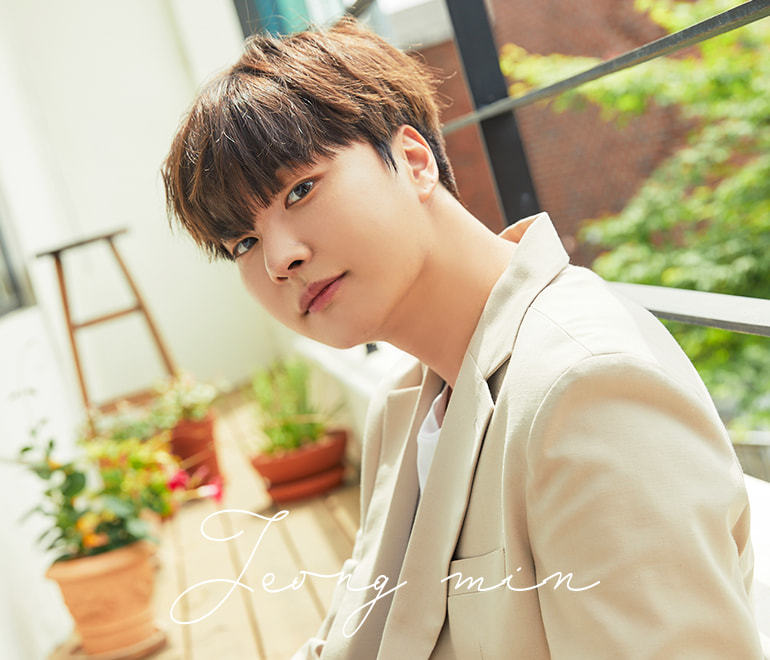
The postscript is that Boyfriend never really disappeared. Vocalist Jeongmin walked straight from the disbandment into a Herald Interview declaring he had "resorted to alcohol a lot" during the transition and then launched his own label, Araline, with the founder of Sweetune, Boyfriend's longtime producing team. In late 2021 the members regrouped under the name BF at a new agency (WESTTIME Entertainment), released a "10th anniversary" single ("Ending Credit") that was tonally exactly what the title suggested, and continued Japan-centric promotion. In February 2025 they reclaimed the "BOYFRIEND" trademark and returned to the original group name with a new single called "Time Limit." A full-group 15th anniversary comeback (mini album "Boyager 6") was slated for May 2026.
For a mid-tier second-gen group whose Wikipedia page most Gen Z K-pop fans have never opened, that is a genuinely respectable third act, and a reminder that the "fairy tale trilogy" era was never the endpoint. It was Boyfriend at their conceptual peak, and the closest the second gen ever came to treating a K-pop MV as literature.
Explore More of K-Culture with Daebak
Want to bring a little piece of Korea into your life? The Daebak Box is packed with the best Korean snacks, ramen, and cultural goodies delivered monthly to your door.


