


Table of Contents
Eating out in Korea is mostly easy. Korean servers are generally efficient and patient, English menus exist at many tourist-area restaurants, and the universal pointing strategy works almost everywhere. But knowing a handful of essential Korean dining phrases will transform a basic meal into a much warmer interaction, get you better service, and earn small smiles from Korean servers who notice the effort.
This guide walks through the most important Korean restaurant phrases for visitors and learners: how to ask for a table, how to order, how to ask for what you need during the meal, how to pay, and what to say before and after eating to follow Korean dining etiquette.

Walking Into a Restaurant
The first phrase to know is the greeting. Korean servers will almost always say "어서 오세요" (eo-seo o-se-yo), meaning "welcome." You do not need to respond verbally, though a small nod or smile is polite. To ask for a table for two, say "두 명이에요" (du myeong-i-e-yo), meaning "we are two." For larger groups, swap in se myeong (three), ne myeong (four), or da-seot myeong (five).
If you want to ask whether they have an empty table, say "자리 있어요?" (ja-ri i-sseo-yo, "is there a seat?"). For BBQ restaurants and other large group settings, you may also be asked "몇 분이세요?" (myeot bun-i-se-yo, "how many people?"), which you can answer simply with the number plus myeong.
Ordering Food
The single most useful Korean ordering phrase is "이거 주세요" (i-geo ju-se-yo), meaning "this one please." Point at a menu item or photo and use this phrase, and you are done. If you want to order multiple items, repeat the phrase or say "이것도 주세요" (i-geot-do ju-se-yo, "this one too").
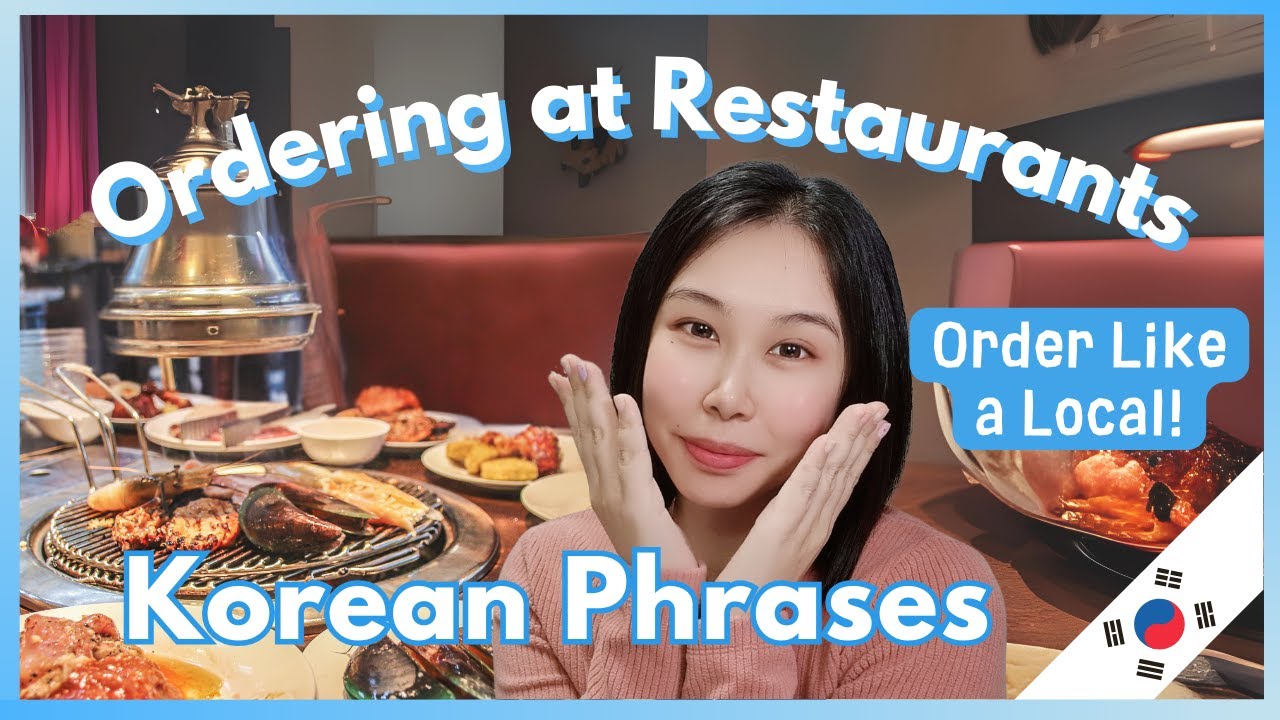
For more specific orders, learn the number-and-counter pattern: "한 개 주세요" (han gae ju-se-yo, "one of these please"), "두 개 주세요" (du gae ju-se-yo, "two please"), and so on up to ten. For dishes that come in portions, like Korean BBQ meat, the counter changes to 인분 (in-bun), as in "삼겹살 이 인분 주세요" ("two portions of samgyeopsal please").
Asking for Korean BBQ Specifics
Korean BBQ restaurants have their own vocabulary. To call the server over, the Korean approach is to raise your hand slightly and say "여기요!" (yeo-gi-yo, literally "here!"), which is direct but polite. Korean restaurants are louder than European or American ones, and calling out is normal rather than rude.

Other useful BBQ phrases include "고기 더 주세요" (go-gi deo ju-se-yo, "more meat please"), "가위 주세요" (ga-wi ju-se-yo, "scissors please") for cutting your meat, and "불 좀 키워 주세요" (bul jom ki-wo ju-se-yo, "please turn up the heat") when the grill cools down. Korean servers usually flip and trim your meat for you at upscale BBQ places, so do not feel obligated to handle it yourself.
Asking for Banchan and Refills
Korean side dishes (banchan) are free and refillable at most Korean restaurants. To ask for more, say "반찬 더 주세요" (ban-chan deo ju-se-yo, "more side dishes please") or, if you want a specific one, name the dish and add "더 주세요". Common refills include kimchi, kongnamul (seasoned bean sprouts), danmuji (pickled radish), and sigeumchi (seasoned spinach).
For water, soju, or beer, the pattern is the same. "물 더 주세요" (mul deo ju-se-yo, "more water please"), "소주 한 병 주세요" (so-ju han byeong ju-se-yo, "one bottle of soju please"), or "맥주 한 잔 주세요" (maek-ju han jan ju-se-yo, "one glass of beer please"). The container counter changes: byeong for bottles, jan for glasses, geon for cans.
The Pre-Meal and Post-Meal Phrases
Korean dining etiquette includes two essential phrases that bookend every meal. Before eating, say "잘 먹겠습니다" (jal meok-get-sseum-ni-da), which translates literally as "I will eat well" but functions like "thank you for the meal." After eating, say "잘 먹었습니다" (jal meo-geot-sseum-ni-da), "I ate well," roughly equivalent to "thank you for the meal" or "that was delicious."

These two phrases carry significant emotional weight in Korean culture. Saying them to a Korean host who cooked for you (or to the chef and staff at a restaurant) is a meaningful acknowledgment of the work behind the meal. Many Korean adults still say these phrases at every meal, even when eating alone at home.
Asking for the Bill
When you are ready to pay, say "계산해 주세요" (gye-san-hae ju-se-yo, "please ring me up") or simply "계산이요" (gye-san-i-yo, "bill please"). In most Korean restaurants, you go to the front counter to pay rather than paying at your table. The bill is usually a printed slip handed to you when food arrives or kept by the server.
If you want to split the bill, say "각자 계산해 주세요" (gak-ja gye-san-hae ju-se-yo, "please charge us separately"). Korean restaurants are increasingly comfortable with split payments thanks to mobile payment apps, but historically Korean meals were paid for by one person (often the senior at the table) as a gesture of hospitality. Tipping is not customary and may even confuse the server.
Table Etiquette Worth Knowing
A few non-verbal table rules round out the dining experience. Wait for the oldest person to start eating before you do. Do not stick chopsticks vertically into rice (it resembles a funeral ritual). Pass dishes and pour drinks with both hands when interacting with someone older. Cover your mouth slightly when chewing.

For Korean BBQ specifically, the youngest person at the table typically handles the meat (turning, cutting with scissors, distributing to plates) as a sign of respect. Pouring soju also follows the two-handed rule when serving someone older. These small gestures are not strictly required for foreign visitors but are noticed and appreciated when observed.
Putting It All Together
A typical Korean restaurant visit using these phrases looks like this. Walk in, say "안녕하세요" (hello). Say "두 명이에요" (two people). The server seats you. Look at the menu, point, say "이거 주세요". When the food arrives, say "잘 먹겠습니다". Use "여기요!" to call the server for more side dishes or water. When done, say "잘 먹었습니다" and head to the front to say "계산해 주세요". Pay and leave with a small bow.
That single sequence will get you through 90 percent of Korean restaurant visits without difficulty. Korean servers are used to international visitors fumbling through these phrases, and a little effort almost always earns warmer service than perfect English would. The phrases also serve as a friendly introduction to Korean grammar, particularly the polite verb endings that show up throughout the language.
Explore More of Korea with Daebak
Want to bring a little piece of Korea into your life? The Daebak Box is packed with the best Korean snacks, ramen, and cultural goodies delivered monthly to your door.


