


Table of Contents
Walk into a CU convenience store in Seoul at 11pm and count the SKUs on the snack aisle. You will hit 200 before you reach the second row. Almost all of them are bite-sized. Kkokkalcorn (꼬깔콘) cones, Pepero (빼빼로) sticks, Saeukkang (새우깡) shrimp crackers, small Choco Pie (초코파이) packs sized for a school backpack, yakgwa (약과) layered like poker chips in six-count trays. That is not an accident. That is a decade-plus of category engineering by the Korean confectionery industry, and it is why 과자 (gwaja) has become one of Korea's most under-appreciated cultural exports.
I have spent more than ten years around the K-content and Korean CPG side of things, watching this play out from the marketing meetings up. The bite-size format is not just a design choice. It is a distribution weapon. Small pieces mean easier customs classification, better retail shelf economics, longer shelf life, and, critically, better share-ability on camera. When a NewJeans member cracks open a bag of Pepero on Weverse, the visual reads instantly to fans in São Paulo, Manila, and Berlin. That legibility is worth more than any traditional advertising Korean firms could buy.

Pepero and the invention of a snack holiday
Lotte Wellfood launched Pepero in 1983 as a fairly transparent Pocky copy. Glico has sued more than once over the resemblance. But the story that actually matters was reported by The Korea Times: back in November 1996, teenage girls in North Gyeongsang Province had started exchanging Pepero boxes on November 11 because the four "1s" in 11/11 looked like Pepero sticks lined up on a table. It was a bottom-up teenage joke. Lotte, to their credit, did not manufacture the holiday. Their sales team in South Gyeongsang noticed the November spikes, told headquarters, and Lotte rolled out the branded Pepero Day campaign in 1997.
Today Pepero Day drives more than half of Pepero's annual Korean sales in a single week. Over ₩50 billion in confectionery moves through Korean retail in the first two weeks of November, and the tail extends into flowers, wine, and small paired gifts. Ezaki Glico watched all of this play out and copied the format backwards, designating November 11 as "Pocky and Pretz Day" in 1999. The student had lapped the teacher.

Why does it work outside Korea? Because the shape does the emotional labor. Pepero is not a pretzel-stick cookie so much as a lightweight excuse to hand something to someone you like without having to say you like them. Ambiguity, not chocolate, is the actual product. Stray Kids serving as brand ambassadors is a smart choice, because their fandom skews younger and more international, and the eight-member limited-edition packages are collector items before they are food. Pepero is now sold in about 50 countries, and in the first half of 2025 export sales overtook domestic sales for the first time. That is not a snack company. That is a soft-power vehicle.
Choco Pie and the export of 정 (jeong)
Orion's Choco Pie hit its 50th anniversary in 2024. Cumulative units sold: over 50 billion. Cumulative revenue: over ₩8 trillion (about $6 billion). Sixty-seven percent of that revenue came from overseas markets. Vietnam treats Choco Pie as ceremonial food used in ancestral rites, of all things. Russians grew up on the berry jam variant. In China it has topped the Customer Recommendation Index for the snack pie category seven times.
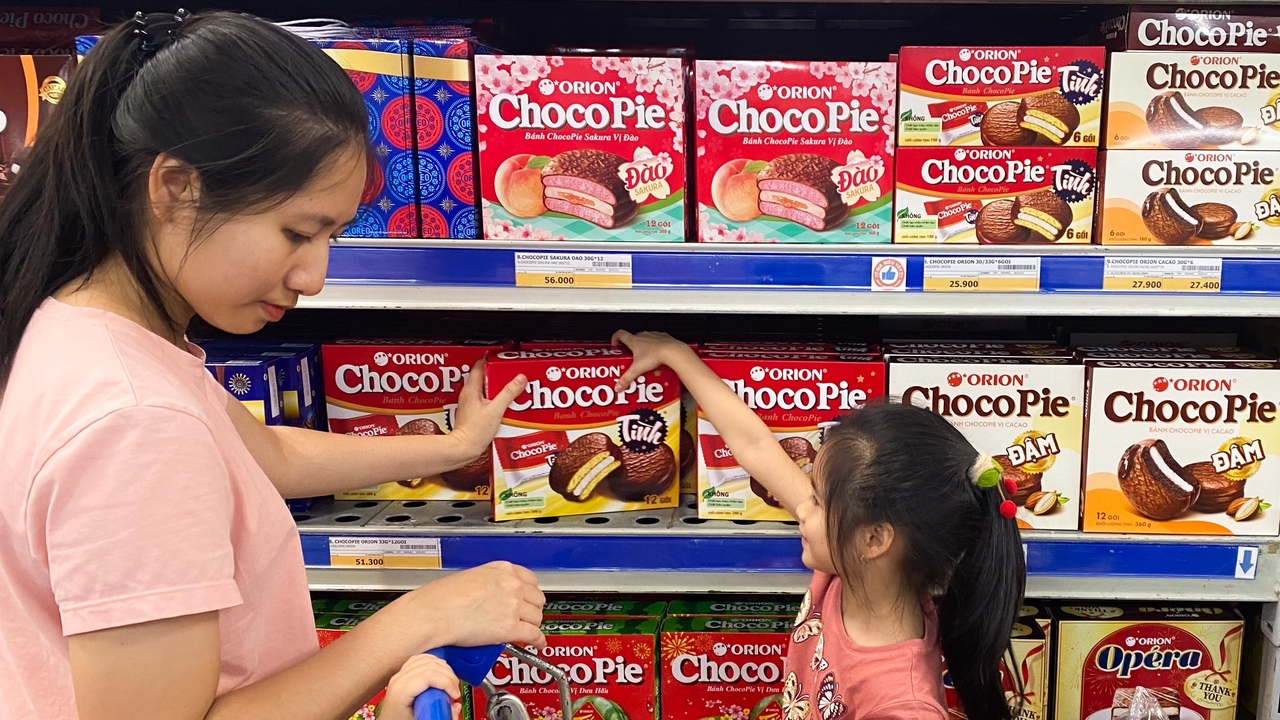
The real Orion move was not the pie. Anyone can produce a chocolate-coated marshmallow sandwich. The move was branding the product around 정 (jeong), a Korean word that roughly translates as "the deep, quiet affection you accumulate with someone over time." When Orion runs Choco Pie TV spots in Korea, they are almost always about a father slipping one to his kid, a coworker leaving one on a colleague's desk, a mother packing one into a lunchbox. They sell an emotion, not a snack. Then they localize the emotion with matcha and red bean in Shanghai, coconut in Hanoi, berry jam in Moscow. Same feeling, different flavor grammar. That is category-defining brand work, and it explains why the copycat Lotte Choco Pie (launched 1979, five years after Orion's) has never caught the original despite decades of trying. Emotional real estate, once claimed, is very hard to steal.
Kkokkalcorn, Saeukkang, and the savory backbone
The Korean snack pantheon is not all chocolate. The savory side is arguably where the export playbook got sharpest. Nongshim's Saeukkang, launched 1971, is the oldest packaged snack still on the Korean market. It hit ₩57.8 billion in H1 2025 alone, making it the country's number-one selling snack product for the second consecutive year, per Food Industry Statistics Information. Orion's Poka Chips followed at ₩54.4 billion. Choco Pie at ₩47.8 billion. Pepero at ₩42.6 billion. Kkokkalcorn, Lotte Wellfood's cone-shaped corn puff (launched 1983, same year as Pepero), came in at ₩41.2 billion.

The Saeukkang moment worth studying is the "KPop Demon Hunters" scene where Zoey, the vocalist of the fictional group Huntrix, hungrily rips open a bag of shrimp crackers. Netflix's captions labeled them "potato chips," but every Korean viewer clocked the exact packaging in half a second. Nongshim rushed out a KPop Demon Hunters collab pack in weeks. This is what a decade of K-content investment does for a snack brand: your product becomes a legible cultural signifier that a Sony animation team can drop into a film without a licensing conversation, and you monetize the retro-fit collab on the back end. The appeal is not the shrimp flavor (it is mild, honestly). It is the crunch profile, that specific hollow-inside crackle that Korean drama snack sound designers have been amplifying for years. Once you have heard it on screen, the bag is a memory trigger.
Kkokkalcorn plays a similar role with a different cohort. The salty-sweet corn cone is aggressively nostalgic for anyone who grew up in Korea in the 1990s or 2000s. This is why Lotte launched the Kkokkal Cone MAD HOT gochujang charcoal-grilled variant in 2025: pull the same buyer back with a spicier reboot, and let their kids find it too. Nostalgia plus a small twist is the Korean CPG playbook in one sentence. Homerun Ball (choux puffs, Haitai), Choco Songyi (mushroom-shaped chocolate biscuits, Orion, called Choco Boy in English) and Ppushu Ppushu (crush-in-bag noodle snack, Ottogi) all run the same play. Idols endorse them not because the checks are big but because the products signal "I grew up here too," which is the most valuable emotional beat a K-pop group can hit.
Yakgwa: a thousand-year-old cookie has a Gen Z moment
Then there is yakgwa (약과). Deep-fried wheat cookie soaked in ginger honey syrup, layered like a laminated pastry, garnished with pine nuts and thin ginger threads. Koreans have been making these for over a thousand years, since the late Silla Dynasty. The name literally means "medicine confection" because honey was so scarce and expensive in premodern Korea that it was classified as medicinal. Goryeo Dynasty kings actually banned commoners from making yakgwa at one point because the ingredients were being consumed too fast for royal supply.
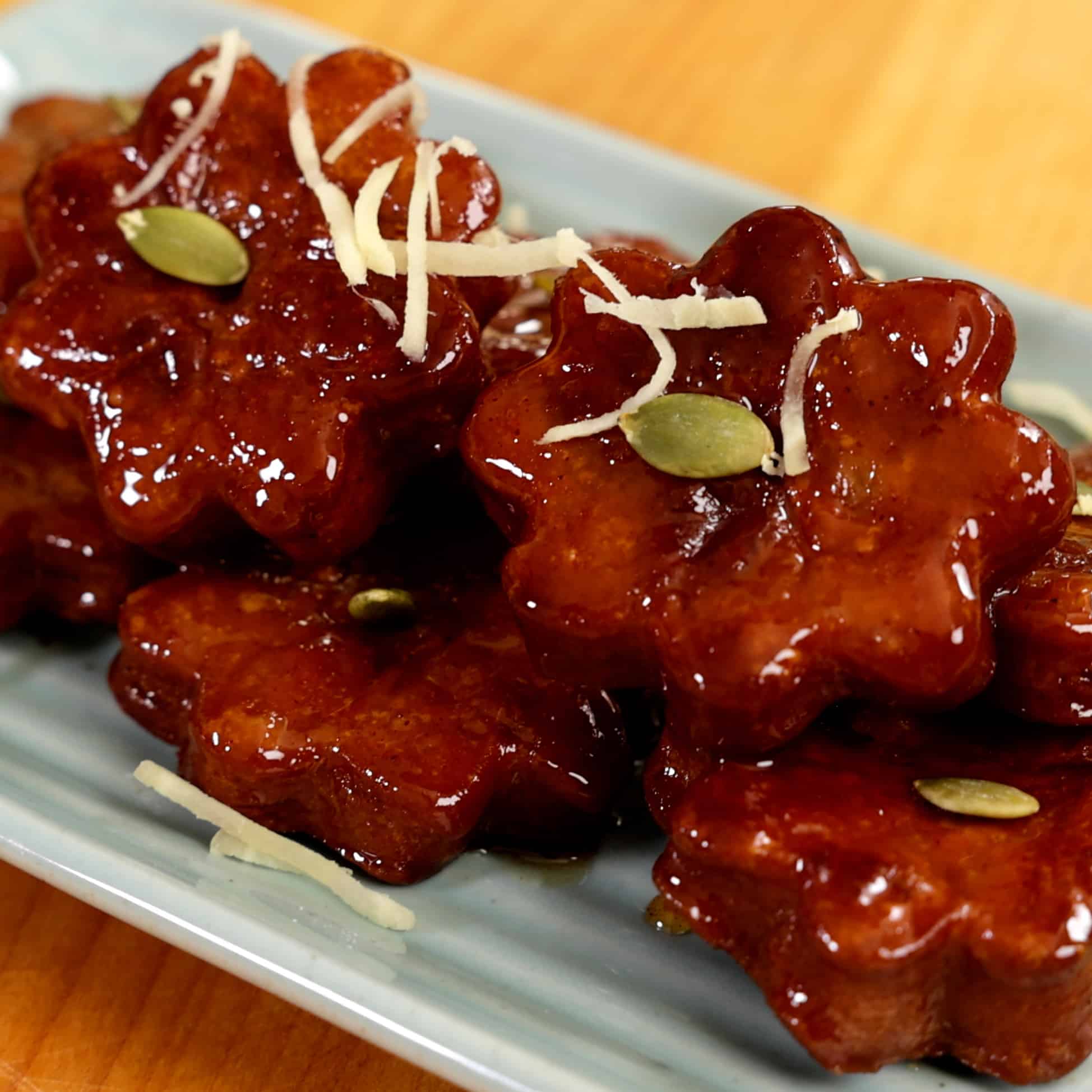
Fast forward to 2022, and yakgwa became a full-blown Gen Z trend in Korea. Cafés in Seongsu-dong started stacking yakgwa lattes, yakgwa croffles, and yakgwa on top of Basque cheesecake. TikTok mukbang creators queued for hours at Kkulmatjib and other legacy bakeries. The Maangchi yakgwa recipe (which remains the canonical English-language recipe on the internet) has racked up over 300,000 YouTube views. What actually happened? Korean Gen Z reclaimed a "grandmother's food" as an aesthetic object. The layered honey-soaked interior photographs beautifully, the ginger heat plus pine nut garnish reads as slow-food virtuous compared to industrial snacks, and in a country where young workers are stressed and overburdened, yakgwa signals care, ritual, and craft in a way a Pepero stick cannot.
What makes yakgwa specifically Korean, and not just "another fried honey cookie," is the layering technique. You do not knead the dough. Kneading builds gluten and makes the cookie chewy. Instead you press, stretch, fold, press again to laminate the dough so it forms distinct sheets. That is what creates the crumbly-yet-juicy 쫄깃 (jjolgit) bite that a Filipino biscocho or a Middle Eastern ma'amoul cannot replicate. The syrup soaks into the layers instead of just coating the surface. The ginger threads on top are not garnish, they are a palate cleanser between the sweet honey punch and the sesame oil finish. Every element is doing textural work. That is why Korean Gen Z picked it up. It rewards attention.
The through-line: bite-size is the strategy
Look at the whole shelf again: Pepero, Choco Pie, Kkokkalcorn, Saeukkang, yakgwa. Different price points, different eras, different production methods. One thing in common: they are all portion-controlled, share-first, camera-friendly, and built around a specific emotional register that translates in one caption. Korean snack exports hit roughly $8 billion in annual value in 2024, and the bite-size format is not incidental to that number. It is the reason the number exists.
The Squid Game dalgona scene made Korean tourism officials scramble to put dalgona candy kits in every Incheon airport souvenir shop within months. The KPop Demon Hunters Saeukkang cameo did the same for Nongshim's export division. If you are betting on which Korean CPG category will keep translating cleanly through screens for the next decade, my money is on the bite-size stuff. Small enough to hold up to the camera. Loud enough in flavor to survive being described in one sentence. Cheap enough to ship globally without spoiling. That is a hard combo to beat, and Korea has been iterating on it for fifty years.
Craving your own bite-sized adventure? Every month, our SnackFever Box ships hand-picked Korean snacks straight from Seoul, including seasonal Pepero flavors, limited-edition Choco Pies, Kkokkalcorn variants, Saeukkang collab packs, and modern yakgwa when the bakeries can keep up with demand. Try them before the next K-drama makes them impossible to find on Amazon.


