


Table of Contents
Doljanchi (돌잔치) is the Korean first birthday party, a ritual that has marked the most important milestone in a child's early life for centuries. The word combines dol (돌), meaning the full circle of one year, and janchi (잔치), meaning feast. The day honors a baby's survival through a vulnerable first year and asks family and ancestors to bless the child with health, wealth, and a long life.
The Origins of Dol and Why the First Year Mattered
The tradition has been recorded since the early Joseon period. Before modern medicine, Korean infant mortality was severe. By some accounts, a quarter of all babies in the 1950s did not reach age one, and earlier centuries were worse. Reaching twelve full months was not assumed, so families marked the day with rituals of gratitude and protection.
Households would first prepare a samsinsang, a small offering table for Samsin, the household goddess who watches over children. Only after thanking Samsin did the family move on to the celebration table, the dolsang. The structure of the day, ritual offering first and feast second, still shapes modern doljanchi.
The Dol Hanbok: Dressing the Birthday Baby
For many Korean families, the doljanchi is the day a child wears a full hanbok for the first time. Boys are typically dressed in a striped saekdong jeogori jacket, baji trousers, and a sagyusam or vest, topped with a bokgeon or jobawi cap. The colors lean toward blues, indigos, and rich crimsons.
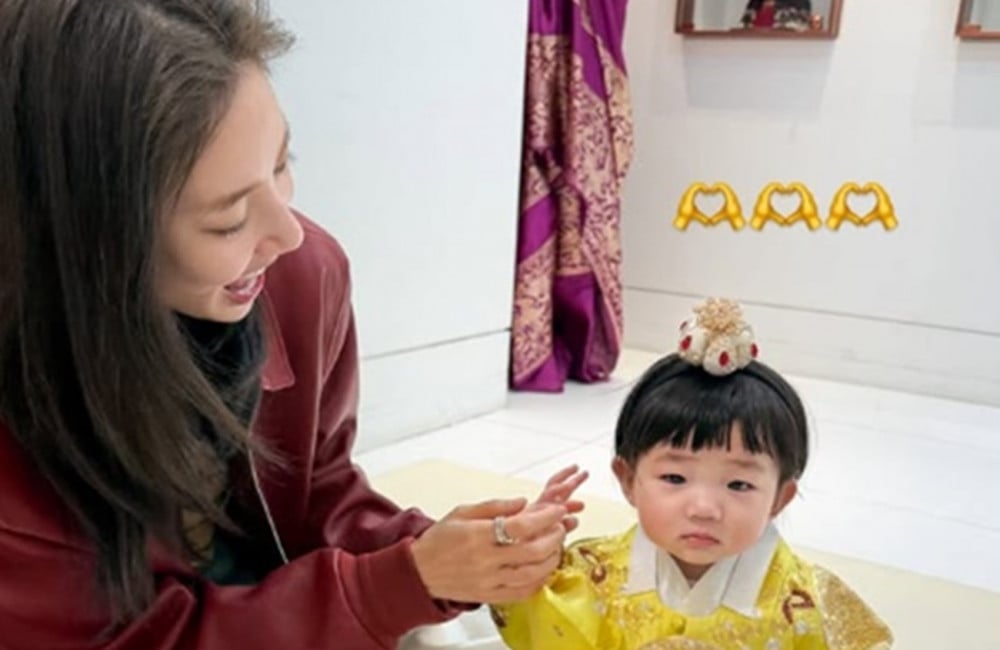
Girls wear a colorful jeogori with a long red chima skirt and often a jokduri or jobawi headpiece embroidered with floral motifs. Tiny embroidered tarae beoseon socks complete the outfit. Singer Son Dam Bi recently shared photos of her daughter Haei's hanbok fitting ahead of her doljanchi, the kind of post that fills Korean social feeds every spring.
The Dolsang Table
The dolsang (돌상) is the centerpiece of the party. Two categories of items fill the table: ritual foods and the doljabi objects. Foods are stacked tall in symbolic shapes. White baekseolgi rice cake represents purity. Multicolored mujigae-tteok, the rainbow layered cake, signals harmony. Red bean susu kyeongdan balls are believed to ward off bad spirits, while long noodles and skeins of white yarn represent a long life.
Beside the food are seasonal fruits, jeon, jujubes, and yakgwa. In the past, the dolsang sat in the anbang, the main inner room of a hanok. Today it is more often a styled display in a banquet hall or studio, but the symbolic logic of each item has not changed.
The Doljabi Ritual: A One-Year-Old's Prophecy
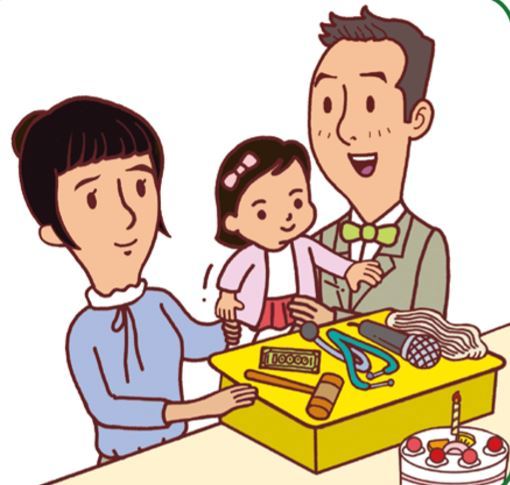
The most anticipated moment of the day is doljabi (돌잡이). A row of objects is placed before the baby, who is encouraged to crawl forward and grab one. The first item the child picks is said to foretell their future path.
The traditional set includes:
- 실 (sil, thread): a long life
- 돈 (don, money): wealth
- 책 (chaek, book): a scholar or successful student
- 쌀 (ssal, rice): abundance and never going hungry
- 활과 화살 (hwal-gwa hwasal, bow and arrow): a warrior or military career, traditionally for boys
- 바늘과 자 (needle and ruler): household skill, traditionally for girls
Modern parents add objects that match today's careers. A 청진기 (cheongjingi, stethoscope) points to a doctor, a 마이크 (maikeu, microphone) to a singer or entertainer, a 골프공 (golpeugong, golf ball) to a sports star, a gavel to a judge, and a computer mouse to a software engineer. The ceremony is now a family game as much as a prophecy, and the choices say as much about the parents' hopes as the child's future.
Celebrity Doljanchi and Pop-Culture Influence
Korean reality television has turned celebrity first birthdays into national events. On the December 2, 2018 episode of KBS's The Return of Superman, comedian Sam Hammington and his family celebrated his son Bentley's first birthday. The brothers, Bentley and William, posed for a photo shoot in traditional clothing including Joseon-era scholar robes and royal attire. At the doljabi table, Bentley hesitated over the rice before grabbing the gavel, which signals a future as a judge or high public official.
Tablo's daughter Haru and Choo Sarang, the half-Japanese half-Korean daughter of MMA fighter Choo Sung-hoon, were also introduced to global audiences through the same show after their dol years. Their families' celebrations helped popularize the modern doljanchi look, mixing Korean tradition with Western party design.

From Home Ritual to Catered Banquet Hall
Modern doljanchi look very different from a Joseon-era home ritual. Through the 2000s and 2010s, the celebration scaled up into a wedding-style event. According to The Korea Herald, one banker in the mid-2010s spent over 3.5 million won, invited more than 150 guests to a hotel banquet hall, served 40,000-won catered meals per head, and hired a professional emcee and photographer.
That model is now under pressure. A 2016 Petit Elin poll found that over 30 percent of mothers with infants under one year old did not plan to host a doljanchi, with most calling the parties a show of vanity. Korea Bizwire reported in late 2025 that inflation and soaring gold prices have pushed many families toward smaller home meals, modest studio photo sessions, or charity donations in lieu of a party.
Themed Photoshoots and the New Doljanchi Industry
Even families who skip the banquet hall rarely skip the photos. Korean studios offer themed dol photo packages with full hanbok, Western tuxedos and dresses, and styled dolsang backdrops. Themes built around Disney characters, royal court attire, and minimal modern color palettes have grown popular on Instagram. The dol towers, multi-tier displays of dduk rice cakes and macarons, have become a central feature of many parties, often custom-ordered weeks in advance.
Pre-packaged doljanchi kits sold through online malls let parents host smaller home parties without sacrificing the visual symbolism. The kits typically include a styled tablecloth, a printed dolsang sign, a set of doljabi objects, and a paper hanbok for backdrop photos.
Doljanchi Gifts and Etiquette
Traditional doljanchi gifts emphasized longevity. A pure gold ring, the geumbanji, was the standard, placed on the child's finger as a wish for health and prosperity. Family elders often gave a 24-karat ring around 3.75 grams, called a don in Korean weight measure. As gold prices have climbed, many guests now give cash or a half-don ring instead, and some families request gold-themed greeting cards rather than physical rings.
Etiquette for guests is similar to a Korean wedding. Bring a clean envelope of cash, dress neatly but not in white, and avoid taking the focus off the child. Coworker invitations are increasingly considered a financial burden in Korea, and the 2016 Kim Young-ran anti-graft law sets clear limits on doljanchi gift values for officials, journalists, and teachers.
Doljanchi in the Korean Diaspora
Doljanchi has spread with the Korean diaspora to the United States, Canada, Australia, and beyond. Korean American families in Los Angeles, New York, and Toronto have built a small industry of dol photographers, hanbok rental shops, and rice cake bakeries. Many diaspora celebrations are hybrid affairs, mixing Korean rituals with Western birthday cake and English-language signage.
The format varies by region. A Hawaii-based Korean family might host an outdoor luau-style dol with Korean foods. A Korean American family in Chicago might book a hotel ballroom with a full dolsang plus a Western cake-smash session. Regardless of the setting, the doljabi remains the constant ritual, the moment that anchors a global Korean family identity in a single childhood tradition.
Explore More of Korea with Daebak
Want to bring a little piece of Korea into your life? The Daebak Box is packed with the best Korean snacks, ramen, and cultural goodies delivered monthly to your door.


