


Table of Contents
Ask any Korean travel agent what changed after 2020 and you'll hear the same answer: 제주도 (Jeju) went from honeymoon-and-tangerine cliche to Korea's most obsessed-over adventure playground. When mainland borders slammed shut, Jeju stayed open, and the domestic tourism spend that would have gone to Osaka or Bali funneled into the island instead. The result: roughly 8 trillion won in annual tourism receipts and 13 million visitors a year rolling through Jeju International Airport in the post-pandemic recovery. I've been in the K-content and travel space for over a decade, and the real shift wasn't the numbers. It was what people came to do. The Instagram-and-cafe crowd is still there. What exploded underneath it is the outdoor Jeju that locals always loved: summiting Hallasan before sunrise, walking a section of 올레길, chasing 오름 in golden hour, and diving with 해녀 grandmothers who have worked the same reef for fifty years. This is the version of Jeju worth the flight.
한라산 (Hallasan): the summit worth setting an alarm for
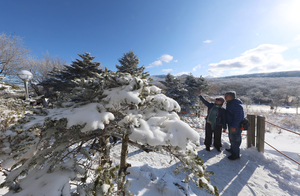
Every Korean has an opinion on 한라산, and most of them are wrong until they hike it. At 1,947 meters it is the tallest mountain in South Korea, a dormant shield volcano crowned by 백록담 (Baengnokdam), the crater lake that gives the summit its dreamy calling card. The full round-trip via the Seongpanak or Gwaneumsa trail runs 10 to 12 hours, and the park closes the summit push at 11:30 a.m. so hikers descend before the mountain's weather rolls in. That's the operational reality most guides skip: you leave the trailhead by 6 a.m. or you don't see 백록담.
What makes it worth the alarm clock is the layer-cake ecology. You start in temperate forest, move through cloud-belt fern zones, and top out in an alpine band that shouldn't exist this far south. In winter the whole thing turns into a Ghibli painting, and Korean hikers plan entire weekends around a single snow-day photo. Locals will tell you the shorter Eoseungsaengak trail is a warm-up, not a substitute. They're right.
올레길 (Olle Trail): the slow-travel pilgrimage locals actually finish
올레 is Jeju dialect for the narrow path from your gate to the road, and that's exactly what the trail feels like: an insider's shortcut through somebody's backyard. The full network is 425 kilometers spread across 26 numbered routes, half coastal cliff-walk and half oreum-and-village. Route 7 (Oedolgae Rock to Wolpyeong Village) took top spot in a Jeju Olle Foundation survey of 2,778 thru-hikers who finished every route, and it's the trail U.K. magazine Active Traveller named among the world's Top 10 Coastal Walks.

The appeal isn't just scenery. Founder Suh Myung-sook modelled Olle on Spain's Camino de Santiago after her own burnout sabbatical, and the routes are stitched with intent: a bench where the light hits at 4 p.m., a farmer's stall selling one thing, a shrine you'd never find otherwise. Korean walkers pick off one route per weekend and stamp a passport. Foreign hikers usually pick Routes 7, 10 or 18-1 and call it life-changing. Both approaches work.
오름 (Oreum): the mood-hike locals treat like cafe-hopping
오름 are Jeju's obsession no visitor understands until they've climbed one. These are parasitic volcanic cones (roughly 360 scattered across the island) formed by side vents on the Hallasan magma system, and they look like green thumbprints painted onto the landscape. The two you'll actually climb are 새별오름 (Saebyeol) and 용눈이오름 (Yongnuni), but the airport-adjacent 도두봉 (Dodubong) is the easy warm-up.
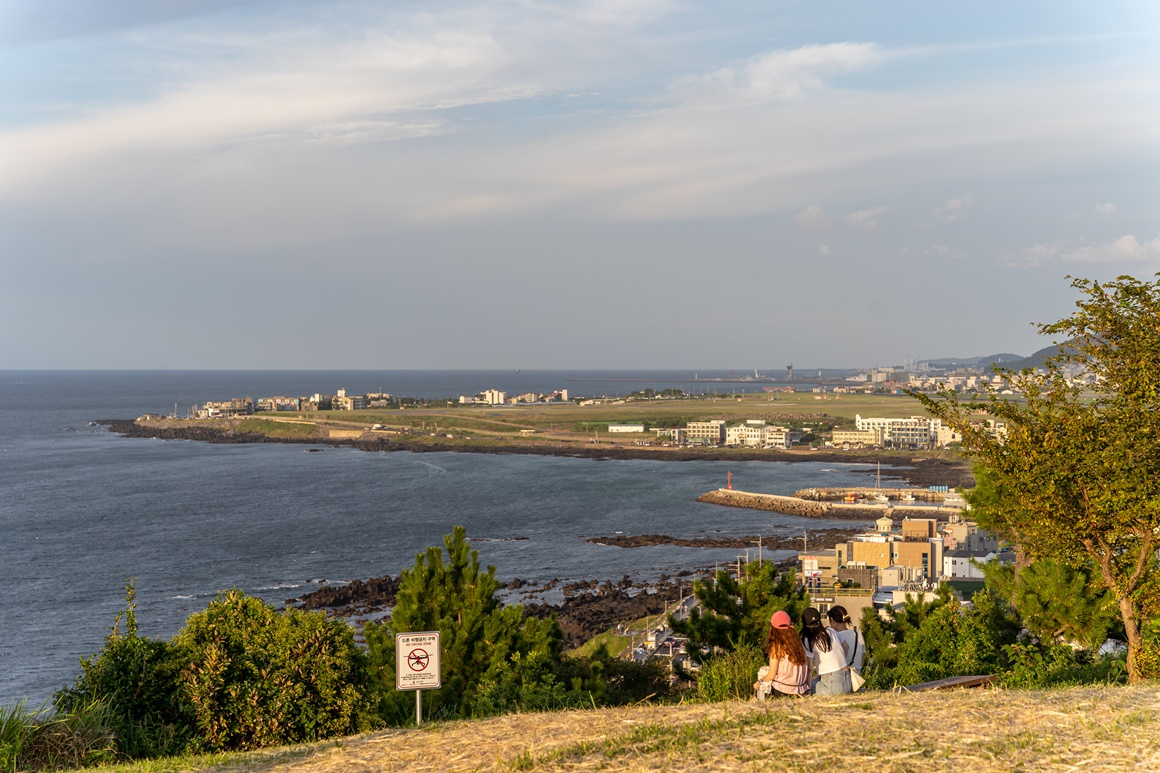
Saebyeol tops out at 519 meters and shows off silver-grass fields in autumn that turn the whole hillside platinum. Every Lunar New Year the island lights those grasses on fire for the Jeongwol Daeboreum festival, and the burn is telegenic enough to trend on Korean Instagram for a week. Yongnuni's twin craters are gentler and better for a sunset picnic. Locals treat oreum-hopping the way Seoulites treat cafe-hopping: one per day, no pressure to get to the top of anything. That's the point. Hallasan is a summit. Oreum is a mood.
해녀 (Haenyeo): dive with the grandmothers who built Jeju's economy
The 해녀 are Jeju's cultural crown jewels: women who free-dive up to 10 meters on a single breath, harvest abalone and sea urchin, and have been doing it for centuries with nothing but a diving mask, a lead weight belt, and a floating buoy called a 테왁 (tewak). UNESCO listed them as Intangible Cultural Heritage of Humanity in 2016, and the FAO added them to its Globally Important Agricultural Heritage Systems roster in 2023.

What matters for a visitor is that the tradition is quietly dying. Fewer than 2,900 active divers remain, over 90 percent of them are 60 or older, and the number drops about 8 percent a year. That's why the Hansupul Haenyeo School in Hyeopjae and the Beophwan Haenyeo School in Seogwipo now run open-enrollment programs (roughly 50,000 to 100,000 won for a taster day) that let you dive alongside the grandmothers. Do it. Not because it's a photo op, but because the community mechanic is unusual: haenyeo dive in teams, breathe in rhythm, and never leave anyone behind. Spend an afternoon with them and you understand why Welcome to Samdal-ri built its whole emotional core around their code.
Ponies, sunrise peaks, and the K-drama trail
If Hallasan is the vertical and Olle is the horizontal, everything else is the fun-scale in between. 성산일출봉 (Seongsan Ilchulbong) is a 182-meter tuff cone on the eastern coast, roughly 5,000 years old, UNESCO-listed, and famously the best sunrise spot on the island. Serious divers use it as a shore-dive access point around the cliff base. On the south coast, Jungmun Beach draws surfers year-round thanks to a break that actually works, and Jeju Horse Park in Seogwipo runs the 제주 조랑말 (Jeju native pony) trails: the breed is small, sturdy, and older than most Korean royal bloodlines, with course prices ranging from 12,000 to 50,000 won depending on trail length.

The K-drama angle is bigger than most travel writers admit. My Mister used Jeju for the emotional turning point in episode 10. Welcome to Samdal-ri (JTBC, 2023-24) built its entire visual world around real Jeju locations rather than a Yangju backlot. JTBC quietly paid a location premium to shoot on the actual island because international travel demand tends to follow prestige K-drama scenery, and it worked. Post-Samdal-ri, Jeju visits from Southeast Asian markets ticked up double digits.
None of this is bucket-list posturing. Jeju has more depth than the "Korea's Hawaii" framing gives it credit for, from 제주 4·3 memorial sites that hold the island's harder history to the small oreum you'll never find on a Naver blog top-10 list. Go for the hikes. Stay for the food, the divers, and the fact that everyone you meet actually seems to like living there.
Want a taste of Jeju before you book the flight? The Daebak Box ships a monthly curated drop of Korean snacks, cultural goods, and island-exclusive treats to your door, a soft-launch introduction to the same Korea that keeps travelers coming back. Full details at daebak.co/products/daebak-box.


