


Table of Contents
Most people who played Mystic Messenger in 2016 had no idea they were holding an inflection point in Korean gaming. They thought they were chatting with an unhinged hacker named 707 at 3am. After a decade watching the Korean content industry from inside the loop, I can tell you that Cheritz (체리츠), the small Seoul studio behind that game, did something Korean publishers had spent years failing at: they cracked the global mobile market with a 여성향 (yeoseonghyang, female-oriented) product. No Tencent money. No Nexon backing. Just a founder, a six-person team, and a chat app that made you check your phone like a teenager waiting for a text back.
The vacuum Cheritz walked into
To understand why Cheritz mattered, you have to understand what the Korean game industry looked like for women in the early 2010s. It looked like nothing. Korean publishers had been printing money off MMORPGs (Lineage, MapleStory) and FPS titles (Sudden Attack, Special Force) for a decade, and the audience strategy was simple: 20-something Korean men with PC bang (PC방) habits and disposable income. Female players were treated as a rounding error. Casual mobile puzzlers and Anipang-style social games were the closest thing women got to a category built for them.
The founder of Cheritz, Sujin Ri (founder credit on Steam, also sometimes romanized Lee Soo-jin), was a computer engineering student who spotted the obvious gap. Otome games (오토메, the romance visual novel genre aimed at women) were a billion-yen category in Japan with Voltage and NTT Solmare cleaning up. In Korea, that whole shelf was empty. She started Cheritz in February 2012 with the explicit mission tagline "Sweet solutions for female gamers." That tagline reads like marketing copy now. In 2012 it read like a thesis nobody else in Korean games was willing to underwrite.
Dandelion and Nameless: the apprenticeship years
Before the Mystic Messenger blow-up, Cheritz spent four years quietly learning their craft on PC. Dandelion: Wishes Brought to You shipped in August 2012, then English in November of that same year. The premise is pure shoujo: a college student named Heejung Kim finds mysterious animals in her apartment who turn into beautiful boys. It is exactly as ridiculous as it sounds, and Korean visual novel fans loved it. The English release outsold the Korean version more than two-to-one, which Cheritz themselves found surprising. That data point alone changed their strategic posture. By 2013 they were planning Nameless (Nameless: The One Thing You Must Recall) in Korean, English, and Japanese simultaneously, with Chinese added later. Most Korean indie studios localized one language at a time. Cheritz front-loaded the cost because they had already seen where the audience actually was.

Industry framing matters here. Nameless landed on Steam in December 2014 and Dandelion followed in August of that year. That decision (Steam over local Korean platforms like Hangame or Nexon's portal) was the moment Cheritz stopped being a Korean indie studio in the traditional sense and started being a global indie studio that happened to be in Seoul. The K-content business calls this 글로벌 직진 (global jikjin, going straight global). It is what Cheritz did long before HYBE or CJ ENM made it a buzzword for K-pop and K-content exports.
Mystic Messenger: the real innovation people miss
Mystic Messenger launched on Android on July 8, 2016, and iOS on August 18 of the same year. Within a few months it had crossed a million downloads. By 2018 it was well past 7 million. The game eventually won Best Indie Game at the 2017 Korea Game Awards. Those are the talking points. The actual industry significance is more specific.

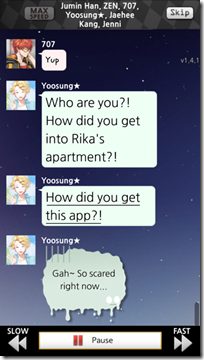
The real-time messaging mechanic was not just a clever UI choice. It was a mechanic-as-narrative bet that nobody else in mobile gaming had fully committed to. Other otome titles in 2016 used static visual novel formats: tap to advance text, get to a choice node, branch. Mystic Messenger ran an actual 11-day clock in real time, with character chat messages arriving at irregular hours, push notifications waking you up at 2am, phone calls from voice actors playing 707 or Zen breaking through your normal phone routine. This was a full year before Instagram Stories normalized timed disappearing content, and before Snapchat's growth made on-app urgency feel native. Cheritz built that pattern into a romance game before TikTok existed as a concept in the West.
Why fans actually loved it (the appeal point most Western writers miss): the format collapsed the distance between fictional intimacy and real attention. When 707 is "online" at the same time you are, and you have 90 seconds to pick a response before the chat moves on without you, the parasocial feeling is not metaphorical. It is mechanically enforced. Otome games before Mystic Messenger were enjoyed as fantasy. Mystic Messenger felt like maintenance. That is a different emotional contract, and the 7M+ downloads were people opting into that contract willingly.
Why the Korean female-gamer market was ripe
One thing to clear up: Mystic Messenger did not invent the Korean female gamer. She existed in massive numbers, playing Anipang (애니팡) on the subway and writing fanfic about K-pop idols on Naver cafés. What Cheritz did was build the first Korean-made product that treated her as a primary buyer instead of a side audience. Korean MMORPG publishers had been ignoring this player for years because the LTV (lifetime value) of a male whale playing Lineage was higher than the LTV of a casual female mobile player. The math was wrong. It was wrong because nobody had built the right product to extract that value.
The monetization design tells the story. Mystic Messenger is free-to-play with an in-game currency called hourglasses (모래시계). You do not spend hourglasses to skip ads or buy weapons. You spend them to recover missed chats, which is the equivalent of catching up on a relationship you slept through. The Kotaku writer Heather Alexandra called this monetization model "less predatory than dangling shiny weapons or relics. You spend money to get a chance at more thorough intimacy and expression." That framing is exactly right. Cheritz turned attention itself into the premium SKU, six years before Western mobile publishers started calling this "engagement-based monetization" in their investor decks. Female players paid because the conversion was emotionally honest. That is a Korean female-gamer market behavior the male-coded MMO industry literally could not have predicted.
The slow indie archetype: Cheritz vs. the China model
By 2018, the otome game market in Asia exploded. Chinese publishers Papergames (Mr. Love: Queen's Choice), then later Tencent (Light and Night), NetEase (For All Time), and Mihoyo (Tears of Themis, before they pivoted to Genshin scale) all came in fast and hard with 3D models, gacha mechanics, and quarterly content updates. Mr. Love: Queen's Choice alone pulled 4 million daily active users within a month of its December 2017 launch. The Chinese otome category became the "four great national otome games" by 2020, with Love and Deepspace later doing $200 million globally by mid-2024.
Here is the structural insight Cheritz watchers should track: Cheritz did not chase that velocity. After Mystic Messenger, the next major Cheritz release (The Some: The Forbidden Lab) did not arrive until August 2022, six years later. In Chinese publisher time, six years is roughly 18 major content cycles. From a pure ROI lens, this looks like under-execution. From a Korean indie quality lens, it is something else. Cheritz is the archetype of what Korean game critics call the 느린 인디 (neurin indi, slow indie) studio. Build at your own pace, ship when ready, do not get crushed by quarterly content cadence. The studio kept its team small. They did not take outside investment for years (Sujin Ri publicly mentioned they operated without publisher or investor money through 2017). They donated $100,000 to charity from Mystic Messenger profits in 2017, which is on-brand for an indie that values community over scale.

This is the bet Korean indie game studios are still making, and it is a real philosophical split with the Chinese model. Mihoyo runs on 6-week patch cycles. Tencent runs on quarterly content drops. Cheritz runs on "when we are happy with it." Korean fans of Mystic Messenger have spent literally years waiting on side-story DLC, and a meaningful chunk of them still defend the wait. That tolerance for slowness is a Korean indie game culture marker. It is also why Cheritz lost competitive ground when the Chinese 3D otome wave hit in 2022 to 2024. The strategic trade is legible: protect quality and protect the brand promise, lose share to faster-moving competitors. Both halves of that trade are visible in the current state of the studio.
What Cheritz proved (and what it cost)
Whether you cared about Mystic Messenger personally or not, Cheritz settled a few questions for the Korean game industry that nobody was willing to ask in 2012. Question one: will female-targeted Korean mobile games sell globally? Answer: yes, with the right format. Question two: can a six-person Seoul indie studio compete against Japanese otome incumbents like Voltage? Answer: yes, by skipping the format they were locked into and inventing a new one. Question three: do female gamers pay? Answer: yes, when the product respects them.
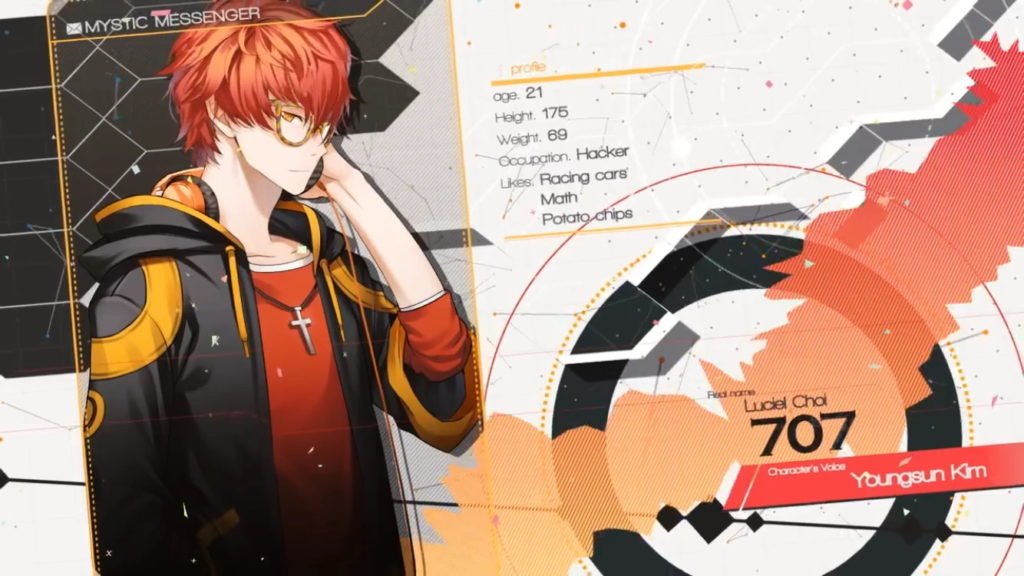
The cost side of the ledger is also worth saying out loud. Cheritz's slow-release cadence let Chinese publishers eat the global otome market from 2018 onward. The studio that opened the door for global otome on mobile is no longer the dominant player in the category it helped create. That is a Korean indie game story in miniature: a brilliant first mover, a smaller follow-up arc, a slow burn after. The Mystic Messenger characters (Jumin Han, Jaehee Kang, 707, Zen, Yoosung) still have active fan art communities on X and Tumblr in 2026. The Cheritz Market store still ships character merch. The studio still posts updates on its team Tumblr. That kind of fan retention nine years after launch is rare in mobile gaming. In Korean indie game terms, that is the win condition. It just is not a Mihoyo-shaped win.
Why this matters for the next wave of Korean indie games
The current wave of Korean indie studios building for female and global audiences (Project Moon, Smilegate's smaller indie arm, various solo Korean visual novel developers shipping on Steam) is operating with a playbook Cheritz wrote. Global day-one release. Multilingual ship. Skip the local Korean platforms. Build community on Tumblr or X first, official Naver café second. Treat fan art as marketing. Take outside investment late, if at all. None of that is unique to Cheritz any more, but Cheritz was the one who made it the default for Korean indie game development aimed at women.
If you are tracking K-content as an industry, the Cheritz story is the early indicator of what later happened to K-pop, K-drama, and K-beauty: small Seoul-based shop, mostly female founders or female-led teams, global-first product strategy, slow burn into a recognizable cultural export. The pattern repeats. Mystic Messenger was the otome version of it. The fact that it shipped four years before BTS hit the Billboard Hot 100 is not a coincidence. The Korean creative export wave was already underway in 2016. It just had not been named Hallyu 4.0 yet.
Explore More of Korea with Daebak
Want to bring a little piece of Korea into your life? The Daebak Box is packed with the best Korean snacks, ramen, and cultural goodies delivered monthly to your door.


