


Table of Contents
The holidays are a time when people around the world gather with family, give thanks for the year's blessings, and enjoy food that only comes out on special occasions. In the West, Thanksgiving is one of the most beloved of these moments. Korea has its own version, and in many ways it goes even deeper. Welcome to Chuseok (추석), also known as Hangawi: Korea's harvest festival and the closest thing you'll find to a Korean Thanksgiving.
When Is Chuseok?
Unlike Thanksgiving, which falls on a fixed calendar day, Chuseok moves around every year. It is always celebrated on the 15th day of the 8th month of the lunar calendar, which typically lands sometime in September or October, right when the harvest is coming in and the seasons are changing. The holiday officially spans three days: the day before Chuseok, Chuseok itself, and the day after. Many Koreans take even more time off to travel back to their ancestral hometowns, making it one of the biggest travel periods of the year.
Traditional Clothing: Breaking Out the Hanbok
If you follow K-pop idols on social media, you have probably seen those gorgeous photos of them dressed in flowing, colorful traditional garments around this time of year. Those are hanbok (한복), Korea's traditional dress, and Chuseok is one of the main occasions when everyday Koreans break them out of the closet. Families often dress up together, and cultural spaces like palaces and folk villages open free of charge to visitors who arrive wearing hanbok. It is one of the most photogenic moments of the Korean calendar.
Honoring Ancestors: Charye and Seongymo
The heart of Chuseok is gratitude, and that gratitude extends to those who came before us. Two important rituals define the holiday:
Charye (차례) is a memorial ceremony held early on the morning of Chuseok. Families arrange a table of beautifully prepared foods, freshly harvested rice, alcohol, songpyeon rice cakes, and seasonal produce, as offerings to their ancestors. The family bows together and gives thanks for the harvest and for the lives of those who shaped their family.
Seongymo (성묘) involves visiting ancestral graves. Family members make the trip to the burial sites, clear away any overgrown weeds, and hold a brief ceremony of respect. It is a deeply moving practice that connects the living with the memory of their lineage.
The Food: The Best Part of Any Holiday
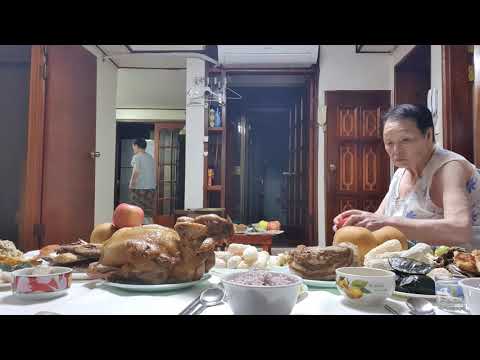
Every culture has its signature holiday dishes, and Chuseok is no exception. Korean families spend hours, sometimes a full day, preparing for the feast. Here is what you can expect on a Chuseok table:
Songpyeon (송편), the iconic Chuseok treat. These small, half-moon shaped rice cakes are made from freshly harvested rice flour and filled with sweet fillings like red bean paste, a honey-sesame mix, or chestnut paste. They are traditionally steamed over pine needles, which infuses them with a subtle, fragrant aroma. Legend has it that if you make a beautiful songpyeon, you will have beautiful children!
Jeon (전), Korean savory pancakes that show up in countless variations. Expect scallion pancakes (pajeon), kimchi pancakes, and seafood pancakes sizzling away in every family kitchen around Chuseok. The sound and smell of jeon frying is essentially the sensory signature of the holiday.
Seasonal produce dishes, late summer and early autumn produce takes center stage: squash, Asian pears, persimmons, apples, and fresh chestnuts all feature prominently. Multiple varieties of kimchi make an appearance, along with marinated beef (galbi) and fish dishes.

Celebrating Together
Beyond the ceremonies and the food, Chuseok is simply about being together. Families play traditional folk games like ssireum (Korean wrestling) and ganggangsullae (a circle dance performed under the full harvest moon), and these days many also watch special holiday programming on television. K-pop fans look forward to the ISAC, the Idol Star Athletics Championships, which traditionally airs as a Chuseok special.

Whether you are Korean or simply a fan of Korean culture, Chuseok is a holiday that speaks to something universal: the desire to gather, to remember, and to be grateful. If you ever get the chance to experience it in Korea, or with a Korean family, do not miss it. It is one of the most beautiful expressions of what makes Korean culture so rich and enduring.
Chuseok is coming up, how many of you will be celebrating this year?
Explore More of Korea with Daebak
Want to bring a little piece of Korea into your life? The Daebak Box is packed with the best Korean snacks, ramen, and cultural goodies delivered monthly to your door.


