


Table of Contents
Here is the honest read from someone who has been covering Korean heritage industries for over a decade: the 해녀 (haenyeo) of Jeju are not just a scenic postcard, they are a working labor force running a fisheries model UNESCO officially recognized in 2016, and they are dying out on a timeline the Jeju provincial government can now put on a chart. The number of active divers dropped to 2,371 in 2025, roughly half of what it was a decade ago, and more than 60 percent of the remaining haenyeo are in their 70s. That is the actual math of the tradition right now, and it is what makes every K-drama scene, every documentary premiere, and every millennial diver signing up for 해녀학교 (Haenyeo Academy) matter more than it looks on the surface.
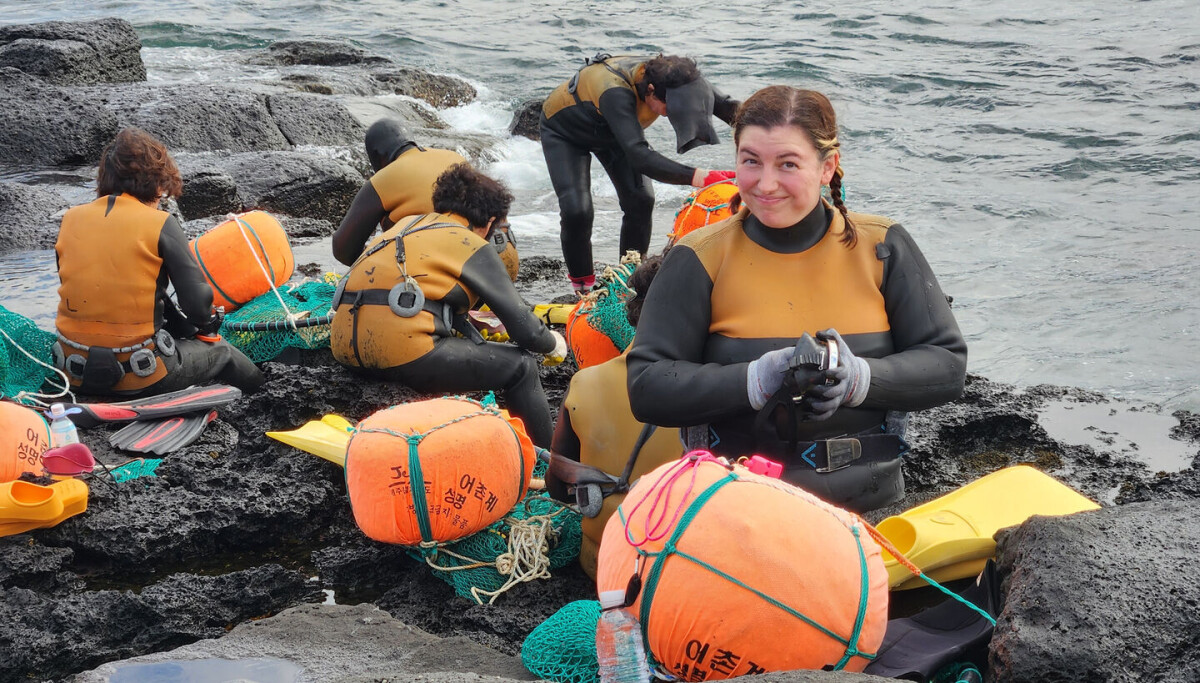
What 해녀 actually means: a working title, not a costume
The word 해녀 literally translates to "sea women," and the job description sits somewhere between commercial free-diver, artisanal fisher, and community elder. A working haenyeo goes down 10 to 20 meters on a single breath, holds it for around two minutes on the deeper dives, and harvests by hand: 성게 (sea urchin), 전복 (abalone), 소라 (conch), 해삼 (sea cucumber), 문어 (octopus), and 미역 (seaweed). No oxygen tank. No regulator. Just a wetsuit, a mask, a knife, and a 태왁 (taewak) float that doubles as a rest station and a catch bag. What Western coverage tends to miss is that the haenyeo are not a re-enactment troupe kept alive for tourism. They are the actual fisheries labor force in most Jeju coastal villages, and they are still the only people harvesting the reef-adjacent species at scale. When you eat wild abalone sashimi at a Jeju restaurant, there is a very high chance a haenyeo pulled it up that morning.
The 1970s wetsuit that changed everything (and almost broke the tradition)
Here is the industry-side detail that most travel pieces skip: the shift from the traditional cotton 물옷 (mul-ot, literally "water clothes") to the modern neoprene wetsuit in the 1970s is the single biggest inflection point in haenyeo history in the last century, and it is a double-edged sword. Before the wetsuit, cold-water exposure limited a diver's session to roughly one hour in winter and maybe two hours in summer, which naturally capped how much any one woman could harvest. That cap was, effectively, the sustainability mechanism. When neoprene arrived, session length jumped to four hours in cold months and six hours in warm months. Catches doubled, then tripled. Great for household income, catastrophic for the shellfish beds. Village 해녀회 (haenyeo associations) had to invent their own management rules almost overnight, and the ones that are still functioning today, like the Yeongrak-ri fishing village cooperative, are the ones that self-imposed catch quotas, seasonal closures, and rotation systems before the government did. That is not a small thing. That is haenyeo running a working commons in real time.
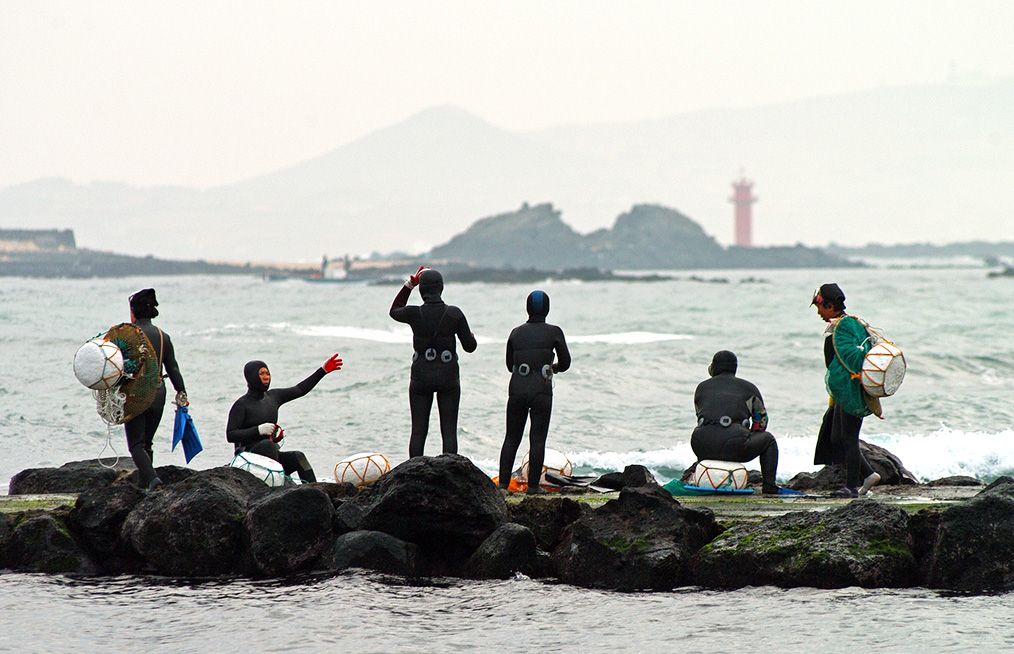
물질, the twice-daily shift: what a real day looks like
The word for the diving work itself is 물질 (muljil), and Korean media sometimes romanticizes it into a meditative practice, but the actual rhythm is closer to a hard fisheries shift. A typical harvest day starts around 9 or 9:30 a.m., depending on the tide. The divers walk together, usually about a kilometer, from a village staging area to the water. They spend three to four hours in the sea on a good day, less when swells pick up. In the peak season (October through May in most western Jeju villages, when 소라 conch is running), a strong diver can pull up 20 to 25 kilograms of shellfish in a single session. By late spring, that number falls to five kilograms on a good day, and the season closes so the beds can recover. The pay is honest and modest: even a top-earning diver like a full-registered haenyeo makes something in the low 2 to 3 million won range across the whole October-to-May season, which is why almost every working haenyeo runs a side business, from a homestay to a pet hotel to a Naver blog income stream. This is small-scale artisanal fisheries economics, not folkloric labor.
Why this became a women's craft: Jeju's semi-matriarchal fisheries structure
The gender inversion is what makes haenyeo culture legible as its own thing rather than a subset of Korean coastal fishing. Historically, Jeju men worked the offshore boats and were often lost to storms, conscription, or the 1948 Jeju 4.3 events, which left an entire generation of Jeju women running households as primary earners. Diving was the trade they controlled, and because the diving income was reliable and daily, the household budget effectively centralized around the woman. Ethnographers who have studied Jeju in the mid-20th century have described the resulting family structure as semi-matriarchal, which is a very specific and unusual thing in the Korean Confucian context. Even today, the fishing village cooperatives (어촌계) in Jeju are the only rural community organizations in Korea where women dominate the leadership rolls. What the appeal point comes down to, for global audiences, is that the haenyeo represent one of the last living examples of a working-class female labor guild that predates and outlasted the industrial economy around it. That is a story you cannot invent.
The dying-out numbers, and why they matter now
The demographic collapse is not a projection, it is happening in real time. In 1965, Jeju had roughly 23,000 to 26,000 active haenyeo. By 1970, the number was 14,143. By 2022 it was 3,226. By 2023 it had fallen to 2,838 for the first time under the 3,000-diver line. And by 2025 the Jeju provincial fisheries office was recording 2,371 registered active haenyeo, with over 60 percent of that shrunken pool in their 70s or older. The reason to care about that trajectory is not sentimental. It is that the tacit knowledge of haenyeo work, which reef holds abalone in which month, which currents mean a safe surface, which storm-signals mean "get out of the water now," takes seven-plus years to transfer to a new diver. If the transfer window closes, the knowledge does not migrate. It just ends. That is the underlying urgency behind the Jeju government's annual roughly 5 billion won grant program for haenyeo welfare, medical support, and recruitment (numbers reported by Jeju Special Self-Governing Province in recent budget filings).

해녀학교 and the millennial pipeline: the state-funded recruitment play
The intervention that is actually working, sort of, is the 해녀학교 (Haenyeo Academy) system. The Hansupul Haenyeo School near Hallim-eup is the best-known, with classroom lectures on marine ecology and safety plus Saturday in-water training that runs for months. Graduates who commit to a village co-op can go through a probation-and-vote process to become fully registered haenyeo. The certification bar is real: you have to dive at least 60 days a year and sell about 1.2 million won worth of catch across that period, and then the existing divers in your village have to vote you in. That last step, the community vote, is the part that keeps this from being a tourist credential. What has changed since roughly 2020 is that the pipeline is actually catching a new demographic: younger millennial and Gen X women, some Korean, a few foreign, treating haenyeo work as a serious second-career choice. One of the most visible examples is Kylie Genter, a New Yorker who joined the Yeongrak-ri co-op and got fully registered in April 2025 after starting to dive in January 2024. Her Instagram documentation has moved the "haenyeo as living tradition" story into a global feed in a way brochure copy never could.
Why K-drama keeps writing haenyeo characters: the emotional shorthand
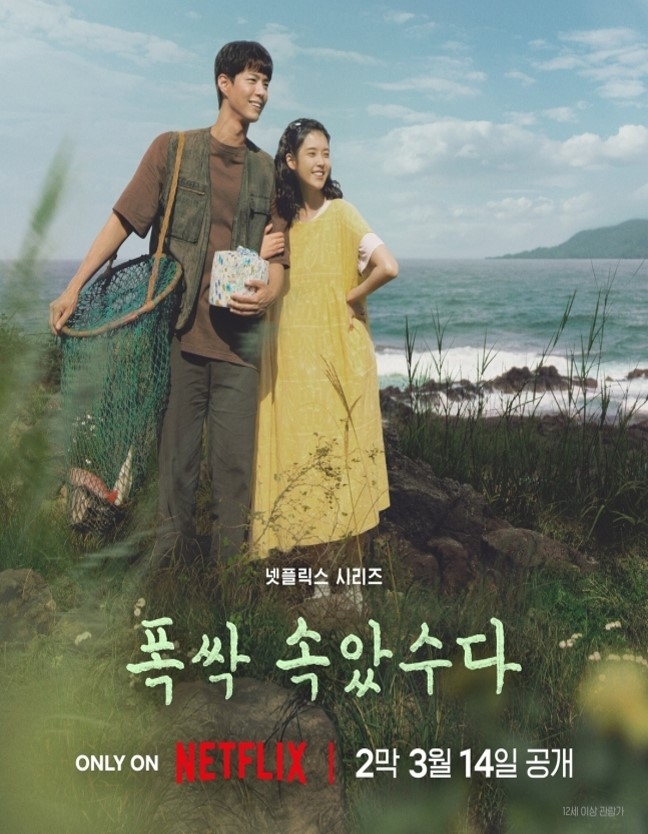
If you have been watching Korean drama since roughly 2020, you have probably noticed haenyeo characters showing up as an emotional shorthand for endurance, community, and generational grief. It is not accidental. Writers reach for the haenyeo mother the same way American writers reach for a coal-mining father: it is a compact way to signal a specific class-and-region history without exposition. The 2022 tvN omnibus Our Blues put Han Ji-min in the role of Lee Young-ok, a rookie haenyeo carrying a secret past, and used her diver identity as the metaphor for surfacing what you have been hiding underwater. The 2023-2024 JTBC drama Welcome to Samdal-ri gave Kim Mi-kyung the role of Go Mi-ja, a village haenyeo leader whose line to trainees became one of the most-quoted moments of the K-drama year: "Do not be greedy. Stay underwater only as long as your breath allows. When you cannot hold on any longer, return to the surface and catch your breath." That line got shared by Korean fans through 2024 not because it is pretty writing, but because it is real haenyeo pedagogy. The 2025 Netflix hit When Life Gives You Tangerines, starring IU and Park Bo-gum, opens with IU's on-screen mother Gwang-rye, played by Yum Hye-ran, diving with a debilitating lung condition to keep her daughter out of the water for good. That is the plot engine of the whole show. Haenyeo grief is the plot engine.

The tourism and preservation economy: about 30 billion won and rising
The commercial layer that has emerged on top of the working haenyeo economy is worth understanding on its own terms. The Jeju Haenyeo Museum in Hado-ri, the diver performance shows at Seongsan Ilchulbong sunrise peak, the haenyeo-themed cafes and restaurants (many of them serving actual diver-harvested seafood back to the same buyers), and the growing haenyeo experience programs at the village co-op level add up to something in the neighborhood of 30 billion won a year in Jeju's cultural-tourism economy by recent provincial estimates. The government layers on top of that with the annual haenyeo welfare grants, insurance support for divers over 70, and the free wetsuit and equipment programs. This is the model Korean cultural preservation is trying to make replicable: turn a fading practical craft into a semi-subsidized cultural asset, keep the practitioners paid, and let global storytelling (K-dramas, documentaries, social media) refill the recruitment pipe.
The documentary wave and international attention
The other axis pulling haenyeo culture into a global conversation is the documentary boom. The Last of the Sea Women, directed by Korean American filmmaker Sue Kim and released in October 2024 through Apple TV+, premiered at the 49th Toronto International Film Festival and got picked up by the Busan International Film Festival, framing the haenyeo as literally a last generation. In 2025, BBC Studios Asia and JTBC's Deep Dive Korea: Song Ji-hyo's Haenyeo Adventure put actress Song Ji-hyo through the same rigorous training pipeline documented in real time, marking BBC Studios Asia's first Korean co-production. The Song Ji-hyo project matters industrially because it is the first haenyeo-focused format designed simultaneously for domestic Korean TV and pan-Asian streaming, which changes who the recruitment message reaches. That is a specifically 2020s Hallyu-industry move: use a global-facing IP to solve a hyper-local labor shortage.
Why haenyeo culture actually matters (the appeal point, said plainly)
What makes haenyeo culture stick in the global imagination is not the exoticism of women diving without tanks. It is that they are one of the last living examples of a working-class female tradition that (a) predates industrial fisheries, (b) built its own management commons, (c) produced a semi-matriarchal family structure inside a Confucian country, and (d) is now visibly negotiating its own survival with the state, with tourism, and with global media. Every K-drama haenyeo scene is trading on that specific weight. Every Kylie Genter Instagram reel is a piece of that story too. The 정 (jeong), the deep bonded affection that Korean fans talk about, is what the village 해녀회 has always run on: the older divers taking care of the younger ones, the daily bath after a dive, the shared catch. When you strip out the aesthetic layer, that is what remains, and that is what should still be there in 2040. Whether it is depends on whether the recruitment pipe, the government grants, and the K-content storytelling stay pointed at the same thing at once.
Explore Korean culture with Daebak
If this insider read on the working reality of Jeju's haenyeo, from the 1970s wetsuit inflection to the 2025 recruitment push, made you want more of the Hallyu-expert lens on Korean culture, tradition, and the industry moves behind the headlines, the Daebak Box is a monthly deep-dive: curated Korean snacks, pop culture, and lifestyle picks that land past the surface story and into what Koreans actually love. Subscribe, and let each month arrive like a village welcome to a new diver on shore.


