


Table of Contents
Jeon (전) is one of those Korean food categories that Western readers tend to hear "Korean pancake" and picture the wrong thing entirely. After a decade sitting in the Hallyu content industry watching K-food get translated into English-language menus and Costco freezer aisles, I can tell you the jeon translation is the one that trips up new fans the most. Jeon is not sweet, not fluffy, not a breakfast plate under maple syrup. Jeon is a pan-fried, egg-and-flour-battered savory disc, usually served as banchan (반찬, side dish) or as a main-event drinking snack, and the category is broad enough to swallow everything from kimchi-studded 김치전 to Busan's massive 해물파전 to the honey-sweet flower pancakes eaten during Buddha's Birthday. If you only know one Korean pancake because a K-drama character was slapping one on a rainy day, you have barely opened the door.
What Actually Counts as 전 (Jeon)?
The definition Koreans use is much wider than the Western "pancake" bucket. Jeon (전) covers anything sliced or minced, dipped in a flour-and-egg batter, and shallow-fried in oil. That means a slice of zucchini becomes 호박전. A single perilla leaf stuffed with meat becomes 깻잎전. A whole napa cabbage leaf becomes 배추전 (a Gyeongsang-do specialty most Seoul kids have never eaten). The batter-heavy pancake style Westerners recognize is really a sub-category called 부침개 (buchimgae), which includes kimchi jeon, pajeon, and bindaetteok. Home cooks and menus use jeon and buchimgae almost interchangeably these days, which is why every Korean cookbook Amazon carries files them under the same tab. The category is a fry-oil grammar, not a recipe.
The reason this matters for global fans: when Bibigo, Saongwon, and JIN Kimchi launched frozen K-jeon SKUs for Costco US and Korean H Marts in 2023 and 2024, they had to pick one type to lead with. Bibigo's Sobaba brand went with a crispy fried format that leans more buchimgae. Saongwon's master-jeon brand rolled Crispy Kimchi Pancake into 13 countries including Costco US and Canada by 2024. The industry read here is straightforward. Kimchi jeon and pajeon are the two flavors Korean CPG brands bet on for export because they carry the strongest single-word recognition among non-Korean shoppers. The rest of the jeon universe, richer and more regionally weird, is still waiting for its export moment.
김치전 (Kimchi Jeon), the Comfort Food Everyone Cheats On
Kimchi jeon is the entry drug. Every Korean kid grew up watching their mom pull sour, over-fermented cabbage kimchi out of the back of the fridge, chop it small, dump it into a bowl with flour, water, a bit of the brine, some scallions, and turn it into a crispy-edged, tangy, spicy disc in under fifteen minutes. That is the appeal point Korean food writers rarely explain to Western readers. Kimchi jeon is what you make when the kimchi is too sour to eat straight but too precious to throw out. It is a rescue dish that happens to be one of Korea's most beloved rainy-day comfort foods. Maangchi's classic recipe video for kimchijeon has 1.77 million YouTube views for a reason. She spelled out the emotional logic: "On a rainy day on the weekend, when a Korean family wants something special and cozy to eat, this is something anyone can make using the ingredients we have at home. Then mom will say: 'You want me to make kimchijeon?' and everybody will say: 'Yayyy!'" That is the correct emotional temperature.

What Western pancake lovers usually miss is the texture math. The pancake has to be 쫄깃 (jjolgit, chewy) on the inside and 바삭 (basak, crispy) on the outside at the same time, and that only happens when the oil is generous and the pan is very hot. This is not a low-oil, health-food pancake. That is the entire point. Chef bloggers like Sue at My Korean Kitchen quietly slip cornstarch and cold sparkling water into their batter to push the crisp further, which is an industry-level trick that home cooks in Korea started copying only in the last five to seven years. Kimchi jeon is a dish that keeps evolving inside its own tradition.
파전 (Pajeon) and Its Big Sister 해물파전 (Haemul Pajeon)
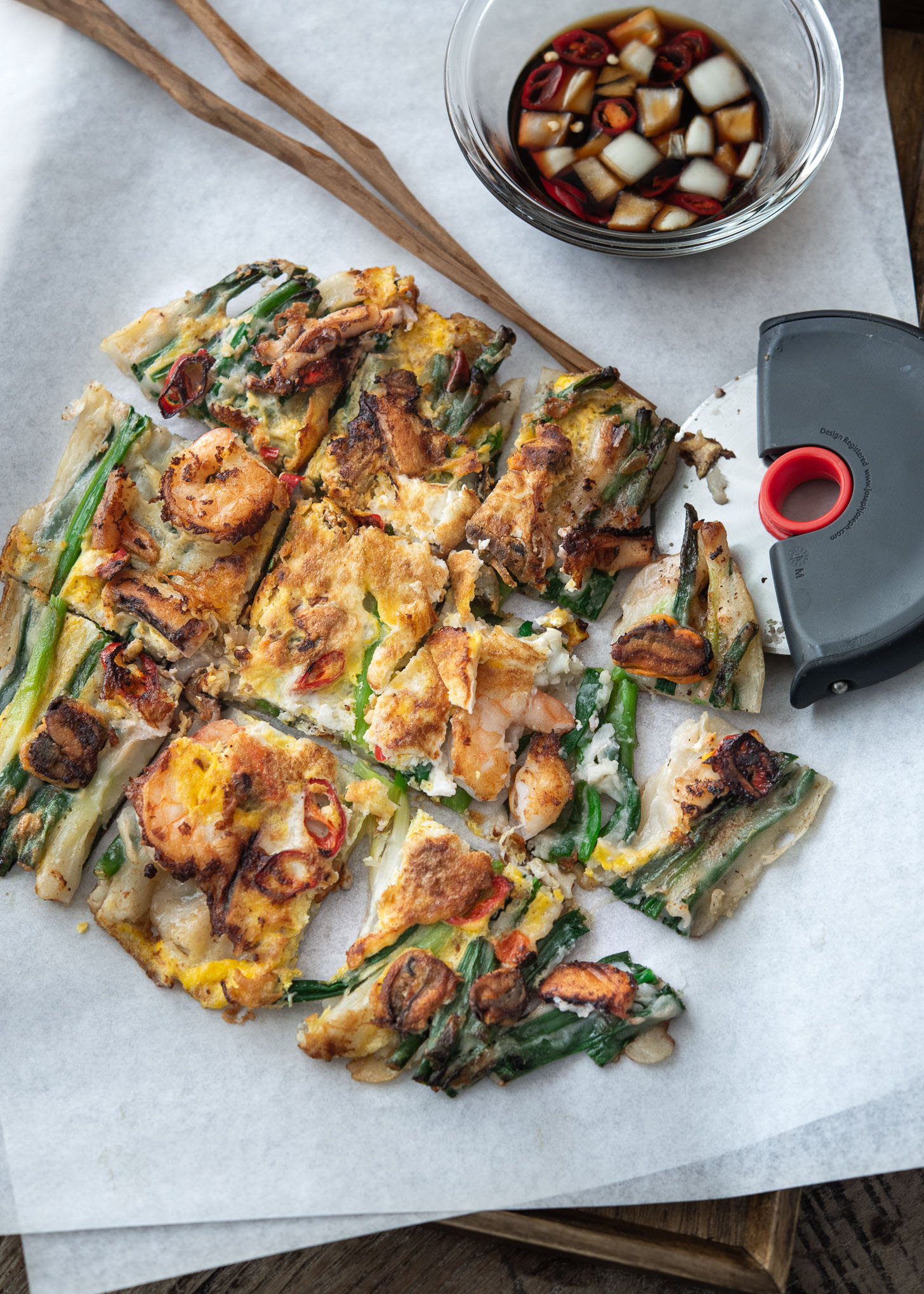
Pajeon is where regional identity enters the story. The base version, 파전, is scallion pancake: whole green onions laid parallel across a pan, bound together by just enough batter to hold the shape, cooked until the whites turn sweet and the greens go tender-crisp. Simple. But the version everyone actually wants at a Korean restaurant is 해물파전 (haemul pajeon), the seafood scallion pancake loaded with squid, shrimp, mussels, sometimes oysters, with a beaten egg drizzled over the top before the flip. This is not a home-cook flex dish. It is the Friday night pancake, the drinking-with-coworkers pancake, the version that comes on a plate the size of a small pizza when four people order it at a 부침개집 (buchimgae-jip, pancake shop).
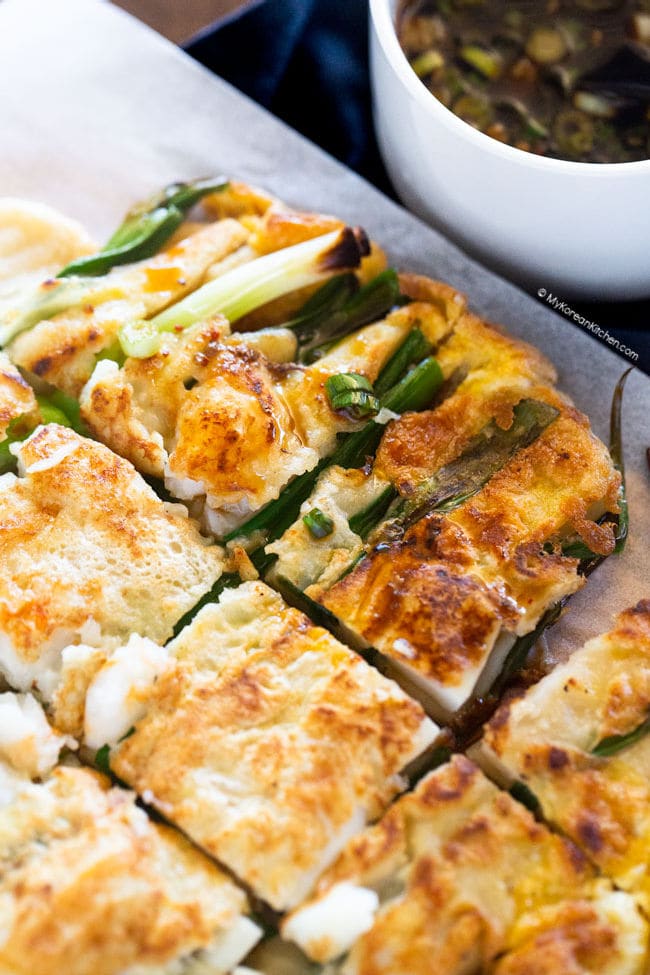
The regional appeal point Western food media almost never explains: 동래파전 (Dongnae pajeon), from the Dongnae district of Busan, is a totally different beast. Dongnae pajeon uses baby scallions grown in the Dongnae region (they were prized in Joseon-era royal tribute lists), plus rice flour and glutinous rice flour in the batter instead of just wheat, plus more seafood, and it is thicker, softer, and wetter than what Seoul restaurants serve. Locals grow up on it and love it. Outsiders often bounce off it on their first try because the texture is closer to a savory bread pudding than a crispy pancake. Busan Metropolitan City has produced official promotional videos about Dongnae pajeon precisely because it is the kind of hyper-regional food that does not travel well without cultural context. That is very Korean: the food you have to be there to fully get.
빈대떡 (Bindaetteok), the Mung Bean Ancestor
Bindaetteok (also called 녹두전 nokdujeon) is where the history buffs get excited. This is a savory pancake ground from soaked mung beans, not wheat flour, and it dates back centuries. Food historians point to Pyongan Province and specifically to Goguryeo-era origins, which puts bindaetteok among the oldest jeon in the Korean repertoire. There is a class-history layer here Korean food media loves. In the Joseon dynasty, plain vegetable bindaetteok was cheap street food for the working class, while pork-and-kimchi-loaded bindaetteok was the wealthier household version. The name itself has a folk-etymology story: some sources say bindae (빈대) refers to bedbugs (unflattering, but reportedly because the flat pancakes stacked at markets resembled a pile of them), while others trace it to older words meaning "for the poor." Either way, the dish outlived the class divide and became one of Korea's most beloved Lunar New Year (설날) and Chuseok (추석) foods.
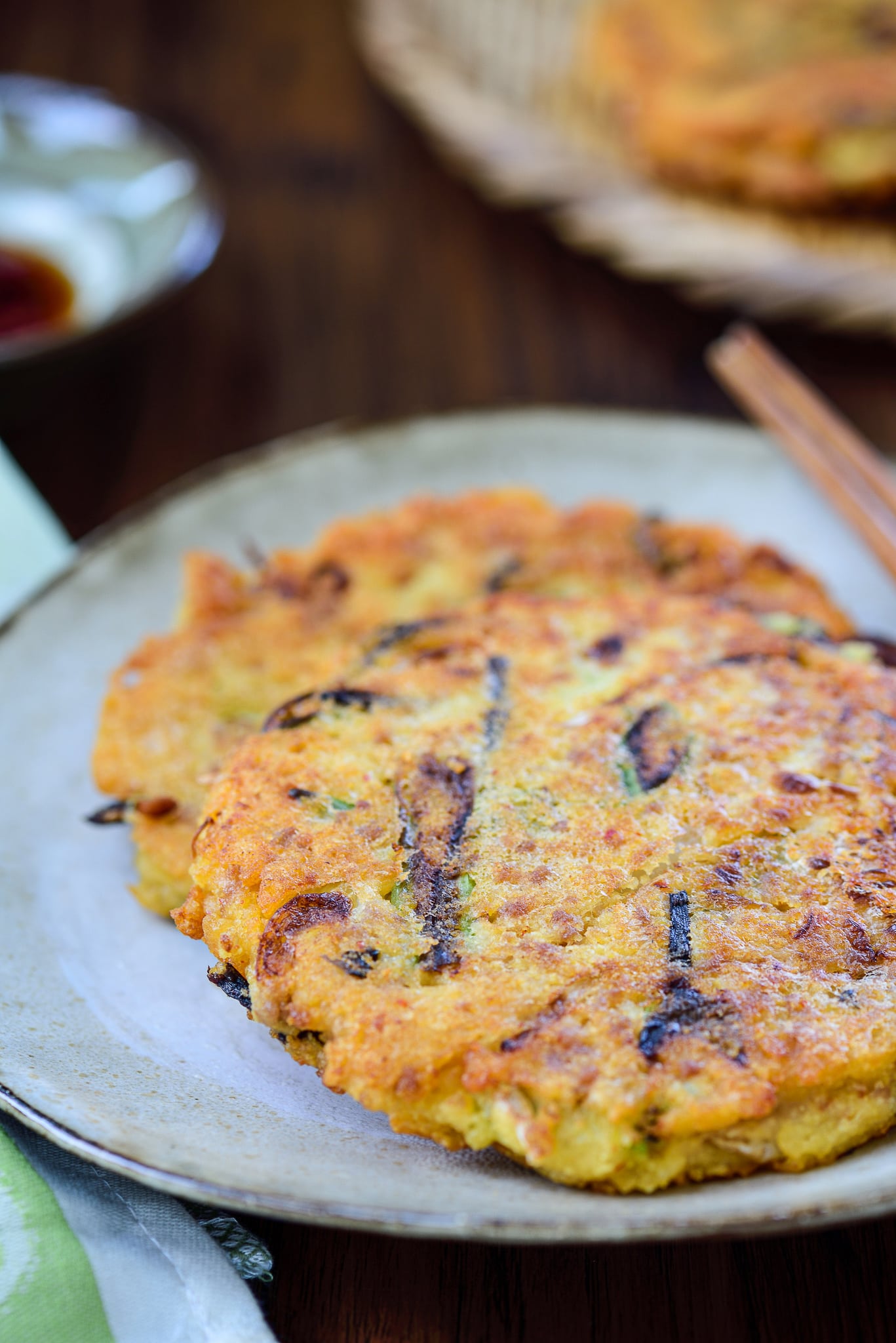
The reason bindaetteok is Korea's rainy-day King rather than kimchi jeon (which most Westerners assume) is boring economics. Data compiled by KB Kookmin Card over three years shows bindae-tteok restaurant sales surged 34 percent on rainy days in July and August of 2019, 46 percent in 2020, and 45 percent in 2021, per Korea Herald reporting. Kimchi jeon spikes at home. Bindaetteok spikes at restaurants because you actually have to soak mung beans overnight and grind them, so making bindaetteok at home from scratch on a wet Tuesday night is not realistic. The bindaetteok you eat at Seoul's Gwangjang Market, deep fried in a bath of hot oil by an ajumma who has been doing it for forty years, is one of the food experiences the Netflix Street Food episode on that market immortalized. That episode alone reportedly doubled international interest in the dish. This is the Hallyu content pipeline doing its quiet job again.
부추전 (Buchujeon), 호박전 (Hobakjeon), and the Vegetable Jeon Universe
Beyond the marquee three, the vegetable jeon world is where regional identity really lives. 부추전 (buchujeon), made with garlic chives, is a Gyeongsang-do favorite and shows up on almost every Busan and Daegu banchan menu. 호박전 (hobakjeon), sliced-zucchini rounds coated in flour and egg, is one of the standard Chuseok ancestral rites (차례상, charyesang) foods, meaning most Korean families have hobakjeon muscle memory from watching their grandmothers plate it for holiday altars. 감자전 (gamjajeon), the potato jeon from Gangwon-do, is often eaten with a splash of coarse salt instead of soy dipping sauce because Gangwon mountain potatoes carry enough natural sweetness that soy sauce competes rather than complements. Each of these is a regional flex more than a national comfort food.
The one that punches above its weight globally right now is 김치전's cousin, 야채전 (yachaejeon), the mixed vegetable pancake. Yachaejeon is a favorite among younger Korean home cooks precisely because it uses up leftover fridge vegetables the same way kimchi jeon uses up sour kimchi. Bloggers like Holly at Beyond Kimchee and Hyosun at Korean Bapsang have made careers explaining these regional jeon variations to English-language audiences, and their traffic in the last three years suggests the appetite for "beyond the two famous ones" is real. If Bibigo and Saongwon are exporting kimchi and scallion versions to Costco, the second wave is probably going to be zucchini, potato, and chive. That is where I would place the industry bet if I were CJ CheilJedang.
비 오는 날엔 파전 (On Rainy Days, Pajeon): The Weather-Food Ritual
The Korean weather-food association around jeon is not marketing spin. It is one of the most durable food-culture patterns in the country, and it has been passed down long enough that Korean office workers in their 20s and 30s still describe it as reflex, not habit. In the Korea Herald piece from July 2023, one 30-something office worker explained it as body memory: "My body knows when to eat jeon since my mom always cooked it for me when the rain fell. I grew up watching numerous scenes on TV where people cooked jeon and enjoyed it with makgeolli on rainy days." Media reinforcement is doing half the work here. The other half is sensory. A Seoul jeon restaurant owner quoted in the same piece offered the folk theory: the sound of raindrops on a roof resembles the sizzling of jeon frying in oil, so hearing rain triggers the flavor memory.
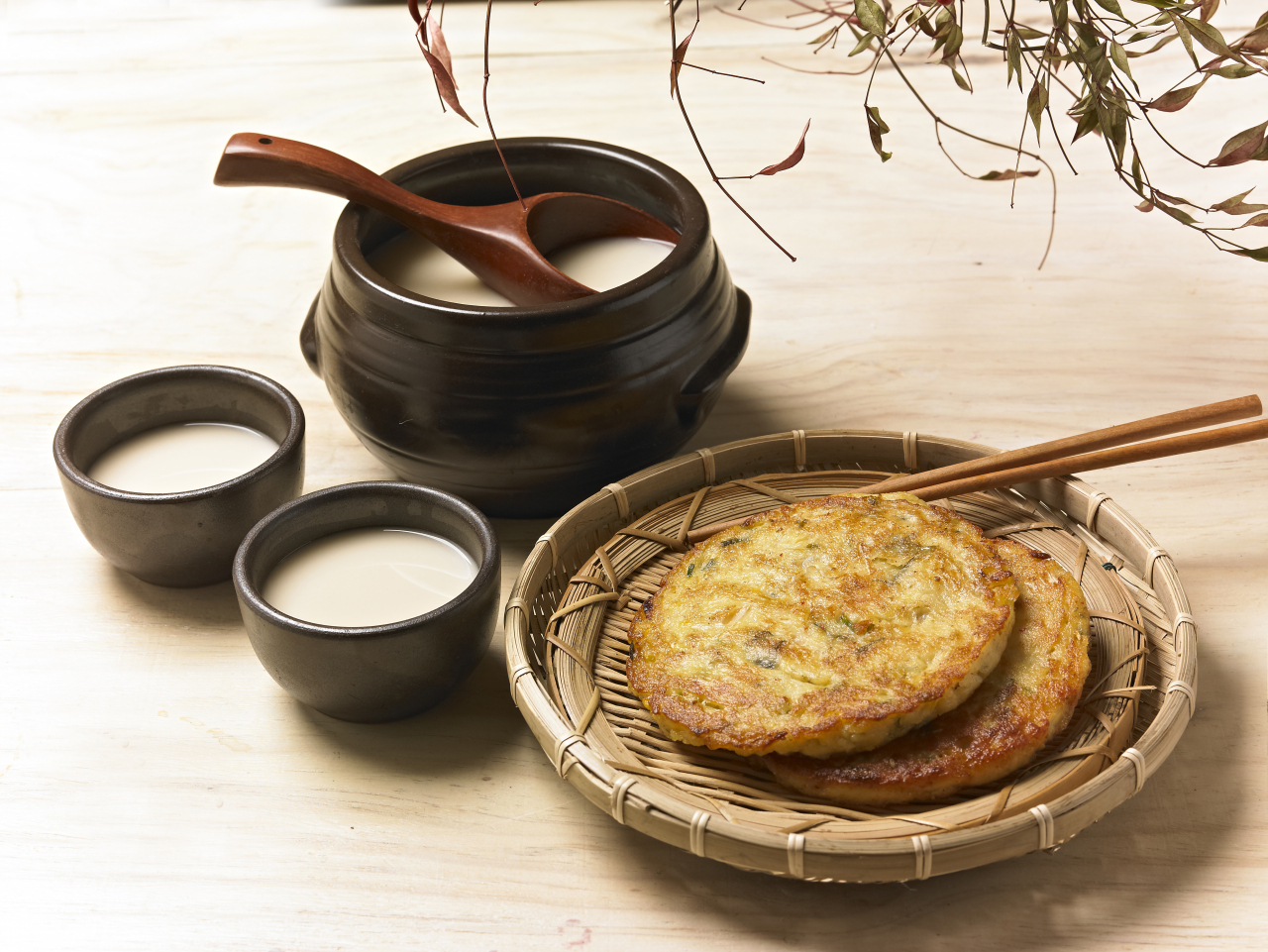
The pairing with 막걸리 (makgeolli, unfiltered rice wine) is not accidental either. Makgeolli has probiotic properties and dietary fiber that help digest the wheat and oil load of jeon, which is why the pairing survived when other traditional food-drink combinations died out. Weekend delivery apps show the pattern in real time. Baemin (배달의민족), Korea's dominant food-delivery app, reported jeon and pancake orders as the #1 category by search-lift on rainy days consistently through the post-pandemic period, and jeon has quietly become one of the most-ordered Korean comfort food categories across the delivery-app economy since 2020. If you are ever in Seoul and it starts pouring at 5 pm on a Friday, watch the Baemin delivery bikes multiply. That is the ritual made visible.
Why 전 Is Now Korea's #1 Export Comfort Food
The industry story most food-culture writeups miss: jeon is quietly the most successful new K-food export category of the 2020s, and it is happening under the radar because it does not have the Instagram thirst-trap look of Korean corn dogs or the viral spike of 불닭 fire noodles. Bibigo's parent CJ CheilJedang launched frozen K-Jeon SKUs into US retail during 2023 and 2024, and Saongwon rolled Crispy Kimchi Pancake into Costco stores across 13 countries including US, Canada, Japan, Taiwan, and Australia by 2024. Frozen-jeon shelf space at H Mart and Zion Market has roughly doubled compared to 2020 baselines, based on retail merchandising conversations in the Korean-American grocery trade. The read is that jeon travels well because it hits four export sweet spots at once: it freezes and reheats cleanly, it is savory and shareable, it fits the "authentic Korean" narrative that Squid Game and Culinary Class Wars primed Western audiences for, and it does not require a specialty sauce the buyer has never heard of.
The Squid Game halo effect is real, by the way. Post-2020 delivery-app data shows Korean comfort food searches abroad spiked hardest for the dishes shown on screen in the show and its spin-offs. Jeon showed up in Squid Game's flashback scenes and repeatedly in K-dramas like Reply 1988 and Crash Landing on You (Korean Bapsang literally built a Crash Landing on You food-guide article around the drama's food scenes). What Western fans see on the screen is what Korean-American frozen aisles start stocking eighteen months later. If you want to know what K-food category CJ will bet on for 2027, look at what Korean grandmothers are frying in K-dramas right now. The answer is often jeon, and the industry has finally noticed.
Bring Korea's Rainy-Day Pantry Home
You do not need a monsoon or a Busan pancake shop to start eating jeon like a Korean. The easiest way to build a Korean snack ritual at home is the SnackFever Box, hand-packed with the actual chips, ramen, sweets, and drinks Korean convenience stores carry, plus the rotating limited-edition items that most Korean-Americans have to text their family in Seoul to source. Pair it with a homemade kimchi jeon on the next rainy Friday, add a bottle of makgeolli, and you have basically imported the ritual.


