


Table of Contents
Here is the read from someone who has been mapping HYBE's global-audience unlocks since Wings dropped in 2016: what BTS's 정국 (Jungkook) pulled off at the FIFA World Cup Qatar 2022 opening ceremony on November 20, 2022 was not a fan moment. It was the biggest single-night audience booking a Korean solo artist has ever received, and HYBE and FIFA both knew exactly what they were buying. Al Bayt Stadium in Al Khor, roughly 50 kilometers north of Doha, held about 60,000 people in the live crowd. The global TV feed, per FIFA's own numbers, put the tournament in front of around 2 billion viewers cumulatively across the opening weekend. Jungkook stood in the middle of that stadium in cream leather, sang 드리머스 (Dreamers) with Qatari singer Fahad Al Kubaisi, and turned into the first Korean solo artist to headline a FIFA opening ceremony. Every downstream number in his career (Seven, Golden, the enlistment gap, the 2025 comeback) is easier to read once you understand what that night actually did.
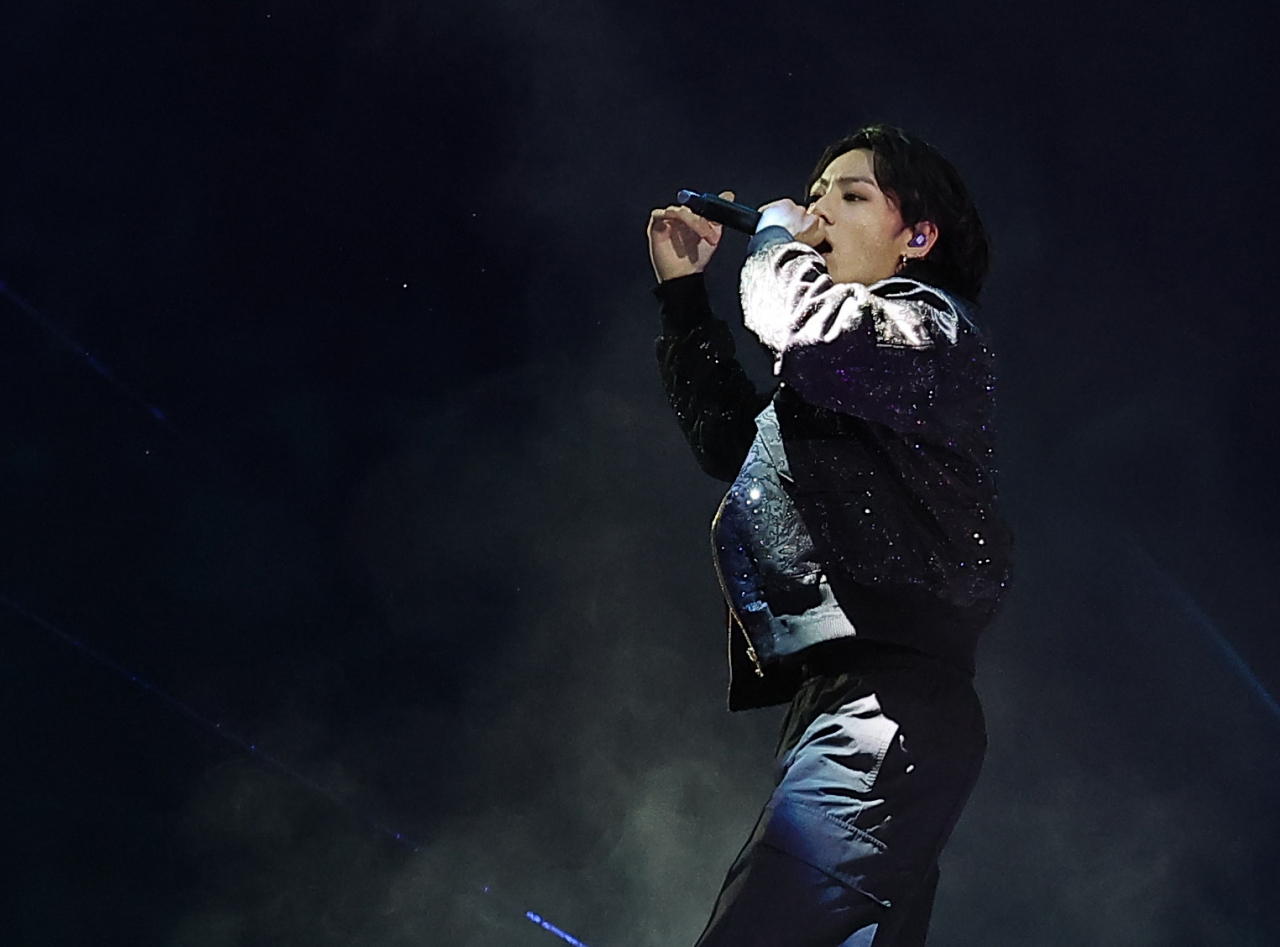
Why FIFA booked a solo Korean vocalist, not a group
The industry mechanic worth naming: FIFA's opening-ceremony slots historically go to acts that unlock a specific hemisphere. Shakira did Waka Waka in South Africa 2010 because Sony wanted Latin America and Africa in one shot. Pitbull and J. Lo did We Are One for Brazil 2014 for US-Hispanic reach. For Qatar 2022, FIFA needed the market that had gone from nowhere to 60% of global streaming growth in five years, which is Asia, and inside Asia the single most bookable artist was a member of BTS. Not the group. A member. This matters because HYBE and FIFA quietly aligned on a solo booking so that (a) the ceremony budget matched a single vocalist deal instead of a seven-member payout, and (b) the individual member got the standalone lift that a group performance would have distributed seven ways.
Jungkook was the natural pick inside the group. He is the 막내 (maknae, youngest member), his English pronunciation is the smoothest in BTS for a Western-audience lyric, and his vocal range covers the low-register verse plus the anthemic chorus 드리머스 needed. RedOne, the Moroccan-Swedish producer who built the song and worked with Lady Gaga, Shakira, and One Direction, wanted a voice that could carry a stadium ballad without the fandom-code baggage of a full BTS release. That is why the deal happened as a Jungkook solo credit, not a BTS group credit. And that is the first quiet signal HYBE was already prepping the group's post-2022 chapter, where each member would launch a distinct solo lane.
The Dreamers song build: Katara Studios, RedOne, Fahad Al Kubaisi
드리머스 was recorded at Katara Studios in Doha, produced by Grammy-winning RedOne, and released the same day as the ceremony (November 20, 2022 KST, 12 AM EST). The song is a stadium-ballad structure with a Middle Eastern melodic top-line and a straight 4/4 pop chorus, which is a very deliberate hybrid. RedOne had done this trick before with Waka Waka's African-guitar hook riding on top of Western pop chord structure. Here he did the same thing with a modal Arabic scale in the verse and a Jungkook-friendly major-key chorus that any radio programmer in Frankfurt or Los Angeles could slot in without adjustment.
Fahad Al Kubaisi's mid-song feature is the appeal mechanic Western coverage tends to skip. He sings a full Arabic verse from roughly 1:40 to 2:15, then he and Jungkook trade lines through the outro. That is not window-dressing. That verse is what made the song legally and culturally a co-host artifact rather than a Western pop track dropped into a Qatari stadium. It also gave FIFA a defensible answer to the "why not an Arab singer only" pushback in local Doha press. The song works because the two vocalists actually share the runtime, and because Jungkook chose to physically walk toward Fahad at the ceremony instead of staying on his own mark. That staging call turned the performance into a genuine duet rather than a pop-star drop-in.
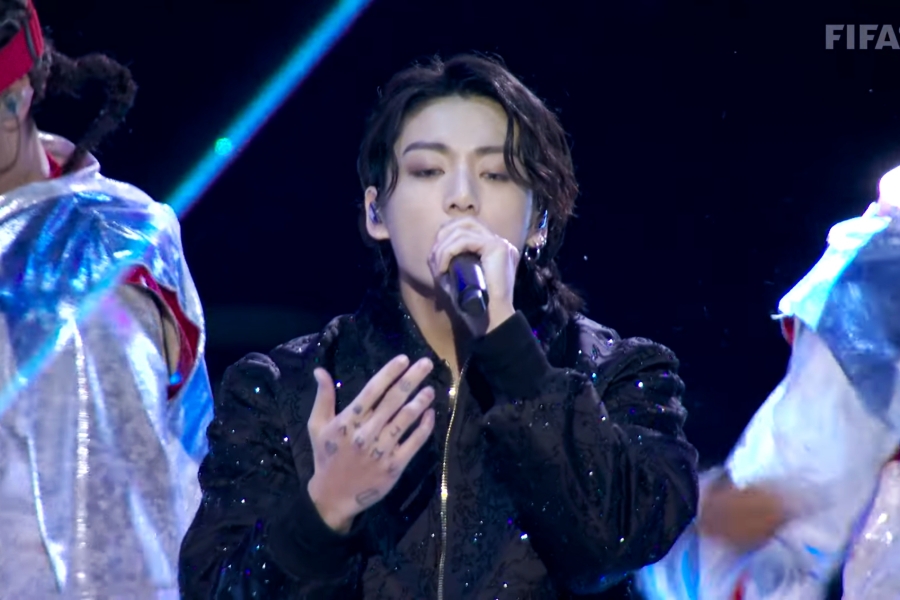
The choreography Jungkook added himself (Koreaboo scoop)
The nuance most Western coverage missed and Koreaboo caught first: the original FIFA cut of the performance did not have Jungkook dancing. He was booked as a stationary vocalist, which is how most opening-ceremony acts get staged (fewer moving parts for live broadcast, easier for camera cuts, safer for the vocal). Jungkook received the choreography video only days before the ceremony because it "would be weird if he did not dance," according to his own recounting later on SUGA's Suchwita talk show. He learned the routine himself, then pushed FIFA to let him do it live. That is a classic BTS-member move (the group is famous for renegotiating stage design mid-rehearsal) and it changed the whole visual grammar of the performance.
The appeal point ARMY (아미) fandom locked onto instantly is that a static Jungkook singing 드리머스 is a good performance, but a Jungkook-plus-dance Jungkook singing 드리머스 is a K-pop performance, and K-pop's whole global identity is built on singing-and-dancing at broadcast quality. Without that adjustment, Dreamers reads as generic anthem. With it, the ceremony read as an actual K-pop showcase, which is what turned it into 50 million+ YouTube views on the FIFA channel by May 2023 and 500 million+ Spotify streams by late 2025.
What the chart numbers actually mean
After the ceremony, 드리머스 did three things that are worth separating out. First, it topped iTunes Top Songs in 102 regions, and it hit #1 on the US iTunes chart in 2 hours and 11 minutes, which was the fastest any World Cup soundtrack has ever done that. iTunes numbers are a fandom-mobilization signal (ARMY hits buy buttons fast) and should be read as demand-density, not general popularity. Second, it debuted in the Billboard Global 200 top 10 and Global Excl. U.S. top 10, which is the streaming-plus-sales signal and matters more for long-tail royalties. Third, and most consequentially for Jungkook's solo trajectory, it hit #1 on Billboard's Digital Song Sales chart as the first World Cup song ever to do so, and it charted at Billboard Hot 100 #11 in Korea run-up weeks.
The Hot 100 #11 read is the one industry insiders flagged in HYBE's Q1 2023 investor briefings, because it proved a Jungkook solo release could chart in the top 15 of the US main singles chart without a full BTS marketing push. That is the exact green-light HYBE needed to greenlight what became Seven in July 2023, and the exact reason Jungkook's solo album Golden landed with a US label push through Geffen instead of just through BigHit Music's own channels. The Qatar 2022 booking was the audition. Everything else was the follow-through.

Seven, Golden, and the fastest 1B Spotify streams ever
Seven dropped July 14, 2023 with Latto on the feature. The song hit 1 billion Spotify streams in 108 days, which was the fastest any track had ever done that in Spotify history at the time. It also debuted at Billboard Hot 100 #1, giving Jungkook the second solo Hot 100 #1 debut by an Asian artist. Golden, the full album, followed on November 3, 2023, and debuted at Billboard 200 #2. All of that happened in the 12-month window immediately after Qatar.
The appeal-point mechanic here is worth walking through. The Qatar performance gave Jungkook the world's biggest single-night TV showcase. Seven then arrived seven months later with a music-industry infrastructure built specifically to catch that audience: Latto for US urban-radio programmers, a shirtless dance-heavy MV shot in a New York apartment for TikTok replay culture, a clean-explicit dual release for streaming platform algorithms, and a release date that specifically dodged the SEVENTEEN and Stray Kids window. It was engineered. And it was engineered because HYBE had spent six months post-Qatar reading the streaming, demographic, and geographic data from the World Cup ceremony to figure out exactly which markets to prioritize.

The enlistment window: December 2023 to June 2025
Jungkook enlisted on December 12, 2023 alongside RM, both entering the 18-month South Korean mandatory military service that every BTS member had committed to. This is a market moment that gets misread constantly. In Korean industry terms, the enlistment is not a career pause. It is a strategic asset-freeze. HYBE spent the Jungkook-Seven-Golden run in mid-2023 pre-loading enough content (a documentary, a Live Play concert film, back-catalog re-releases, and B-side unlock singles) to keep the solo cash flow running through the 18-month gap without needing new recording. This is the same playbook they had run for J-Hope's enlistment earlier in 2023, and the same one they would run for V, Jimin, RM, and SUGA's overlapping service windows in 2023 to 2025.
The Qatar ceremony had a specific role in this asset-freeze design. Because 드리머스 was a FIFA-branded release rather than a BTS-branded release, it kept generating streaming revenue and cultural visibility for Jungkook during the enlistment window without HYBE needing to touch the master. Every time a highlight reel of the 2022 tournament ran on ESPN or a South Korean sports channel between 2024 and mid-2025, Jungkook's global name-recall stayed active. That is unusual asset design. Most K-pop soloists have zero passive-visibility mechanics during their military service. Jungkook had a FIFA soundtrack running as background infrastructure.
The 2025 comeback and BTS group reunion
Jungkook was discharged from the military on June 11, 2025, alongside Jimin. By late June, all seven members had completed service, and BTS confirmed the group reunion for a 2025 world tour with a full studio album to follow. The tour is BTS's first as a full group since the 2019 Speak Yourself run, which puts the industry read on it: this is the return-of-a-billion-dollar-a-year touring franchise, with 6-plus year pent-up ARMY demand across every major market.
Jungkook's specific role in the reunion, per HYBE's Q3 2025 shareholder call, is to lead the group's US-market re-establishment tour dates. The reasoning is straightforward. Post-Qatar, post-Seven, post-Golden, he is the group member with the strongest independent US chart performance and the highest name recognition among non-ARMY US listeners. That means his solo brand pulls in the incremental non-fandom ticket buyers that turn a stadium tour from 90% capacity to a 100% sellout. In K-pop label economics, that 10% swing is the difference between a good tour and a record-breaking one.
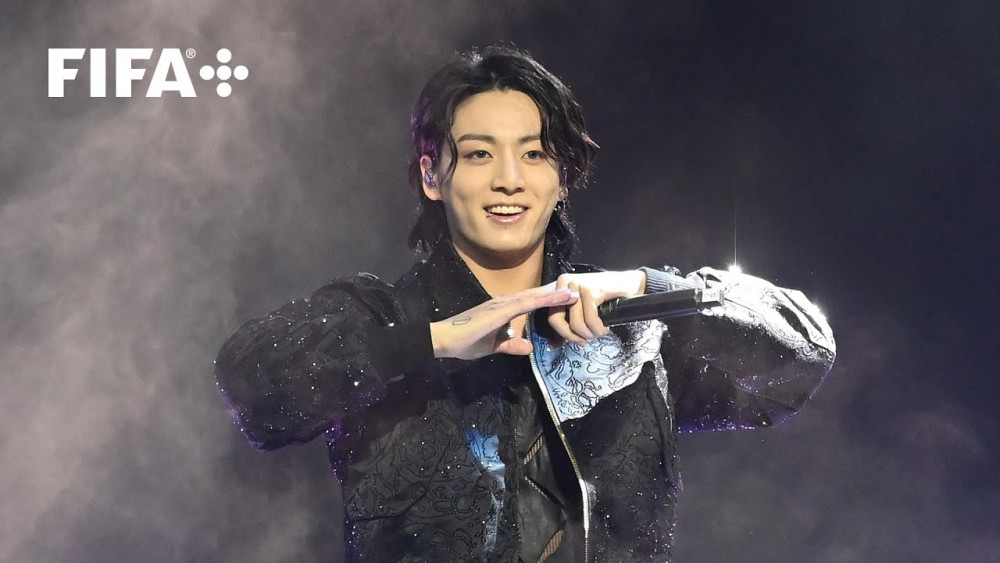
The Golden Maknae positioning and why HYBE built it
정국's "황금 막내" (Hwanggeum Maknae, Golden Maknae) label predates Qatar by roughly a decade. The nickname was cemented in 2013 to 2015 variety appearances (Weekly Idol, Bangtan Bomb clips) where he demonstrated cross-domain aptitude: singing, dancing, rapping in a pinch, sketch drawing, boxing, cooking. In HYBE's post-2018 brand-architecture design, that label became the frame for positioning Jungkook as the group's cross-market cultural export. Where V is the visual pillar, RM is the diplomat, and Suga is the songwriter-producer, Jungkook is the every-format performer. That is exactly the profile you book for a FIFA ceremony.
The appeal to ARMY globally is that 황금 막내 codes as the little brother who is inexplicably good at everything, which is the character archetype Korean 형-동생 (older-younger sibling) social dynamics center on. It is a warmer, less-intimidating pop-star frame than the traditional Western solo-superstar packaging. Jungkook can headline the FIFA opening and immediately go home and do a live-cook Weverse stream in a hoodie. That contrast, protagonist-scale on one screen and dorm-mate-scale on the other, is a specific K-pop mechanic that Western pop rarely delivers. It is why parasocial engagement stayed active through his enlistment and why solo tour ticket demand did not decay during the 18-month gap.
HYBE's soft-power play: FIFA plus BTS as universal-audience unlock
Zoom out and the Qatar booking looks less like a one-off and more like the pilot for HYBE's long-term global-institutions play. In the three years since, HYBE has done label deals with Universal Music Group (Geffen for Jungkook Golden), Republic Records (BTS US), and Interscope. It has bought Ithaca Holdings (Justin Bieber, Ariana Grande roster) and pushed KATSEYE as its US-market native girl group. Every one of those moves is downstream of the same insight FIFA validated in 2022: K-pop's ceiling is not the K-pop fandom, it is the general-audience gate, and BTS solo members are the current-generation battering ram.
For 대한민국 (South Korea) as a country, the Qatar performance also functioned as soft-power booking. Korean government cultural diplomacy budgets have leaned heavily on K-content since the 2013 to 2016 Hallyu 2.0 wave, and a Korean artist headlining the FIFA opener was the biggest single-broadcast Korean cultural export ever, ahead of Parasite's Oscar wins (which reached film audiences, but not 2 billion cumulative TV viewers). Korean government agencies like KOCIS quietly ran background campaigns tied to the ceremony that week. When a national government routes soft-power spend through a private-label idol, that is the endpoint of Hallyu integration into national economic strategy, and Jungkook's Doha performance was the moment that endpoint became fully visible.
Explore More of Korea with Daebak
If the Hallyu-insider read on 정국 (Jungkook), 방탄소년단 (BTS), the FIFA Qatar booking, and HYBE's soft-power playbook made you want more of the industry perspective on K-pop and Korean culture, the Daebak Box is the monthly deep-dive: curated Korean snacks, ramen, K-pop merch, and cultural picks delivered to your door. Subscribe and let each month arrive like Dreamers hitting the Al Bayt Stadium stage.


